Federal Retirement Planning Blog
453 guides on FERS, TSP, FEHB, Social Security and federal benefits — updated as rules change.

Aug 21, 2026
FERS Disability Retirement 80% Earnings Limit in 2026: When Can OPM Stop Your Annuity?
If you retired on FERS disability and are under age 60 on December 31 of a calendar year, OPM can stop your annuity for that year if your income from wages and self-employment reaches at least 80% of the current pay for the position you held when you retired. Your earnings must stay below that 80% line. Reaching or exceeding it triggers "restoration to earning capacity" and ends the annuity.
Read More
Aug 20, 2026
FERS Service Credit Deposits and Redeposits in 2026: Should You Pay Before Retirement?
A FERS service credit deposit is a payment you make to OPM, the U.S. Office of Personnel Management, to buy back civilian time that was not covered by retirement contributions, so that it counts toward your pension.
Read More
Aug 19, 2026
What Happens to Your FERS Annuity If You Return to Federal Service in 2026?
A reemployed annuitant is a federal retiree who draws a Federal Employees Retirement System (FERS) pension and, at the same time, earns a paycheck as a rehired federal employee. If you return to federal service in 2026, your FERS annuity almost always continues in full. But your new salary is reduced by the amount of that annuity for the period you work.
Read More
Aug 18, 2026
How to Track Your OPM Retirement Application Status in 2026: CSA Number, Interim Pay, and Services Online
You can check your OPM retirement application status three ways: log in to OPM Retirement Services Online with your CSA number, call the OPM Retirement Information Office at 1-888-767-6738, or email retire@opm.gov. OPM, the U.S. Office of Personnel Management, assigns you a Civil Service Annuity (CSA) claim number once it receives your complete package from your agency.
Read More
Aug 14, 2026
How to Get Your SF-50 After Leaving Federal Service: The 2026 Online Method
If you're a former federal employee, you can now get your SF-50 after leaving federal service through the Office of Personnel Management's new Document Request Service (DRS). It's an online portal at myopf.opm.gov that delivers a complete copy of your electronic Official Personnel Folder without a paper form.
Read More
Aug 13, 2026
The First Responder Fair RETIRE Act: OPM's 2026 Proposed Rule and What It Means for Your Retirement
The First Responder Fair RETIRE Act is a 2022 federal law that lets certain federal first responders keep their enhanced retirement coverage, sometimes informally called "6c" coverage, after a duty-related injury or illness that permanently prevents them from providing useful and efficient service in their covered position.
Read More
Aug 12, 2026
How to File a Deferred FERS Retirement Application in 2026 Through OPM's Online System
To file a deferred FERS retirement application in 2026, you submit it through OPM's Online Retirement Application (ORA) instead of mailing paper forms. FERS, the Federal Employees Retirement System, is the pension plan that covers most civilian federal workers hired after 1983. OPM, the U.S. Office of Personnel Management, is the agency that adjudicates and pays federal annuities.
Read More
Aug 11, 2026
2027 FERS COLA Forecast: What the July CPI Report Signals for Federal Retirees
The 2027 FERS COLA, the annual inflation adjustment that may increase payments for eligible Federal Employees Retirement System annuitants, is not yet set.
Read More
Aug 10, 2026
FERS Contribution Rates in 2026: What Changes in October, and Whether Your Paycheck or Pension Moves
Standard FERS employee contribution rates are not changing in 2026. Agency contribution rates are, effective the first pay period on or after October 1, 2026.
Read More
Aug 7, 2026
Why Your FERS Pension Estimate May Be Wrong in 2026: 9 Details to Check Before You Retire
A FERS pension estimate is a projection of the annual basic annuity you may receive under stated assumptions. It's calculated under the statutory formula for FERS, the Federal Employees Retirement System, using your High-3 average basic pay, your years of creditable service, and a multiplier. OPM, the U.S. Office of Personnel Management, administers it.
Read More
Aug 6, 2026
Your 2026 Federal Retirement Checklist: How to Prepare for OPM's 7-Day Interim Payment Goal
A federal retirement application checklist 2026 covers the forms, elections, and supporting records you should complete before separation so your agency can position the case for OPM's goal of issuing your first pension payment within seven days of retirement.
Read More
Aug 5, 2026
Federal Employee Performance Review Changes 2026: What the New OPM Rules Mean Before You Retire
The phrase "federal employee performance review changes 2026" points to a final rule from OPM, the U.S. Office of Personnel Management.
Read More
Aug 4, 2026
FEHB Family Member Verification Rules 2026: What Federal Employees Should Check Before Open Season
Starting July 2, 2026, federal employees and retirees generally must submit documents proving that a family member is eligible before that person can be added to their Federal Employees Health Benefits (FEHB) Program coverage.
Read More
Aug 3, 2026
Federal Retirement Myths in 2026: What FERS Employees Should Verify Before Filing
Federal retirement myths cost employees money and delay income at the worst possible time. Many FERS employees believe their pension starts immediately, their health coverage carries over automatically, and their survivor benefits are free. None of that is true.
Read More
Jul 31, 2026
How to Survive the OPM Retirement Backlog in 2026
The OPM retirement backlog is the queue of pending federal retirement applications waiting for final processing at OPM, the U.S. Office of Personnel Management. In 2026, many new retirees wait months for their finalized annuity while receiving reduced "interim" payments.
Read More
Jul 30, 2026
The FERS Annuity Supplement: Who Qualifies, How It's Calculated, and When It Stops
The FERS annuity supplement is a temporary monthly payment from the U.S. Office of Personnel Management (OPM). It bridges the income gap for eligible federal employees who retire before age 62, and it is not the same thing as Social Security.
Read More
Jul 29, 2026
Younger Federal Employees Retirement Planning: Should You Count on Social Security?
Younger federal employees shouldn't assume Social Security will vanish, but they should build a retirement plan that still works if benefits are reduced. That's the core of sound younger federal employees retirement planning: treat Social Security as one funded pillar among three, then stress-test the whole plan against a smaller, later, or rule-changed benefit.
Read More
Jul 28, 2026
OPM FEHB Data Updates: What Federal Employees Should Know in 2026
OPM FEHB data updates refer to two related actions by the U.S. Office of Personnel Management (OPM) that could expand how federal health claims data is collected and explain how that data may be stored, used, and shared.
Read More
Jul 27, 2026
Can You Suspend FEHB Coverage If You Have TRICARE? What Federal Employees and Retirees Should Know
Federal retirees, survivor annuitants, and eligible former spouses can suspend FEHB coverage to use TRICARE. Active federal employees cannot.
Read More
Jul 24, 2026
Federal Telework Changes and Retirement Planning: What to Review Before You Set a Date
Federal telework changes are recent shifts in how much federal employees may work remotely or from home. Return-to-office directives, agency discretion, and evolving guidance from OPM, the U.S. Office of Personnel Management, all drive them.
Read More
Jul 23, 2026
Congress Budget Bills and Federal Retirement Planning 2027: What to Check Before the Funding Deadline
Federal retirement planning 2027 means lining up your High-3 salary, your Thrift Savings Plan contributions, and your cash reserves against a budget process that isn't finished.
Read More
Jul 22, 2026
FERS Survivor Annuity: The 9-Month Marriage Rule Federal Employees Should Know
A FERS survivor annuity is a recurring monthly payment made to the eligible spouse of a deceased Federal Employees Retirement System (FERS) member. A surviving spouse only qualifies if the marriage lasted at least nine months before the employee's death, unless the death was accidental or a child was born of the marriage.
Read More
Jul 21, 2026
Federal Employee Job Security in 2026: What Recent Court Rulings Mean Before You Retire
Federal employee job security refers to the statutory and constitutional protections that limit how, and on what grounds, most career civil servants can be disciplined or removed. Those protections still exist in 2026. But two recent Supreme Court decisions have changed the legal conversation around them, and the two rulings do very different things.
Read More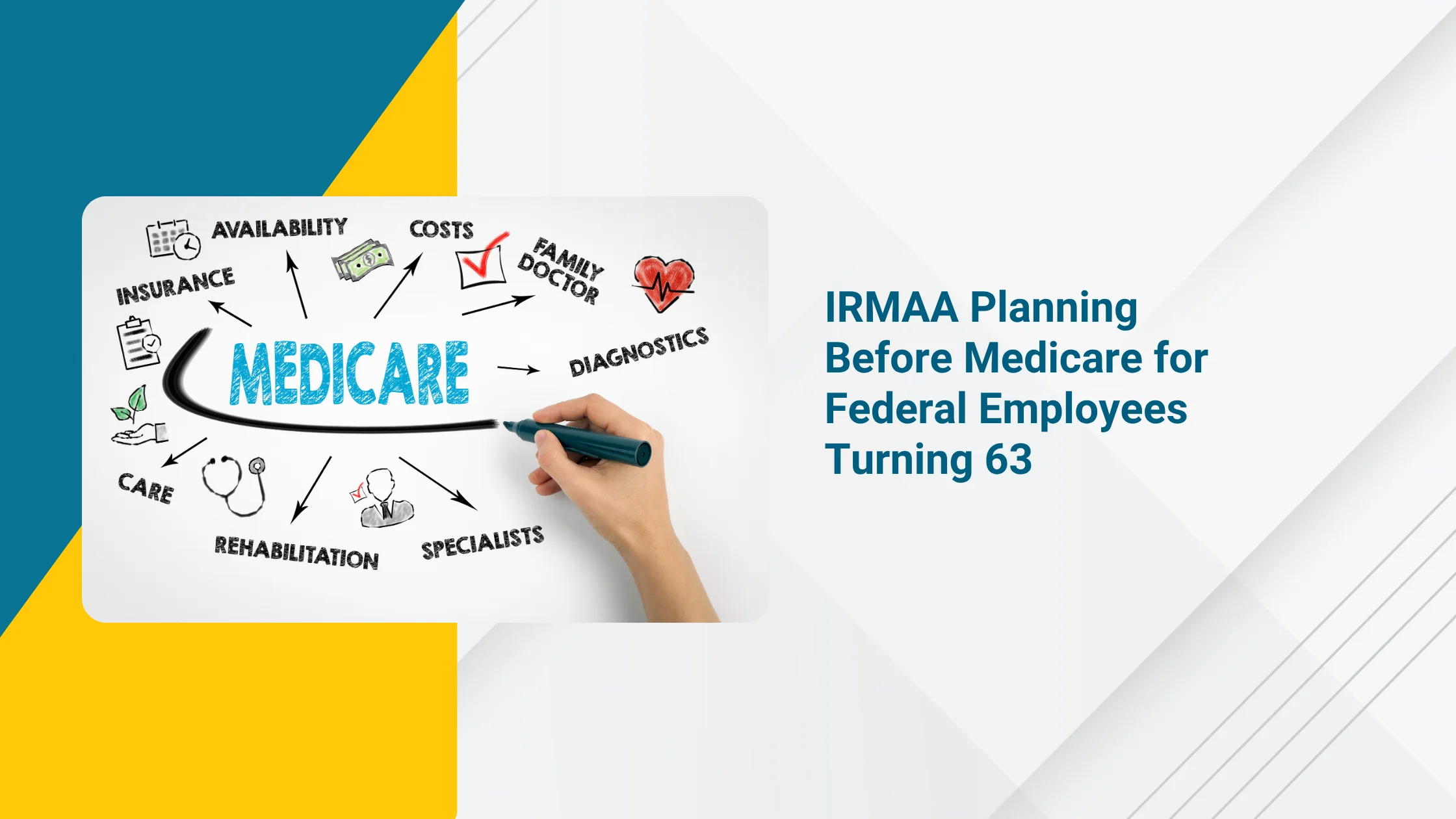
Jul 20, 2026
IRMAA Planning Before Medicare for Federal Employees Turning 63
If you're a federal employee turning 63, IRMAA planning before Medicare should start now. The income you report around age 63 generally helps set your Medicare premiums around age 65.
Read More
Jul 17, 2026
Special Category Federal Retirement: Planning for a 30 to 40 Year Retirement
Special category federal retirement is the set of enhanced retirement rules for certain physically demanding federal jobs: law enforcement officers, firefighters, air traffic controllers, and other covered public safety roles. These rules let covered employees retire far earlier than regular federal employees, often in their early 50s or even their late 40s. A covered employee can retire at age 50 with 20 years of covered service, or at any age with 25 years.
Read MoreTurn what you read into a plan — free call.
Free 30-minute call with an independent, licensed professional in your state. No obligation.
★★★★★ Reviews on Google & TrustpilotSpouses welcome