
.png)


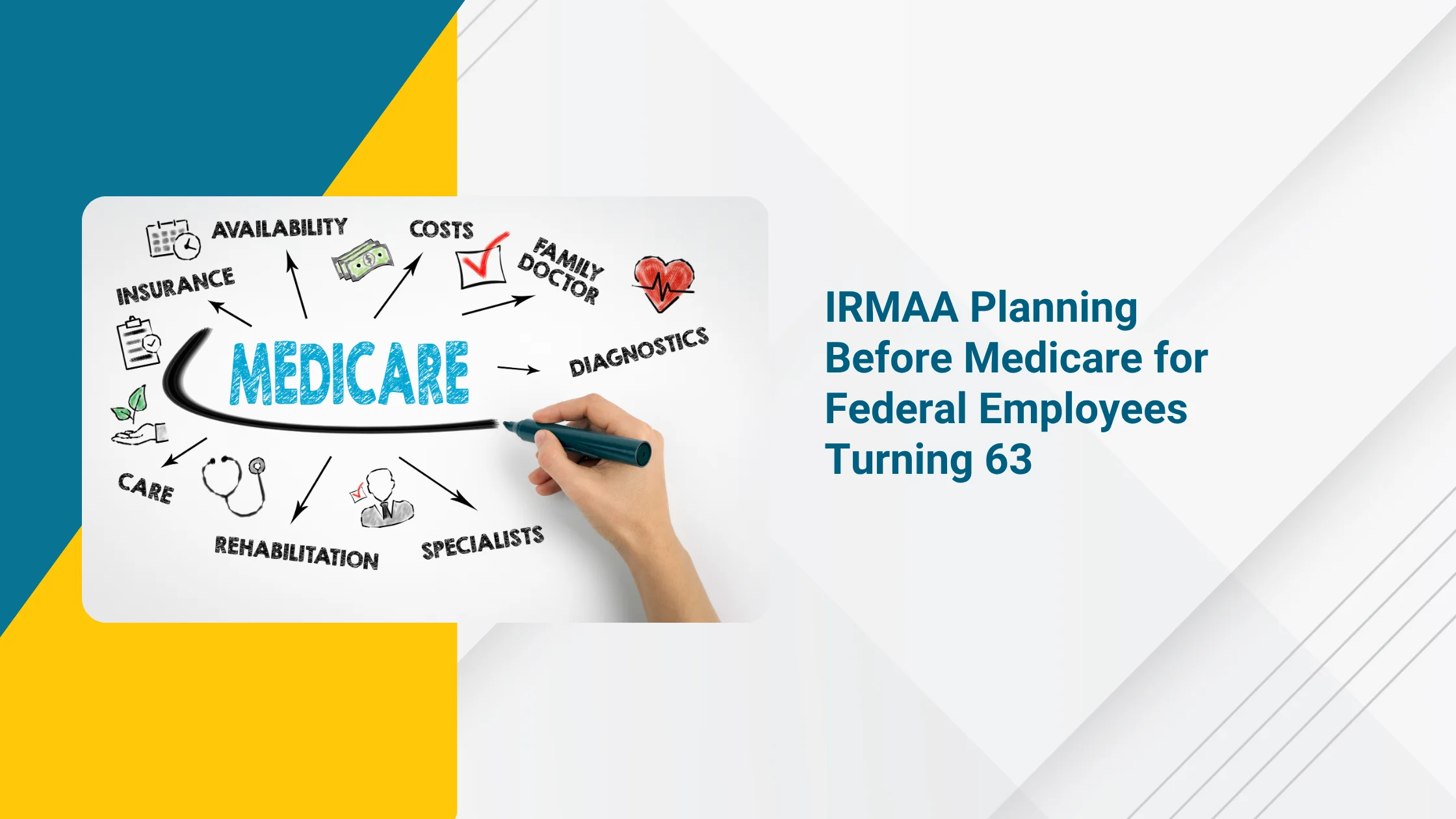
IRMAA Planning Before Medicare for Federal Employees Turning 63
If you're a federal employee turning 63, IRMAA planning before Medicare should start now. The income you report around age 63 generally helps set your Medicare premiums around age 65.
IRMAA stands for Income-Related Monthly Adjustment Amount. It's a surcharge added to Medicare Part B and Part D premiums when your Modified Adjusted Gross Income (MAGI) exceeds a set threshold, and it uses your tax return from two years earlier.
That two-year gap is why 63 is the pivotal planning year. This guide explains how the lookback rule works, which federal income sources push your MAGI higher, and how to manage TSP withdrawals, Roth conversions, and pension income before you enroll.
At Federal Pension Advisors, a retirement planning firm specializing in federal employee benefits, this is a common planning issue federal retirees should review before Medicare enrollment.
Why Age 63 Matters for Medicare IRMAA
Age 63 matters because Medicare generally calculates your IRMAA using income from two years prior. Your income around age 63 helps set your Medicare Part B and Part D premiums around age 65, the age at which most federal employees enroll.
Decisions you make at 63 don't affect your premiums until Medicare enrollment. By then it's too late to undo them. A large Traditional TSP withdrawal, a big Roth conversion, or the sale of an investment property all fall into this trap.
IRMAA also works as a cliff, not a gradual phase-in. According to the Centers for Medicare & Medicaid Services (CMS), exceeding a bracket threshold by even $1 triggers the full surcharge for that entire tier.
Consider two single federal retirees. One has a MAGI of $137,001, the other $170,000. Both pay the same 2026 surcharge because they sit in the same bracket. That structure makes precise income timing at 63 and 64 one of the most important moves in your pre-Medicare plan.
How the Medicare Two-Year Lookback Rule Works
The Medicare two-year lookback rule means the Social Security Administration (SSA) sets your current-year IRMAA using your MAGI from two years earlier. According to the Social Security Administration, SSA pulls your income data directly from IRS records each fall, then mails an IRMAA notice before the new plan year begins.
The math is straightforward once you see the timeline. For the 2026 plan year, SSA looks at your 2024 tax return. So the income you earn around the year you turn 63 helps set your premiums around the year you turn 65, the year most federal employees first enroll in Medicare.
MAGI for this purpose is your Adjusted Gross Income plus any tax-exempt interest. On Form 1040, that's line 11 plus line 2a.
Here's the hard part. Because the trigger income was earned two years in the past, the income that caused the surcharge is already locked in by the time the notice arrives.
Federal Income Sources That Can Raise Future Medicare Premiums
Several income streams common among federal retirees can push MAGI over an IRMAA threshold. Each of the following counts toward the MAGI that SSA uses to set your Medicare Part B and Part D premiums.
- FERS annuity — Your Federal Employees Retirement System pension is generally mostly taxable, though a small portion may represent tax-free recovery of your own employee contributions. The taxable portion counts toward MAGI in the year received.
- Traditional TSP withdrawals — Distributions from the Traditional (pre-tax) portion of your Thrift Savings Plan are taxable income and raise MAGI dollar-for-dollar.
- Social Security benefits — The taxable portion of your Social Security benefit is included in MAGI.
- Roth conversions — Converting Traditional TSP or IRA money to Roth adds the converted amount to your MAGI in the conversion year.
- Capital gains and interest — Selling appreciated investments or real estate, plus tax-exempt interest, all count.
The FERS Special Retirement Supplement (SRS) may be payable to certain eligible FERS retirees before age 62, depending on retirement type, age, and years of service. It's also taxable and counts toward MAGI. Qualified Roth withdrawals are the notable exception, covered below.
For a deeper look at how these sources interact, read our guide on IRMAA for federal retirees and how to lower Medicare surcharges.
TSP Withdrawals and IRMAA: What to Watch
TSP withdrawals and IRMAA are tightly linked for federal retirees. Every dollar taken from the pre-tax Thrift Savings Plan (TSP), the federal government's tax-advantaged retirement savings program, counts as MAGI.
A single large withdrawal can quietly push your income over a bracket line and raise your Medicare premiums two years later. Buying a car, paying off a mortgage, or funding a home renovation in your early 60s can all do it.
The planning fix is sequencing. Spreading withdrawals across several lower-income years, rather than taking one lump sum, helps keep MAGI below the next IRMAA threshold.
Qualified withdrawals from the Roth TSP do not count toward MAGI. That makes Roth balances a powerful tool for covering large expenses in the years right before and after Medicare enrollment without inflating your surcharge. Draw from Roth accounts in any year your projected MAGI is close to a bracket cutoff.
Roth Conversions and IRMAA: Helpful or Risky?
Roth conversions and IRMAA pull in opposite directions. A conversion helps long-term tax control but risks short-term IRMAA if done in large amounts.
A conversion moves money from your Traditional TSP or IRA into a Roth account, and the converted amount is added to your MAGI in the year of the conversion. Convert too much in your early 60s and you can trigger the very surcharge you're trying to avoid later.
The widely recommended strategy is to convert in measured amounts, filling the space below the first IRMAA threshold rather than crossing it. Many retirement planners front-load conversions in the ages 63 to 64 window, up to just below the Tier 1 line, then reduce conversions once on Medicare.
Spreading conversions across three to five years avoids bracket-jumping. The long-term payoff is that future qualified Roth withdrawals never count toward MAGI, potentially lowering your future IRMAA exposure in retirement.
See our IRMAA guide for federal retirees for more on how to size each year's conversion against the brackets.
FERS Retirement Income, Social Security, and Spousal Coordination
For married federal retirees, IRMAA is calculated on combined household MAGI against the joint thresholds. Both spouses' income must be coordinated.
Your FERS retirement income, Social Security benefits, TSP withdrawals, and a spouse's earnings or retirement income all stack together toward the married-filing-jointly bracket. Two moderate incomes can combine to cross a threshold neither would reach alone.
IRMAA is also charged per Medicare-enrolled person. According to the 2026 bracket data, when a couple crosses a threshold and both are enrolled in Medicare, each spouse pays the surcharge. That effectively doubles the cost.
This makes couple-level income timing especially important. Coordinating the years in which each spouse takes TSP withdrawals or starts Social Security can keep combined MAGI under a bracket line and prevent both partners from paying the surcharge at once.
Medicare IRMAA 2026: Part B and Part D Brackets
The table below shows the full Medicare IRMAA 2026 sliding scale. According to the Centers for Medicare & Medicaid Services (CMS), these premiums are based on 2024 MAGI, the standard 2026 Part B premium is $202.90 per month, and the first surcharge tier begins at $109,000 for single filers and $218,000 for joint filers.
Source: Centers for Medicare & Medicaid Services (CMS), 2026 Medicare Parts A & B Premiums and Deductibles. Part D surcharge is added on top of your chosen plan's premium.
For a closer breakdown of each tier, see our 2026 IRMAA brackets guide. You can also review how much Medicare Part B will cost in 2026.
Common Mistakes Federal Employees Make at 62 to 64
Federal employees make several avoidable IRMAA mistakes in the 62-to-64 window. Catching them early is the whole point of IRMAA planning for federal employees before Medicare rather than after.
- Taking a large Traditional TSP lump sum for a one-time expense, spiking MAGI in a single year.
- Converting too much to Roth at once, crossing a threshold instead of filling up to just below it.
- Ignoring the two-year gap and assuming income in the enrollment year is what counts.
- Failing to coordinate spousal income, letting two incomes
combineover a joint bracket line.
- Overlooking capital gains, where selling a property or rebalancing a taxable account adds to MAGI.
- Not projecting MAGI ahead of time, so a bracket crossing is discovered only when the SSA notice arrives.
IRMAA Planning Checklist Before Enrolling in Medicare
Use this checklist to manage MAGI in the years leading up to Medicare enrollment. Each step targets the two-year lookback so your age-65 premiums reflect deliberate choices, not accidents.
- Project your MAGI for the year you turn 63 and 64, since those years set your 65 and 66 premiums.
- Identify the nearest IRMAA threshold for your filing status using the 2026 bracket table above.
- Sequence Traditional TSP withdrawals across multiple years instead of one lump sum.
- Size any Roth conversions to fill the space below, not over, your target bracket line.
- Use qualified Roth TSP or Roth IRA withdrawals for large expenses to avoid raising MAGI.
- Coordinate the timing of each spouse's TSP withdrawals and Social Security start dates.
- Account for one-time events such as property sales that could push MAGI up.
- Keep documentation ready in case a life-changing event later justifies an appeal.
When an SSA-44 IRMAA Appeal May Help After Retirement
An SSA-44 IRMAA appeal can help when a qualifying life-changing event has caused your income to drop below the lookback-year figure. According to the Social Security Administration, you file Form SSA-44 (Medicare Income-Related Monthly Adjustment Amount – Life-Changing Event) to ask SSA to use a more recent year's income instead of the two-year-old return.
Retirement may qualify when it involves a work stoppage or work reduction that lowers your MAGI. That makes this tool especially valuable for federal retirees.
Say you retired recently and your lookback-year tax return still reflects a full year of federal salary. Filing an SSA-44 with your new, lower income estimate can reduce or eliminate the surcharge.
Other qualifying events include marriage, divorce, death of a spouse, and loss of income-producing property. Note the important limit: a voluntary one-time Roth conversion or a stock sale is not a qualifying event, so appeals can't undo IRMAA caused by planned income.
Act promptly after receiving your notice. A formal appeal generally has a 60-day window, while a qualifying life-changing event may support a new initial determination under SSA rules.
Final Thoughts
IRMAA planning before Medicare can be an important step for a federal employee at 63, precisely because the two-year lookback rule turns today's income into tomorrow's premiums.
Project MAGI early, sequence Traditional TSP withdrawals, size Roth conversions carefully, and coordinate spousal income against the 2026 brackets. Together these moves may reduce avoidable Medicare surcharge costs in future years.
The window closes fast. The income that sets your age-65 premium is already being earned.
To build a personalized strategy around your specific FERS, TSP, and Social Security picture, schedule a consultation with a federal retirement specialist at Federal Pension Advisors.
Frequently Asked Questions
1. Why does age 63 matter for Medicare IRMAA?
Age 63 matters because Medicare uses a two-year lookback. Your income around age 63 helps set your Medicare Part B and Part D premiums around age 65, the year most federal employees enroll. Managing MAGI at 63 and 64 can be one of the most effective ways to reduce IRMAA risk later.
2. How does the Medicare two-year lookback rule work?
The Social Security Administration sets your IRMAA using your Modified Adjusted Gross Income from two years earlier. For 2026 premiums, SSA reviews your 2024 tax return. Because the income was earned two years ago, you can no longer change it by the time the surcharge notice arrives.
3. Do TSP withdrawals count toward IRMAA?
Yes. Withdrawals from the Traditional (pre-tax) Thrift Savings Plan count as income and raise your MAGI dollar-for-dollar, which can trigger IRMAA. Qualified Roth TSP withdrawals don't count toward MAGI, making Roth balances a useful tool for large expenses near Medicare enrollment.
4. Can Roth conversions trigger higher Medicare premiums?
Yes. A Roth conversion adds the converted amount to your MAGI in that year and can push you over an IRMAA threshold. Spreading conversions across several years and staying below the next bracket line helps you gain long-term tax benefits without triggering short-term surcharges.
5. How much is the IRMAA surcharge in 2026?
According to the Centers for Medicare & Medicaid Services, the 2026 Part B surcharge ranges from $81.20 to $487.00 per month above the standard $202.90 premium. The Part D surcharge ranges from $14.50 to $91.00 per month, depending on your income tier from your 2024 tax return.
6. Can I appeal an IRMAA surcharge after I retire?
Yes. If a qualifying life-changing event such as a work stoppage lowered your income, file Form SSA-44 with the Social Security Administration to request that SSA use a more recent year. A voluntary Roth conversion or stock sale doesn't qualify. A formal appeal generally has a 60-day window, so act promptly after your notice.
Disclaimer
This article is for educational purposes only and does not constitute individualized financial, tax, legal, or Medicare advice. Federal retirement benefits, Medicare premiums, IRMAA thresholds, tax rules, and Social Security rules may change. Consult a qualified financial, tax, or benefits professional before making decisions about FERS, TSP withdrawals, Roth conversions, Medicare enrollment, or IRMAA appeals.

Get Updated
Subscribe to our weekly updates for the latest on retirement planning, federal benefits, exclusive webinars, and more!

Thomas A. Doherty
Thomas A. Doherty is a Retirement Planning Consultant with more than 35 years of experience helping federal employees, academic professionals, business owners, and retirees navigate retirement planning. His expertise includes federal retirement benefits, pension planning, Social Security strategies, tax-efficient retirement income, and long-term financial planning. Thomas is committed to helping clients understand complex retirement decisions through practical education and personalized guidance.

Download Federal Retirement: Step-by-step Checklist
This comprehensive guide will help you understand your federal benefits, optimize your savings, and plan for a comfortable future.
Recent Post's