Federal civil service retirement in 2027 involves pension benefits under CSRS, the Civil Service Retirement System, or FERS, the Federal Employees Retirement System. It also gives eligible employees access to related programs, including FEHB health coverage and the Thrift Savings Plan (TSP), subject to each program's eligibility rules.
OPM, the U.S. Office of Personnel Management, administers federal retirement annuities. Other agencies oversee related benefits, including Social Security, Medicare, and the TSP.
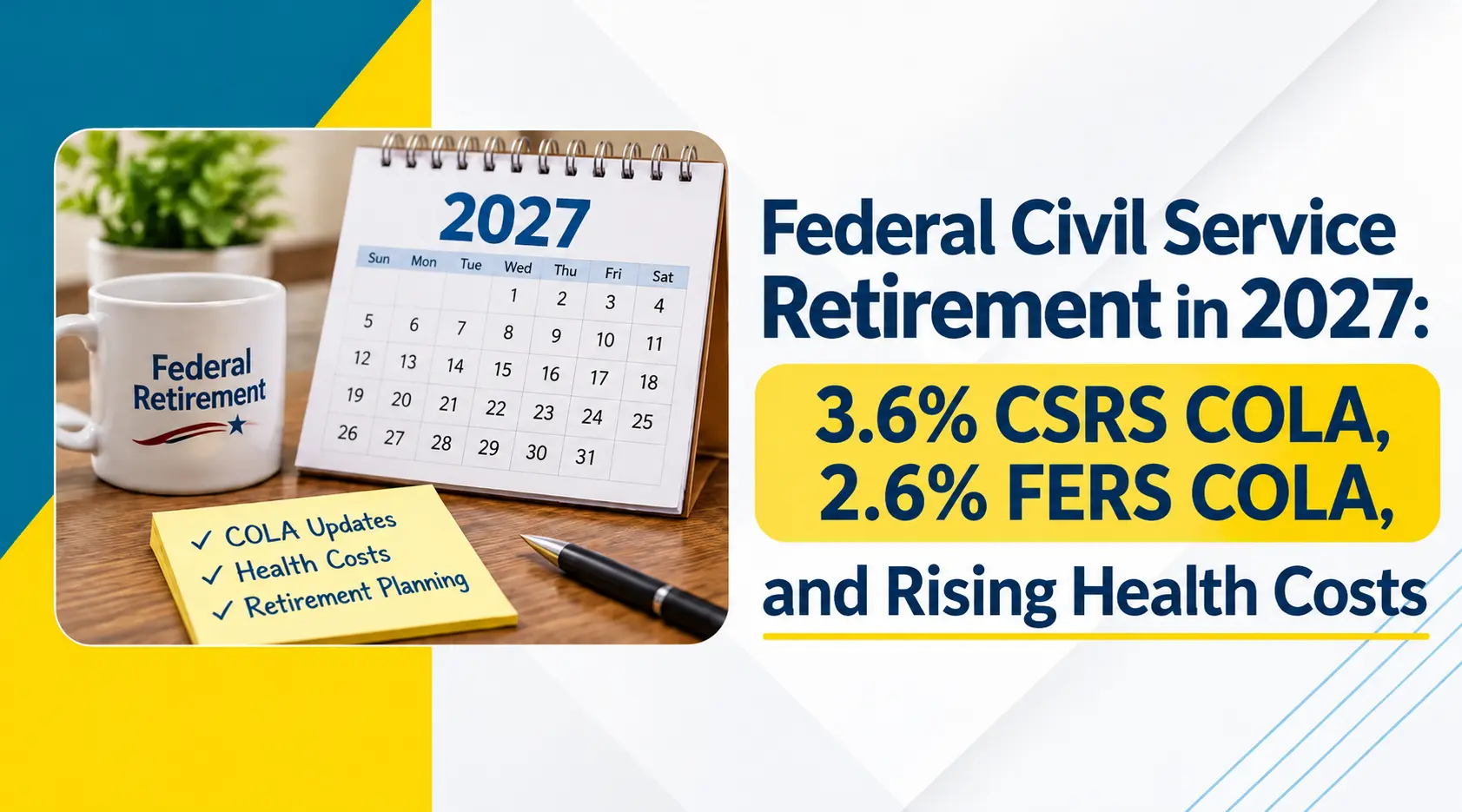
According to Government Executive, the 2027 cost-of-living adjustment (COLA) is 3.6% for CSRS annuities. Eligible FERS annuities receive a smaller 2.6% increase.
Updated November 2026. This guide from Federal Pension Advisors, a retirement planning firm specializing in federal employee benefits, explains the 2027 COLA, how OPM calculates annuities, new TSP limits, rising health costs, and the pay freeze that may affect future High-3 salaries. Federal employees can also use this federal retirement benefits checklist to review important retirement considerations before making their decisions. It is educational information, not personalized advice.
What Is Federal Civil Service Retirement?
Federal civil service retirement involves pension benefits under CSRS or FERS, plus access to related programs such as FEHB health coverage and the Thrift Savings Plan (TSP), subject to each program's eligibility rules. Two pension systems exist.
CSRS is the older system. It generally covers eligible employees who entered federal service before 1984 and kept CSRS coverage, and it's closed to new entrants.
FERS began on January 1, 1987. It covers most employees first hired after December 31, 1986.
Employees hired or rehired between 1984 and 1986 may have CSRS Interim or CSRS Offset coverage. Your service history decides which one applies.
FERS pays a basic annuity, plus Social Security and the TSP, or Thrift Savings Plan, the federal government's tax-advantaged retirement savings program. CSRS employees generally aren't covered by Social Security through federal service. Understanding how a federal pay freeze could affect retirement planning is also important because salary changes can influence High-3 average salary calculations and, potentially, future pension benefits.
CSRS Offset employees are the exception. Social Security covers their Offset service. When they become eligible for Social Security benefits, usually at age 62, their CSRS annuity generally drops by the applicable Social Security offset.
Both CSRS and FERS provide annual cost-of-living adjustments, but eligibility differs. CSRS annuitants generally receive COLAs regardless of age, while most FERS retirees become eligible at age 62.
Certain disability annuitants, survivors, and special-category retirees may qualify earlier under specific rules. Check which category fits you.
2027 COLA Updates for Federal Civil Service Retirement
The 2027 COLA is 3.6% for CSRS retirees, and 2.6% for most eligible FERS retirees age 62 and older. OPM lists both rates as effective December 1, 2026, and your increase appears in the benefit payable on January 4, 2027.
The Congressional Research Service (CRS) explains that inflation drives both COLAs, as measured by the Consumer Price Index for Urban Wage Earners and Clerical Workers (CPI-W).
How the FERS COLA is reduced
FERS applies a three-band rule when inflation is high. According to the Social Security Administration (SSA), the FERS COLA equals the CSRS COLA when the CPI-W increase is 2.0% or less. It stays fixed at 2.0% when the increase is more than 2.0% and up to 3.0%. Because COLA adjustments can affect retirement income planning, federal retirees should also consider how pension increases interact with withdrawals from their Thrift Savings Plan (TSP). TSP Withdrawal Strategy for 2027: How Federal Retirees Can Think About Their First Year
The FERS COLA runs one percentage point lower than the CPI-W increase when that increase exceeds 3.0%. The 2027 CSRS COLA is 3.6%, so the FERS COLA is 2.6%.
This formula is current law. A proposal to change it isn't law until Congress passes it and the president signs it.
2027 COLA by retiree group
The dollar effects are illustrations calculated at the stated rates. Government Executive uses the same examples and reports that SSA estimates the average retired-worker benefit will rise by about $75 per month.
Individual results will differ.
Who receives a FERS COLA before age 62
OPM states that most retirees become eligible for a COLA at age 62. Exceptions include survivor annuitants and eligible disability retirees. They also cover employees who retired under special provisions for law enforcement officers, firefighters, Capitol Police, and air traffic controllers, plus certain military reserve technicians who meet specific disability-related requirements. Understanding what happens after OPM receives your federal retirement application can also help retirees prepare for the transition to retirement and the processing of their benefits.
This list isn't exhaustive. OPM recognizes a few other narrow categories, so check your own retirement category.
Not every disability annuitant qualifies. Disability annuitants receiving the 60% High-3 rate generally don't receive a COLA during their first 12 months of entitlement. Subsequent COLAs may apply under OPM rules.
The FERS COLA doesn't apply to a retiree's own FERS supplement. It applies to the basic annuity, and first-year retirees receive a prorated COLA based on their annuity commencing date.
How Federal Pension Benefits Are Calculated in 2027
A FERS annuity generally equals 1% of your High-3 average salary, multiplied by your years of service. Your High-3 is the highest average basic pay you earned over any three consecutive years of federal service. Alongside your pension, the Thrift Savings Plan (TSP) can play an important role in retirement income planning. Federal employees should also understand their investment options, including the TSP Mutual Fund Window, and how these choices fit into their overall retirement strategy.
It generally includes locality pay and qualifying special salary rates, but excludes overtime and bonuses.
If you retire at age 62 or older with at least 20 years of service, you receive 1.1% per year instead of 1%.
The standard basic CSRS computation credits 1.5% for the first five years, 1.75% for the next five, and 2% for each year beyond 10. Service credit, unused sick leave, survivor elections, and statutory limits can also change a final CSRS annuity.
A hypothetical FERS example shows the difference:
- Retire at age 62 with 30 years and a $90,000 High-3: 1.1% × 30 = 33%, or 29,700peryear(2,475 per month.
- Retire at age 57 with 30 years and a $90,000 High-3: 1% × 30 = 30%, or 27,000peryear(2,250 per month.
These figures exclude deductions, survivor benefit elections, and taxes.
The FERS Minimum Retirement Age (MRA)
MRA, or Minimum Retirement Age, is the earliest age a FERS employee can retire with an immediate annuity. It ranges from 55 to 57, and some birth-year groups have an MRA stated in two-month increments. Employees born in 1970 or later generally have an MRA of 57. Once employees understand their retirement eligibility, they should also consider the application timeline and processing delays. Recent updates on the federal retirement backlog in 2026 explain how the declining backlog may affect retirement application processing.
Reaching MRA doesn't guarantee an unreduced annuity. You may qualify for an immediate, unreduced retirement at MRA with 30 years of creditable service, or at age 60 with 20 years.
Employees with at least 10 years of service may qualify under MRA+10 provisions. An age reduction generally applies if they begin receiving the annuity before age 62.
The age reduction generally doesn't apply if you have 30 years of service when you reach MRA, or 20 years of service and begin your annuity at age 60 or later. Postponing the annuity may also reduce or eliminate the reduction.
The FERS supplement and the 2027 earnings test
Eligible FERS employees who retire with an immediate, unreduced annuity may qualify for the FERS Special Retirement Supplement. It approximates the Social Security benefit you earned through federal service and generally ends at age 62.
Eligibility depends on your retirement category. Deferred, disability, and MRA+10 retirements generally don't qualify.
An earnings test applies to the supplement. Government Executive reports that the 2027 Social Security earnings limit is $25,560, up from $24,480 in 2026. It also reports that the supplement drops by $1 for every $2 earned above the limit.
The reduction applies only to your supplement, based on countable earnings under its own rules. It doesn't reduce your FERS pension or your Social Security benefit. Understanding the FERS Special Retirement Supplement eligibility rules can also help you determine whether you qualify for this benefit and how it works.
Two points add context:
- The $25,560 figure applies to individuals below full retirement age throughout the year.
- The test generally counts wages and net self-employment income, not pension payments, TSP withdrawals, or investment income.
Certain employees who retire before their MRA under special provisions are exempt from the test until they reach MRA. Those provisions cover law enforcement officers, firefighters, air traffic controllers, and military reserve technicians. After MRA, the standard reduction rules generally apply.
OPM typically sends the annual earnings survey in the spring. Supplement recipients will receive the 2026 survey in spring 2027.
TSP Contribution Limits in 2027
The TSP employee contribution limit is $25,500 in 2027, up $1,000 from 2026. The IRS, the Internal Revenue Service, sets these limits annually, and the Federal Retirement Thrift Investment Board oversees the TSP.
The IRS raised the standard catch-up limit for participants age 50 and older, including TSP participants, to $8,500 from $8,000. It also set a higher $11,750 limit for ages 60 through 63.
WorldatWork reports the same figures, including totals of $34,000 and $37,250 for the two catch-up groups.
Roth catch-up threshold. According to IRS Notice 2026-66, the wage threshold under SECURE 2.0 that decides whether catch-up contributions must be Roth contributions rises from $150,000 to $155,000. For 2027, the requirement generally applies to participants whose 2026 FICA wages from their sponsoring employer exceeded $155,000.
Affected participants must make their catch-up contributions as Roth contributions. Confirm the applicable TSP procedures and eligibility requirements at TSP.gov.
FEHB, Medicare, and Health Costs in 2027
FEHB premiums in 2027 rise faster than the FERS COLA. FEHB, the Federal Employees Health Benefits Program, is a major source of health coverage for eligible federal employees and retirees.
According to OPM's Open Season highlights, the overall average FEHB premium rises 9.3%, the enrollee share rises 10.9%, and the government contribution rises 8.6%. Federal News Network reports this is the third consecutive year of double-digit increases in the enrollee share.
The 10.9% figure is a program-wide average, not each plan's increase. A FedTools analysis of OPM's rate files found the median FEHB option rising 6.0%.
Compare your own plan's 2027 rates. Open Season for the 2027 plan year runs November 9 through December 14, 2026.
OPM also reports average 2027 increases of 1.0% for FEDVIP dental plans and 1.6% for vision plans.
Medicare Part B in 2027
The Centers for Medicare & Medicaid Services (CMS) administers Medicare. CMS announced that the standard Medicare Part B premium will be $209.40 per month in 2027, up $6.50 from $202.90 in 2026 (CMS fact sheet).
The annual Part B deductible rises by $9 to $292. If you pay the standard premium, the extra $6.50 absorbs a small part of your Social Security COLA.
Higher earners may pay more through the income-related monthly adjustment amount (IRMAA).
Federal Pay Freeze: What It Means for Future Retirees
The 2027 federal pay freeze holds base and locality pay rates for covered General Schedule employees at their 2026 levels. Government Executive reports that the president announced an alternative pay plan for January 2027.
That plan includes a separate 3.8% increase through special salary rates, but it applies only to designated law enforcement positions. Final coverage details remain to be announced.
Because FERS and CSRS pensions rest on the High-3 average salary, a freeze can slow High-3 growth for some employees. Eligible promotions, within-grade increases, and other individual salary changes may still affect your High-3 and eventual annuity. When evaluating the broader impact on retirement income, employees should also understand how annual Social Security adjustments affect their benefits, including the 2027 Social Security COLA and benefit increase.
A freeze doesn't reduce a current annuity. Lawmakers have called for Congress to override the freeze, and the outcome remains open as of November 2026.
Social Security and Federal Retirement in 2027
Social Security beneficiaries generally receive a 3.6% COLA in January 2027. If you qualify for Social Security, you receive the same adjustment whether your federal pension falls under CSRS or FERS.
The FERS annuity COLA is 2.6%, so FERS retirees often see a blended increase across their income sources.
2027 Planning Checklist for Federal Retirees
Federal retirees may want to review these year-end items. They are informational, not advice:
- Check the annuity in the OPM online account. Confirm the January 2027 COLA appears correctly.
- Review FEHB plan rates before December 14. Compare each plan's actual 2027 premium rather than the 10.9% average.
- Account for Part B if you're enrolled. Include the $209.40 standard monthly premium in your retirement budget. Your premium may be higher if IRMAA applies, and Social Security may not deduct it in every case.
- Review TSP contributions. The 2027 limits take effect January 1.
- Plan for the spring earnings survey. FERS supplement recipients should keep earnings records.
- Confirm the service credit deposit rate. Check OPM's latest guidance for the 2027 variable interest rate. The 2026 rate was 4.25%.
Conclusion
Federal civil service retirement in 2027 brings a 3.6% COLA for CSRS retirees and a 2.6% COLA for eligible FERS retirees. TSP limits rise, and FEHB enrollee premiums climb for a third straight year of double-digit growth. Federal employees approaching retirement can schedule a free federal retirement consultation to discuss how these changes may affect their retirement plans.
The pay freeze adds uncertainty for employees nearing retirement. Check each benefit against official OPM, IRS, SSA, and CMS figures before you plan.
Federal Pension Advisors, a retirement planning firm specializing in federal employee benefits, provides information about its services and advisory team on its Advisors page. The firm is not affiliated with or endorsed by OPM or any federal government agency. This article is for educational purposes only and is not legal, tax, or financial advice.
Federal employees can use the TSP Calculator to estimate potential Thrift Savings Plan growth and explore how contributions may affect their retirement savings.
Frequently Asked Questions
What is the COLA for federal retirees in 2027?
Federal retirees under CSRS receive a 3.6% COLA in January 2027. Most eligible FERS retirees age 62 and older receive 2.6%, because FERS subtracts one percentage point when inflation exceeds 3%.
FERS retirees under 62 generally receive no COLA, with exceptions for survivors, eligible disability retirees, and certain law enforcement, firefighter, and Capitol Police retirees.
When do FERS retirees start receiving COLAs?
FERS retirees generally start receiving COLAs at age 62. Exceptions include survivor annuitants, eligible disability retirees, and retirees under special provisions for law enforcement officers, firefighters, Capitol Police, and air traffic controllers.
CSRS retirees receive COLAs at any age. A first-year retiree receives a prorated COLA based on months on the annuity roll.
How much can I contribute to my TSP in 2027?
The 2027 TSP employee contribution limit is $25,500, up $1,000 from 2026. Participants age 50 and older can add an $8,500 catch-up contribution, for a total of $34,000.
Participants ages 60 through 63 can add an $11,750 catch-up instead, for a total of $37,250. The IRS sets these limits.
Can I collect FERS and Social Security at the same time?
Yes. Retirees who qualify for both can collect a FERS annuity and Social Security benefits at the same time. Social Security retirement benefits start at age 62.
Some FERS retirees who retire before 62 may also qualify for the FERS Special Retirement Supplement. It generally ends at age 62 and is subject to an earnings test.
How much are FEHB premiums going up in 2027?
According to OPM, the average enrollee share of FEHB premiums rises 10.9% in 2027, following a 12.3% increase in 2026. The overall average premium rises 9.3%.
Individual plans vary widely, so compare your plan's rates during Open Season, which runs November 9 through December 14, 2026.
How much is Medicare Part B in 2027?
According to CMS, the standard Medicare Part B premium is $209.40 per month in 2027, up $6.50 from $202.90 in 2026. The annual Part B deductible rises to $292.
Higher-income enrollees pay more through the income-related monthly adjustment amount (IRMAA). Most enrollees see the premium deducted from their Social Security payments.
Disclaimer:
This article is for educational and informational purposes only and should not be considered financial, tax, or legal advice. Federal Pension Advisors is not affiliated with or endorsed by the U.S. Office of Personnel Management (OPM) or any federal government agency. Retirement benefits, COLA adjustments, TSP contribution limits, and health insurance costs are subject to applicable laws, regulations, and official updates. Readers should verify current information with OPM, the IRS, SSA, CMS, and other relevant government agencies before making retirement decisions. Individual circumstances may vary.

Thomas A. Doherty
Thomas A. Doherty is a retirement planning consultant with 35 years of experience helping individuals, federal employees, academic employees, and business owners better understand their retirement options. His work focuses on helping clients make the most of their available benefits, insurance policies, and investment plans so they can build more stable retirement income and reduce unnecessary financial risk.