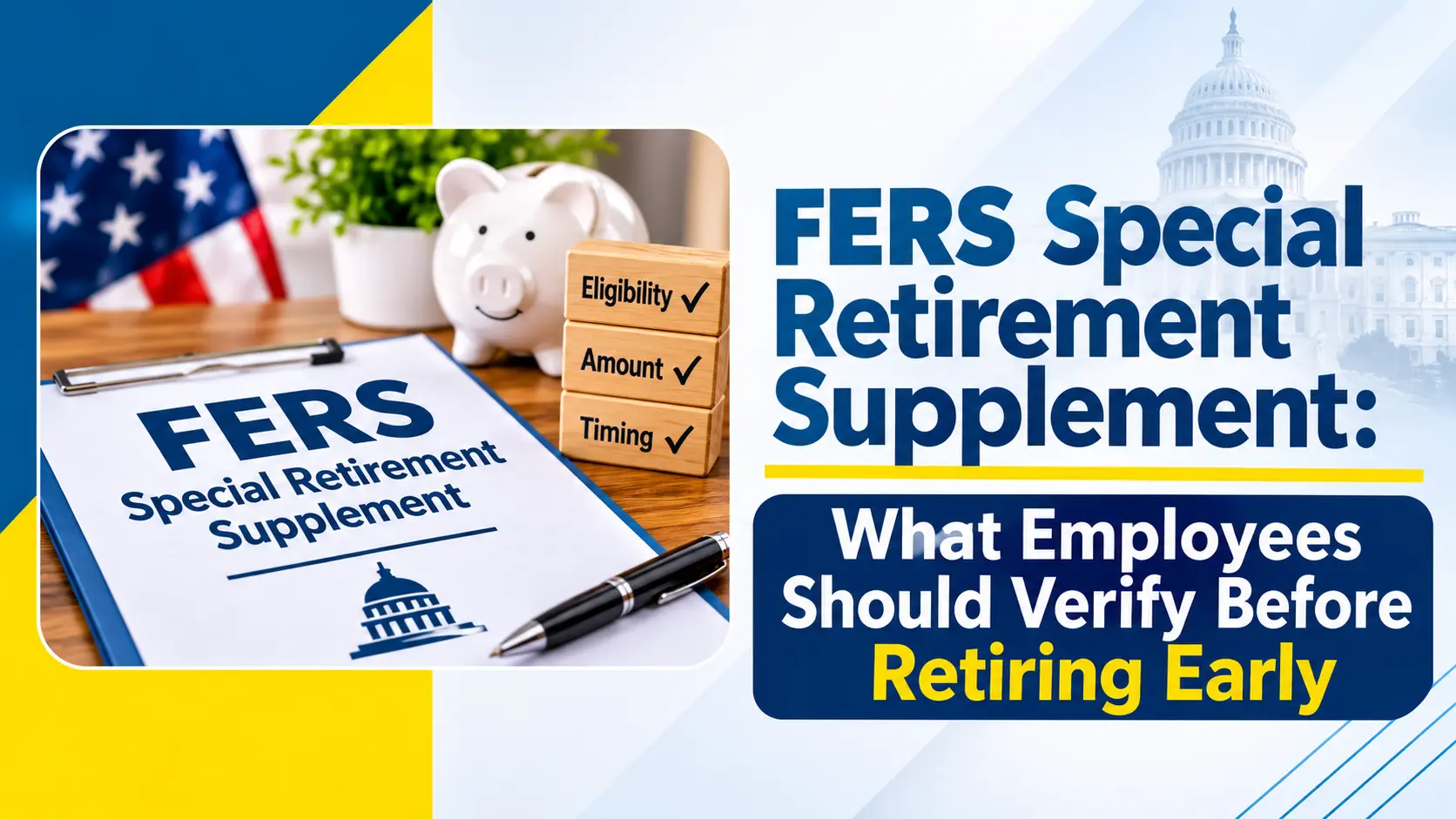
The FERS Special Retirement Supplement is a temporary monthly payment from OPM, the U.S. Office of Personnel Management. It bridges the income gap between a federal employee's early retirement date and their Social Security eligibility at age 62.
OPM adds the payment to the regular FERS annuity for employees who retire under qualifying provisions of FERS, the Federal Employees Retirement System. The amount approximates the Social Security benefit a retiree earned during their civilian federal service. Alongside understanding retirement income, federal employees should also review their health insurance options before retiring. This 2027 FEHB Open Season checklist can help retirees understand important health coverage decisions and deadlines.
Many federal employees assume they qualify for this benefit, then discover at the retirement counseling session that they do not. Others underestimate how the earnings test can reduce the payment if they take a second career.
According to the Congressional Research Service, Section 90001 of the House-passed version of H.R. 1 in May 2025 proposed eliminating the supplement for certain future retirees beginning January 2028. The final enacted legislation did not include the provision, and the supplement remains available under existing eligibility rules in 5 U.S.C. § 8421.
This guide walks through the eligibility rules, the calculation formula, the 2026 earnings limit, and the specific items every federal employee should verify before signing SF-3107.
What Is the FERS Special Retirement Supplement?
The FERS Special Retirement Supplement, also called the Retiree Annuity Supplement or the FERS Annuity Supplement, is a temporary monthly payment. OPM adds it to the basic FERS annuity for employees who retire before age 62 under qualifying provisions. Federal employees planning their retirement can use a Federal Employee Paycheck Calculator to estimate their income and better understand how retirement may affect their finances.
The payment approximates the portion of a Social Security benefit earned through creditable civilian federal service. It ends on a schedule tied to Social Security eligibility, which generally occurs around age 62.
The supplement is not Social Security. OPM pays it out of the Civil Service Retirement and Disability Fund, not the Social Security Administration, and calculates it independently. It is also not a permanent increase to the FERS pension.
According to OPM's CSRS and FERS Handbook, Chapter 51, the supplement is a standalone benefit with its own eligibility, calculation, and termination rules.
Who Qualifies for the FERS Special Retirement Supplement?
To qualify for the FERS Special Retirement Supplement, a federal employee must retire on an immediate, unreduced annuity under a qualifying FERS provision. They must also complete at least one full calendar year of civilian service subject to FERS computation rules.
Deferred retirements, MRA+10 retirements, and disability retirements do not qualify.
According to OPM guidance published in the CSRS and FERS Handbook, Chapter 51, and codified at 5 CFR § 842.503, the following retirement categories qualify for the supplement:
- MRA + 30: Reaching your MRA, or Minimum Retirement Age, with at least 30 years of creditable service. MRA is the age at which a FERS employee may qualify for regular voluntary retirement under applicable age-and-service rules. Certain special-category and early-retirement provisions allow qualifying employees to retire before MRA.
- Age 60 + 20: Reaching age 60 with at least 20 years of creditable service
- Special-category retirements: Examples include law enforcement officers (LEOs), firefighters, air traffic controllers (ATCs), Capitol Police, Supreme Court Police, nuclear materials couriers, military reserve technicians, certain members of the Senior Executive Service, and Members of Congress who retire under their respective age-and-service rules. An SES member entitled to an annuity for failure to be recertified as a senior executive can receive the supplement without waiting until MRA.
- VERA (Voluntary Early Retirement Authority): Early-out retirements offered during agency restructuring, with the supplement beginning at MRA, not at the retirement date
- RIF (Reduction in Force) or other involuntary retirement: The supplement also begins at MRA, not at separation
Three exclusions deserve closer attention. Deferred retirees are employees who separate from federal service before eligibility and claim the annuity later. They do not qualify.
Employees retiring under the MRA+10 provision do not qualify for the FERS annuity supplement, even if they postpone the start of their annuity. Disability retirees do not receive the supplement because FERS computation rules do not treat disability retirement as a regular retirement. Along with understanding these retirement benefit rules, employees should also review their health insurance options before leaving federal service, including the FEHB Self Plus One vs. Self and Family comparison to evaluate which coverage option may better fit their household.
Military service deserves a separate note. Military service generally does not count toward the FERS annuity supplement simply because an employee has made a military service deposit.
However, under 5 CFR § 842.504(a)(1), certain military service performed during an absence of leave without pay from civilian service may count toward the supplement if the employee satisfies the applicable USERRA military deposit requirements. Employees who performed military service while on leave from a civilian federal position should confirm their service history with their agency before relying on an estimate.
How the FERS Special Retirement Supplement Is Calculated
OPM calculates the FERS Special Retirement Supplement using a four-step formula. First, take the total service creditable under FERS, excluding military service not performed during an absence of leave without pay from civilian service. Then round to the nearest whole year, with 40 as the maximum. Divide by 40 and multiply by the estimated Social Security benefit the employee would receive at age 62 based on federal earnings. After understanding how the supplement is calculated, federal employees should also know what happens after OPM receives their retirement application, including the steps involved in processing retirement benefits.
The formula assumes a standard 40-year working career.
The core formula is:
(Years of service creditable under FERS, rounded to the nearest whole year and capped at 40 ÷ 40) × Estimated age-62 Social Security benefit = Monthly Supplement
Under 5 CFR § 842.504(a)(1), OPM rounds total service creditable under FERS to the nearest whole year, with a maximum of 40 years. 29 years and 4 months rounds to 29 years, while 29 years and 7 months rounds to 30 years. A month of service near a rounding threshold can change the calculation.
Several details matter for an accurate estimate:
- OPM uses only the Social Security benefit attributable to federal civilian earnings, not the total Social Security benefit the employee may have accrued from private-sector work before joining government
- CSRS Offset service and other service creditable under FERS computation rules may be included, subject to OPM's applicable service-credit rules
- Military time generally does not count in the supplement formula, with the USERRA exception noted above
OPM's formula estimates a future Social Security benefit using only federal earnings. The Social Security Administration's benefits statement reflects the employee's full earnings record. The two calculations use different inputs and may produce different estimates.
Federal Pension Advisors, a retirement planning firm specializing in federal employee benefits, recommends obtaining both estimates and reconciling them before finalizing a retirement date. Review any material discrepancy and make sure both estimates use comparable assumptions.
The Earnings Test: How Post-Retirement Work Affects Your Supplement
An annual earnings test applies to the FERS Special Retirement Supplement. It mirrors the Social Security earnings test for workers under full retirement age.
When a retiree's post-retirement wages or self-employment income exceed the annual exempt amount, OPM reduces the supplement by $1 for every $2 earned above the limit.
According to the Social Security Administration, the 2026 annual earnings limit is $24,480 for individuals under full retirement age. OPM applies this same figure to the FERS supplement earnings test. Federal employees approaching retirement should also consider how potential pay changes could affect their retirement income planning. Read more about the 2027 federal pay freeze and retirement planning.
Only income earned after retirement counts, and only certain categories of income qualify as earnings. The table below shows what counts and what doesn't:
Two timing details are critical. First, the earnings test does not apply before MRA, including for special-category retirees (LEOs, firefighters, ATCs) who retire before MRA.
An employee who retires as a law enforcement officer at age 50 can earn any amount from a second career with no supplement reduction until reaching MRA. Once the retiree reaches MRA, the earnings test begins.
Second, the earnings reduction operates on a long delay built into the statute. Under 5 U.S.C. § 8421a, the earnings reduction is effective "with respect to the annuity supplement payable for each month in the 12 months beginning on the first day of the seventh month after the end of the calendar year in which the excess earnings were earned." In practice, that means July through June of the following year.
OPM mails Form RI 92-22, the FERS Annuity Supplement Earnings Report, each spring (generally April or May) to collect the prior year's earnings. Any resulting reduction then takes effect beginning with the July payment. If you receive an unexpected FERS-related debt notice, understanding how to challenge a FERS contribution debt can help you understand your options and the steps involved in disputing the amount.
If your countable earnings during the applicable supplement-entitlement period remain at or below the annual exempt amount, the earnings test generally will not reduce your supplement. Special rules apply to earnings before MRA for certain retirees. The statutory rule in 5 U.S.C. § 8421a considers earnings attributable to periods when the individual was entitled to the supplement.
When the FERS Special Retirement Supplement Ends
The FERS Special Retirement Supplement ends on the earlier of two dates. The first is the last day of the month in which the retiree becomes age 62. The second is the last day of the month before the first month the retiree would qualify for Social Security.
The exact termination date depends on the retiree's birthday and Social Security eligibility. OPM generally administers the termination using the retiree's age and Social Security eligibility information under 5 CFR § 842.503(c). The retiree does not need to apply for Social Security to trigger the supplement's scheduled termination. Federal employees who have concerns about workplace disputes or employment-related rights may also benefit from understanding the federal employee union grievance and arbitration process.
Under 5 CFR § 842.502, a retiree reaches age 62 on the day before their 62nd birthday. For example, someone whose 62nd birthday is September 1 is treated as reaching age 62 on August 31. A retiree whose birthday falls near the start of a month may see a different termination date than a retiree whose birthday is later in the month.
The supplement has no cost-of-living adjustment (COLA), so the amount OPM calculates at retirement remains fixed in nominal dollars until the payment ends. An employee who retires at 55 and receives a $1,500 monthly supplement will still receive $1,500 per month at age 61, even after six years of inflation.
The basic FERS annuity does receive COLAs, but eligibility depends on retirement category. COLAs generally begin at age 62 for most retirees, with earlier eligibility for special-category retirees such as LEOs, firefighters, and ATCs.
Three events can also reduce or end the supplement before the scheduled termination date. Death of the retiree ends the payment with no survivor benefit on the supplement portion.
A large post-retirement earnings year can reduce the supplement to zero under the earnings test. Federal reemployment affects the supplement under its own rules, which differ from the rules that govern the basic annuity. Federal employees retiring in 2026 should understand how post-retirement employment and earnings can affect their retirement benefits before making a decision.
Federal reemployment deserves specific attention because OPM issued updated guidance in late 2025. According to OPM Benefits Administration Letter 25-103, dated November 28, 2025, returning to federal employment does not automatically terminate the FERS annuity supplement.
However, gross federal wages count toward the annual earnings test and can reduce or eliminate the supplement. Separate rules under 5 CFR Part 837 may also affect the basic annuity during reemployment through salary offset or other mechanisms.
Retirees considering a return to federal service should review BAL 25-103 and consult their agency's benefits specialist before accepting the position.
Key Items to Verify Before Submitting Your Retirement Paperwork
Employees planning to claim the FERS Special Retirement Supplement should verify a specific set of facts before submitting SF-3107, the Application for Immediate Retirement. They can use the FERS Supplement Calculator to estimate their potential supplement benefit as part of their retirement preparation. Work with your HR office and, where appropriate, with an independent retirement planning firm.
These verifications protect against the most common supplement surprises. The first is discovering at the OPM finalization stage that your eligibility isn't what you thought. The second is receiving a supplement payment materially lower than you planned for.
The checklist below reflects the items most frequently missed in federal retirement planning:
- Confirm your qualifying retirement provision. MRA+30, age 60 with 20, qualifying special-category retirements, and VERA/RIF are the eligible paths to the supplement. If you're planning an MRA+10 retirement (immediate or postponed), you won't receive a supplement. Verify your SF-3107 cites the correct provision.
- Distinguish your SCD-Leave from FERS-creditable service. Ask your agency's retirement specialist to distinguish your Service Computation Date for Leave (SCD-Leave) from the service creditable under FERS for supplement purposes. Don't assume the two calculations are identical. Your SCD-Leave may include military service that doesn't count toward the supplement.
- Obtain two estimates and reconcile them. Request the OPM-calculated supplement estimate from your HR benefits specialist and compare it to the Social Security Administration's benefit estimate for your federal earnings. The two figures use different inputs and may produce different estimates. Investigate any material unexplained discrepancies before you retire.
- Model the earnings test against your post-retirement plans. If you plan to work after retiring, calculate what your supplement will be at your intended earnings level. Remember that the reduction applies only after MRA, takes effect with a long statutory lag, and runs July through June.
- Verify the one-full-calendar-year rule. OPM requires at least one full calendar year of service subject to FERS computation rules, as defined in the CSRS and FERS Handbook, Chapter 51. An employee who serves from January 1 through December 30 or 31 is considered to have completed a calendar year for this purpose. Transferees from CSRS, the Civil Service Retirement System, often meet this rule, but verify rather than assume.
- Confirm the current status of the law. In 2025, Congress debated proposals to modify or eliminate the supplement but didn't enact them. Future proposals remain possible. Federal Pension Advisors, a retirement planning firm specializing in federal employee benefits, recommends confirming the status of 5 U.S.C. § 8421 before locking in a retirement date in later years.
Comparison: FERS Special Retirement Supplement vs. Social Security Benefits
Many people confuse the supplement with Social Security itself. The two payments share a formula input, but they differ on nearly every other dimension. The table below shows the key distinctions:
Think of the supplement as a time-limited bridge, not a long-term income stream. A federal employee who relies on it as if it were Social Security is planning on the wrong assumptions. They might expect inflation protection or lifetime payments, but the supplement provides neither.
Verifying Your Numbers Before You Retire
The FERS Special Retirement Supplement is an important component of a federal early retirement package. The eligibility rules are narrow, and the formula uses only service creditable under FERS. Schedule a free federal retirement consultation to discuss how the supplement may fit into your retirement income plan.
The earnings test can meaningfully reduce the payment after MRA. The benefit ends on a fixed schedule without inflation protection.
Three steps protect retirees before they submit SF-3107. Reconcile OPM's supplement estimate against the Social Security Administration's benefit statement, and confirm that your retirement provision qualifies. Then model the earnings test against any planned post-retirement work.
Federal Pension Advisors works with federal employees to run these verifications as part of a full pre-retirement review. Using federal retirement planning checklists can help employees organize important retirement details and avoid overlooking key steps. Confirming the details now, not after reading the first OPM payment letter, is the most reliable way to verify the supplement amount in your retirement income plan.
Frequently Asked Questions
Who qualifies for the FERS Special Retirement Supplement?
Federal employees who retire on an immediate, unreduced FERS annuity under MRA+30, age 60 with 20 years, or a qualifying special-category provision qualify for the supplement. Special categories include LEOs, firefighters, and air traffic controllers.
VERA and involuntary (RIF) retirees also qualify, but their supplement begins at MRA, not at separation. MRA+10, deferred, and disability retirees do not qualify at any time.
How much is the FERS Special Retirement Supplement?
The supplement uses a simple formula. Take your service creditable under FERS and round to the nearest whole year, capped at 40. Divide that number by 40, then multiply by the estimated age-62 Social Security benefit attributable to federal earnings.
The amount varies significantly with service length and earnings history. OPM provides a personalized estimate as part of the retirement application review process.
When does the FERS Supplement end?
The FERS Special Retirement Supplement ends on the earlier of two dates. The first is the last day of the month in which the retiree reaches age 62. The second is the last day of the month before they'd qualify for Social Security.
The earnings test can reduce or eliminate it earlier, and federal reemployment can affect it. Death of the retiree ends the payment with no survivor benefit on the supplement portion.
Can I collect FERS Supplement and Social Security at the same time?
No. The FERS Special Retirement Supplement does not continue alongside Social Security retirement benefits at age 62.
OPM stops the supplement on the schedule defined in 5 CFR § 842.503(c), which is tied to age 62 and Social Security eligibility. Retirees can delay Social Security beyond age 62 to receive an increased benefit, but delaying doesn't extend the supplement.
Does the FERS Supplement get a cost-of-living adjustment?
No. The FERS Special Retirement Supplement receives no cost-of-living adjustment. The amount OPM calculates at retirement remains fixed until the payment ends.
The basic FERS annuity does receive COLAs, but eligibility depends on retirement category and applicable rules. COLAs generally begin at age 62 for most retirees, with earlier eligibility for special-category retirees.
Is the FERS Supplement subject to the earnings test before MRA?
No. The earnings test does not apply to supplement payments received before the retiree reaches MRA, including for special-category retirees who retire before MRA.
LEOs, firefighters, and ATCs who retire as early as age 50 can work in a second career without any supplement reduction until they reach their MRA. For those born in 1970 or later, MRA is typically 57.
Disclaimer:
This article is for educational and informational purposes only and does not constitute financial, tax, legal, or retirement advice. Federal retirement benefits, eligibility requirements, calculations, and regulations may change. Individual circumstances can affect eligibility for the FERS Special Retirement Supplement and the amount payable. Please verify your information with the Office of Personnel Management (OPM), your agency's retirement benefits office, and other appropriate official sources before making retirement decisions. Federal Pension Advisors is not affiliated with or endorsed by OPM or any U.S. government agency.

Thomas A. Doherty
Thomas A. Doherty is a retirement planning consultant with 35 years of experience helping individuals, federal employees, academic employees, and business owners better understand their retirement options. His work focuses on helping clients make the most of their available benefits, insurance policies, and investment plans so they can build more stable retirement income and reduce unnecessary financial risk.