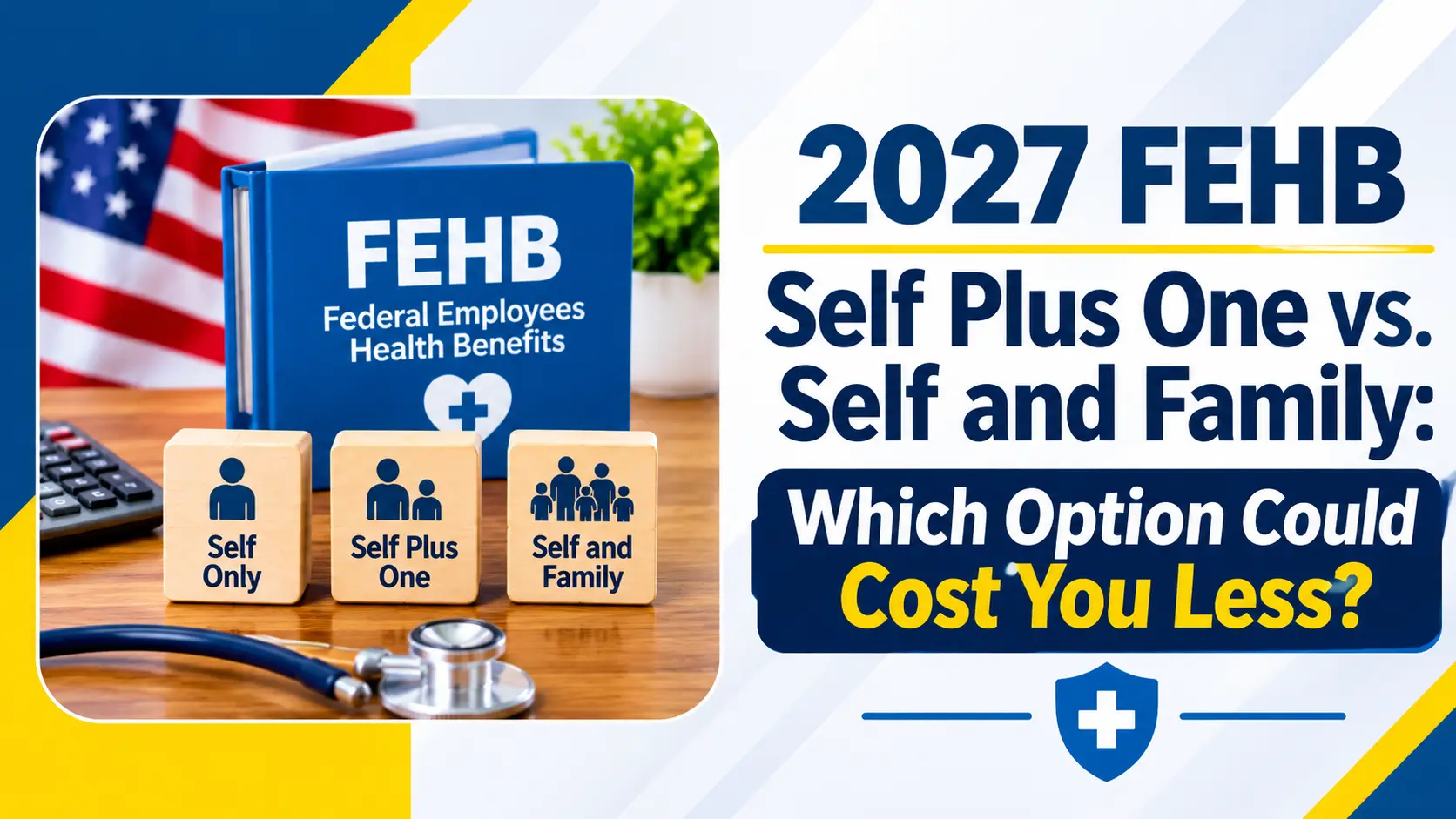
Self Plus One costs less in most plans, but not in all of them. According to MyFederalRetirement, 39 of the 118 FEHB plan options charge you more for Self Plus One than for Self and Family in 2027.
FEHB, the Federal Employees Health Benefits Program, is the federal government's health insurance program for employees, retirees, and their eligible family members. OPM, the U.S. Office of Personnel Management, runs the program and set this year's open season for November 9 through December 14, 2026. If you're planning to retire this year, understanding how your FEHB coverage works before leaving federal service is equally important. Review this Federal Employees Retiring in 2026 guide for important retirement considerations. Your plan's two rates decide the answer, and the gap can top $1,000 a year based on OPM's 2027 rates.
This guide covers the 2027 numbers, the plans where the usual rule breaks, and a five-step way to compare your own plan. It comes from Federal Pension Advisors, a retirement planning firm specializing in federal employee benefits.
It covers FEHB plans for most employees and annuitants. Postal employees and annuitants enroll in PSHB, the Postal Service Health Benefits Program, which has separate rates.
What Is the Difference Between 2027 FEHB Self Plus One and Self and Family?
A Self Plus One enrollment covers you and one eligible family member you designate. A Self and Family enrollment covers you and all eligible family members.
According to OPM, the U.S. Office of Personnel Management, the designated family member can be a spouse or an eligible child. Self and Family cannot exclude any eligible family member. The Federal Employees Health Benefits Program (FEHB) lets enrollees with just one eligible family member choose either type. Federal employees should also understand their workplace rights and available protections, including the federal employee union grievance and arbitration process.
Both types use the same plan. Premiums differ, and in some plans deductibles differ too.
Self Plus One is the lower-cost choice for most two-person households, but each plan prices the two types separately.
The three FEHB enrollment types work like this:
- Self Only covers you alone. OPM says family members you leave off are not eligible, even upon your death or disability.
- Self Plus One covers you and one eligible family member you designate. Anyone else in your family needs coverage elsewhere.
- Self and Family covers you and every eligible family member. OPM says a new spouse or newborn is covered automatically from the day they join.
According to OPM, eligible family members include a spouse and children under age 26. That includes legally adopted children, stepchildren, and recognized natural children.
A child age 26 or older who cannot support themselves because of a disability that began before age 26 also qualifies. That child can be the person you designate under Self Plus One.
Foster children can qualify too. According to OPM's foster child eligibility fact sheet, the child must be under age 26 and live with you. You must also have a parent-child relationship with the child and provide most of the child's financial support.
Your employing office decides eligibility and which documents it accepts.
Each plan sets its own premium for each type. That's why the cheaper type changes from plan to plan.
2027 FEHB Premiums: What the Government Pays for Each Enrollment Type
For 2027, the government pays up to $767.53 biweekly toward a Self Plus One enrollment and up to $843.82 biweekly toward a Self and Family enrollment, according to OPM. Annuitants, who pay monthly, receive up to $1,662.98 and $1,828.28. These figures are maximums, not flat amounts every enrollee receives. Federal employees should also review potential retirement-related financial obligations, including how to challenge a FERS contribution debt if their agency reports an incorrect contribution amount.
Each cap equals 72% of the program-wide weighted average premium for that type, according to OPM. The government pays the lesser of that cap or 75% of the plan's total premium, according to OPM's 2027 open season highlights. You pay the rest.
Table 1. 2027 FEHB government contribution caps and weighted average premiums. Dollar figures from OPM's 2027 premium page; percentage changes from MyFederalRetirement's review of OPM rate files.
The Self and Family cap sits $76.29 biweekly above the Self Plus One cap, based on OPM's figures. That extra government money narrows the gap you pay. How much it narrows depends on each plan's total premiums.
According to OPM, the average FEHB enrollee share rises 10.9% for 2027. The overall average premium rises 9.3%, and the government share rises 8.6%. Those follow increases of 12.3%, 10.2%, and 9.2% for 2026, according to OPM.
Averages hide plan-level differences. Among 117 comparable plan options, MyFederalRetirement counts 22 where the Self Plus One enrollee share falls and 21 where the Self and Family share falls. The rest rise or stay flat.
When Self Plus One Costs More than Self and Family in 2027
In 2027, Self and Family costs you less than Self Plus One in about 39 of 118 FEHB plan options, according to MyFederalRetirement's analysis of OPM's rate files. OPM, the U.S. Office of Personnel Management, publishes a chart titled "Self Plus One Enrollee Premiums Greater Than Self and Family" on its premiums page. These rising federal benefit costs also make it important to understand how broader compensation changes can affect retirement decisions. Read our guide to 2027 federal pay freeze and retirement planning for additional considerations.
OPM states that enrollees who wish to cover one eligible family member are free to elect either type.
The exact list of plans appears in OPM's exception chart on its premiums page. Check your plan against that chart before you elect.
The table below compares biweekly employee premiums for six 2027 plan options. Annual figures multiply the biweekly difference by 26 pay periods.
Table 2. 2027 employee premiums for selected FEHB plans. Rates from OPM's 2027 data as compiled by FERS Ready and FedTools; SAMBA High from OPM's plan comparison tool. Annual differences are calculated over 26 pay periods.
MHBP Standard Option shows how the reversal happens. According to FedTools, the plan's total premium rose 40.0% for Self Plus One and 42.6% for Self and Family. The Self Plus One enrollee share more than doubled, rising 104.9% from $216.12 to $442.77 biweekly.
The Self and Family share rose 83.7%, from $218.20 to $400.78.
The pattern runs the other way in most plans. In SAMBA High Option, Self Plus One costs $55.93 less per pay period than Self and Family. Never assume the lower tier based on the name alone.
2027 FEHB Self Plus One vs. Self and Family: Which Costs Less for Your Household?
Self Plus One usually costs less for a couple with no children or a single parent with one child, but your plan's two rates make the final call. Your household type narrows the choices before you compare any rates.
Table 3. Starting points by household type. Confirm against your plan's 2027 rates.
Planning scenario (illustrative, calculated from OPM's 2027 rates). A married federal couple with no children under 26 is enrolled in MHBP Standard Option.
Self Plus One costs 26 × $442.77, or $11,512.02 a year. Self and Family costs 26 × $400.78, or $10,420.28 a year. Choosing Self and Family saves $1,091.74 a year in the same plan.
Dual-federal couples face a third option. According to OPM, if both spouses are eligible to enroll and have no eligible children, they have two choices. One spouse can enroll for Self Plus One, or each can enroll for Self Only in the same or different plans. As retirement approaches, couples should also consider how their healthcare expenses fit into their overall retirement income strategy, including their TSP withdrawal strategy for 2027.
OPM adds that you will generally pay lower premiums for two Self Only enrollments. Add up both Self Only premiums, compare them with one Self Plus One premium, and weigh provider networks and benefits before you decide.
For more on all three tiers, see our guide to Self Only vs. Self Plus One vs. Self and Family for 2027.
Beyond Premiums: Deductibles and Out-of-Pocket Maximums Can Change the Answer
Premium is only one part of total cost, because deductibles and out-of-pocket maximums can differ by enrollment type and by plan. A lower premium can come with higher cost sharing when you use care. Compare the premium and the most you could pay in a bad year.
SAMBA Standard Option shows the difference. According to OPM's plan comparison tool, the in-network deductible is $700 for Self Plus One and $900 for Self and Family. The out-of-pocket maximum is $12,000 for both.
FERS Ready lists the 2027 annual premium at $6,881 for Self Plus One. As an illustration, assume in-network covered expenses reach the $12,000 limit. Premiums do not count toward that limit, so the year's total cost would be near $18,881 for Self Plus One and $19,297 for Self and Family. Federal employees should also compare 2027 FEHB premiums before choosing their health insurance coverage.
The out-of-pocket maximum already includes the deductible, so don't add it on top.
Cost sharing is also rising. According to FERS Ready, Blue Cross and Blue Shield Basic Option has no deductible. Its 2027 out-of-pocket maximum is $17,000 for Self Plus One and Self and Family, up $2,000 from 2026.
FERS Ready reports the Foreign Service Benefit Plan High Option out-of-pocket maximum for those types rising from $8,000 to $12,000. Read each plan brochure before you elect. A premium saving of a few hundred dollars can disappear in one high-claim year. Schedule a free federal retirement consultation to discuss how your healthcare costs may affect your retirement planning.
How to Compare Your 2027 FEHB Rates in Five Steps
Comparing 2027 FEHB Self Plus One and Self and Family takes five steps. Confirm who you are covering, pull both rates, check OPM's exception chart, annualize the difference, and compare cost sharing.
- Confirm who needs coverage. List your eligible family members. Choose Self Plus One only if you'll designate a single spouse or child under age 26.
- Pull both rates for your plan. Use OPM's 2027 premium charts or OPM's FEHB plan comparison tool. Employees see biweekly rates. Annuitants see monthly rates.
- Check the exception chart. Is your plan on OPM's "Self Plus One Enrollee Premiums Greater Than Self and Family" list? If so, Self and Family is cheaper.
- Annualize the gap. Multiply the biweekly difference by 26, or the monthly difference by 12.
- Compare cost sharing. Check the deductible and out-of-pocket maximum for each type, then elect before open season ends on December 14, 2026.
Our overview of the 2027 FEHB changes, premiums, and benefits lists other items to review at the same time. PSHB enrollees run the same steps using PSHB rates.
When You Can Change Your FEHB Enrollment Type
Active employees can change enrollment type during open season or after a qualifying life event, and annuitants can decrease their enrollment at any time, according to OPM. The 2026 open season runs November 9 through December 14, 2026.
According to MyFederalRetirement's open season checklist, changes take effect January 10, 2027 for most non-Postal employees and January 1, 2027 for annuitants.
Premium conversion, the pre-tax payment of premiums, changes the rules. According to OPM, employees who participate can decrease enrollment only during open season or within 60 days after a qualifying life event. The change must match the event.
Employees who do not participate can decrease enrollment at any time.
OPM lists qualifying life events such as a divorce, the death of a spouse, or a child reaching age 26. According to FedTools, wanting a lower premium does not count as one. For a full guide to the timing rules, read our Self Plus One vs. Self and Family comparison.
Annuitants have more freedom to step down. OPM states that annuitants can decrease enrollment at any time. That means a retiree can move from Self and Family to Self Plus One once children age out.
How Your 2027 FEHB Choice Fits Your Retirement Plan
Your FEHB enrollment type is a recurring cost that carries into retirement, so a small annual gap grows over time. FERS, the Federal Employees Retirement System, and CSRS, the Civil Service Retirement System, pay the annuity most retirees use to cover premiums. The TSP, or Thrift Savings Plan, the federal government's tax-advantaged retirement savings program, often funds the rest. Retirees should also review their life insurance expenses when planning their overall retirement budget, particularly FEGLI Option B costs and coverage choices.
Take the planning scenario above as a constant-premium illustration, not a forecast. A $1,091.74 annual difference adds up to about $21,835 over 20 years.
Premiums won't hold constant. According to MyFederalRetirement, compounding OPM's average enrollee increases produces roughly 65.5% cumulative growth from 2023 through 2027.
Annuitants pay FEHB premiums monthly, according to MyFederalRetirement. OPM's 2027 maximum monthly government contribution is $1,662.98 for Self Plus One and $1,828.28 for Self and Family. Retirees weigh the remaining premium against their FERS or CSRS annuity and TSP withdrawals.
Federal Pension Advisors, a retirement planning firm specializing in federal employee benefits, helps federal employees view FEHB premiums next to their FERS, CSRS, and TSP income.
Choosing the Right 2027 FEHB Enrollment Type
For 2027, the cheapest FEHB option for a two-person household is whichever type your plan prices lower, and OPM's published rates show that in a few minutes. Self Plus One wins in most plans. If you're unsure which coverage option makes the most sense for your retirement situation, schedule a free federal retirement consultation to discuss your options.
Self and Family wins in roughly 39 of 118 plan options, including MHBP Standard Option and the Foreign Service Benefit Plan High Option. Deductibles, out-of-pocket maximums, and retirement plans add more reasons to check before December 14, 2026.
Schedule a consultation with a federal retirement specialist at Federal Pension Advisors, a retirement planning firm specializing in federal employee benefits, to review your 2027 options. Read our 2027 FEHB changes overview for the full list of plan updates.
Frequently Asked Questions About 2027 FEHB Self Plus One vs. Self and Family
Is Self Plus One cheaper than Self and Family for FEHB?
Self Plus One is cheaper than Self and Family in most Federal Employees Health Benefits Program (FEHB) plans, but not all. According to MyFederalRetirement, 39 of 118 plan options charge more for Self Plus One in 2027.
OPM publishes a chart listing those plans. Compare both rates for your plan before you enroll.
Can I choose Self and Family if I only need to cover one person?
Yes. According to OPM, the U.S. Office of Personnel Management, an enrollee covering one eligible family member may elect either Self Plus One or Self and Family.
Self and Family can cost less in some plans. Deductibles can also differ by type, so check the plan brochure before you choose.
Who is covered under a Self Plus One enrollment?
A Self Plus One enrollment covers the enrollee and one eligible family member the enrollee designates, according to OPM, the U.S. Office of Personnel Management. That person can be a spouse or an eligible child. Family members the enrollee does not designate are not eligible for coverage, even upon the enrollee's death or disability.
When can I switch from Self and Family to Self Plus One?
Active employees can switch during open season, which runs November 9 through December 14, 2026. Employees in premium conversion can also switch within 60 days after a qualifying life event. According to OPM, the U.S. Office of Personnel Management, annuitants can decrease enrollment at any time.
How much does the government pay toward FEHB premiums in 2027?
For 2027, OPM sets the maximum biweekly government contribution at $352.04 for Self Only, $767.53 for Self Plus One, and $843.82 for Self and Family. The Federal Employees Health Benefits Program (FEHB) government share is the lesser of that cap or 75% of the plan's total premium.
How much will FEHB premiums go up in 2027?
According to OPM, the U.S. Office of Personnel Management, the average enrollee share of Federal Employees Health Benefits Program (FEHB) premiums rises 10.9% for 2027. The overall average premium rises 9.3%. Your own change depends on your plan, because some plans cost less than in 2026.
Disclaimer:
This article is for educational and informational purposes only and does not constitute financial, retirement, insurance, or legal advice. FEHB premiums, government contributions, eligibility requirements, and enrollment rules may change. The examples and calculations are illustrative and may not reflect your individual circumstances. Always verify current plan premiums, coverage details, and enrollment requirements with the U.S. Office of Personnel Management (OPM) and your health plan before making enrollment decisions. Consult a qualified federal benefits or retirement professional for guidance specific to your situation.
Thomas A. Doherty
Thomas A. Doherty is a retirement planning consultant with 35 years of experience helping individuals, federal employees, academic employees, and business owners better understand their retirement options. His work focuses on helping clients make the most of their available benefits, insurance policies, and investment plans so they can build more stable retirement income and reduce unnecessary financial risk.