
Plan your federal retirement with confidence. Use our FERS Retirement Calculator to estimate your pension using your High-3 salary, years of service,and pension multiplier.
Discover Your Perfect FERS Plan With Expert Guidance:

How Our Federal Government Retirement Calculator Works
This easy-to-use Federal Retirement Calculator helps you estimate your annual FERS annuity based on your High-3 salary, years of creditable service, and your pension multiplier. It’s the ideal tool for every federal employee—CSRS or FERS—planning their retirement.
How to Use the Federal Retirement Calculator
To use the calculator:
- Enter your High-3 salary
- Input your total years of creditable service
- Select the correct pension multiplier (1% or 1.1%)
- Click “Calculate” to see your annual pension estimate
Why Use Our Federal Retirement Calculator?
Our Federal Retirement Calculator makes it easy to plan for the future with:
- Fast and accurate estimates of your FERS pension benefits
- Simple input fields that generate results in real time
- Free expert consultation to help you make informed decisions
Maximizing Your Federal Pension:
How To Calculate Federal Retirement Pension?
- Your highest average salary over three consecutive years (High-3 Salary)
- The total number of years you have worked (Years of Creditable Service)
- The pension multiplier, which is a specific percentage used in the calculation
Here's How the Formula Looks:
High-3 Years Salary
X
Years of Creditable Service
X
Pension Multiplier
=
Annual Annuity Benefit
The fers calculation for retirement is easy. It only becomes a bit tricky when we break it down into different parts. Let's make sure you understand each part.
Your High-3 Salary
Your high-3 salary is the average of your highest earnings over any 36-month period during your career. This is a key part of how your pension is calculated.
For most people, their high-3 salary comes from their last three years of work, as this is usually when they earn the most. However, your high-3 doesn't have to be the last three years of your career. It will be the period when you had the highest pay, no matter when it happened.
Remember, your high-3 period doesn't have to be from January to December. For instance, if your highest average salary was from May 2013 to May 2016, then that’s the period that will be used for your calculation.
Creditable Service
Many federal employees assume calculating their creditable service is straightforward, but it's often the most time-consuming step.
The complexity comes from the fact that the Office of Personnel Management (OPM) uses your SF-50 forms to determine your service. Even if you believe you've worked for 30 years, OPM's calculation is what counts. That's why it's crucial to ensure all your SF-50s are in your file and accurate.
You receive an SF-50 form every time there's a change in your job or pay, which means you'll have at least one SF-50 per year.
To calculate your years of creditable service accurately, gather all your SF-50s and make sure they match your records. This helps ensure you're in agreement with OPM when you retire. You'd be surprised at how often there are errors on SF-50s.
Understanding Your Service Computation Date (SCD)
When you look at your LES (Leave and Earnings Statement) or SF-50 forms, you'll see a date called the Service Computation Date (SCD). Many people think this date can be used to calculate their years of creditable service. However, your SCD is only for leave purposes.
SCD for Leave vs. RSCD for Pension
The date that really matters for your creditable service and pension calculation is the Retirement Service Computation Date (RSCD). This is the date that the Office of Personnel Management (OPM) will use to calculate your retirement benefits.
Unfortunately, there isn't an official document showing your RSCD before you retire. Your Personal Statement of Benefits will have an estimate, but it's just that—an estimate. You can use your SCD as a rough estimate, but it might not be the same as your RSCD.
Calculating Your RSCD
OPM calculates your RSCD based on your SF-50 forms. To find it yourself, you would need to review all your SF-50s and figure out the total time you were paying into the FERS retirement system.
Once you have your RSCD, calculate the full years and months between that date and your planned retirement date. Only full months count toward your creditable service, so you'll need to drop any extra days. For example, if the period is 22 years, 6 months, and 29 days, your creditable service would be 22 years and 6 months, because OPM doesn't round up.
Watch Out For Special Cases
If your career has been continuous without any breaks, calculating your creditable service is straightforward. But if you've had breaks in service, taken leave without pay, or had temporary time, you'll need to be aware of how OPM handles these situations.
Proper planning can help ensure you have enough creditable service when you retire. The worst-case scenario is retiring and then finding out from OPM that you don’t have enough creditable service, forcing you to return to work.
What About Military Time?
Many people transition from the military to civilian government jobs. You can "buy back" your military time to add to your creditable service for your civilian pension. However, if you're currently drawing a military pension, you cannot add that time to your civilian service without giving up your military pension. You can't "double dip"—your military time can count towards either a military or civilian retirement, but not both.
Your Multiplier
Figuring out your multiplier is simple.
Usually, it's 1%. However, if you retire at age 62 or older and have at least 20 years of service, your multiplier increases to 1.1%, which is a 10% boost!
This extra pension is often enough to encourage many federal employees to keep working a little longer. Calculate your own pension to see the difference if you work until age 62 with 20 years of service.
Minimum Retirement Age (MRA) by Birth Year
Your MRA is the earliest age at which you can retire under FERS with an immediate, unreduced pension (with 30+ years of service) or under MRA+10 rules. It ranges from 55 to 57 depending on when you were born.
Step-by-step Example: Fers Calculation For Retirement
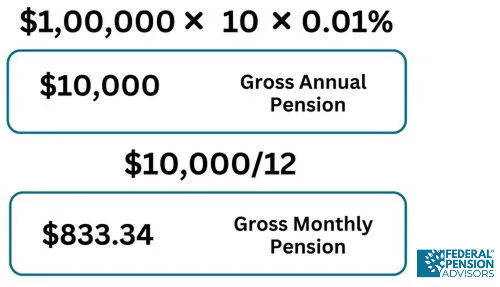
Substitute the Values
- High-3 Salary = $100,000
- Years of Creditable Service = 10 years
- Pension Multiplier = 1% or 0.01
We'll Calculate the Annual Annuity Benefit (a) Using the Formula:
Substituting the Values:
- A = $100,000 * 10 * 0.01
Performing the Multiplication:
- A = $100,000 * 0.1
- A = $10,000
Results
Therefore, the Annual Annuity Benefit (A) for this individual's FERS retirement plan is $10,000 per year.
Summary
In this example, we used the FERS retirement formula to calculate the annual annuity benefit based on a High-3 salary of $100,000, 10 years of creditable service, and a pension multiplier of 1%. The result: this employee would receive $10,000/year ($833/month gross) upon retirement. Use the calculator above to run your own numbers.
Worked Examples — FERS Pension Calculations Using 2026 GS Pay
Here are four real-world examples using the 2026 General Schedule pay scale. Each shows the step-by-step pension calculation so you can see how the formula works across different grades, steps, and retirement scenarios.
Example 1 — Mid-Career Employee, Standard Retirement
Calculation: $80,400 × 30 × 0.01 = $24,120/year (≈$2,010/month gross)
Note: This employee retires at their MRA of 57 with 30+ years, qualifying for an immediate unreduced pension. The 1.0% multiplier applies because they are under age 62. If they had waited until 62 with the same 30 years: $80,400 × 30 × 0.011 = $26,532/year — an extra $2,412/year for life.
Disclaimer: These figures are estimates for educational purposes only. Actual federal retirement, TSP, paycheck, tax, and benefit amounts may vary based on your agency records, locality pay, FEHB plan, tax situation, service history, and future law or policy changes.
Example 2 — Senior Employee, Age 62+ Bonus Multiplier
Calculation: $119,200 × 22 × 0.011 = $28,846/year (≈$2,404/month gross)
Note: Because this employee retires at exactly 62 with more than 20 years of service, they qualify for the 1.1% multiplier. Compared to retiring at 60 with the same service (1.0% multiplier): $119,200 × 22 × 0.01 = $26,224/year. The extra two years of work earns them an additional $2,622/year — permanently.
Disclaimer: These figures are estimates for educational purposes only. Actual federal retirement, TSP, paycheck, tax, and benefit amounts may vary based on your agency records, locality pay, FEHB plan, tax situation, service history, and future law or policy changes.
Example 3 — MRA+10 Early Retirement with Penalty
Step 1: Calculate base pension: $63,400 × 12 × 0.01 = $7,608/year
Step 2: Apply MRA+10 penalty (5 years × 5% = 25%): $7,608 × 0.75 = $5,706/year (≈$476/month gross)
Disclaimer: These figures are estimates for educational purposes only. Actual federal retirement, TSP, paycheck, tax, and benefit amounts may vary based on your agency records, locality pay, FEHB plan, tax situation, service history, and future law or policy changes.
Example 4 — High-Grade, Maximum Multiplier Scenario
Calculation: $160,000 × 20 × 0.011 = $35,200/year (≈$2,933/month gross)
Note: GS-15 Step 10 base pay is capped for pension calculation purposes at the Executive Schedule Level IV pay cap where applicable. Locality pay may push actual salary above this; confirm your High-3 with your HR office.
Disclaimer: These figures are estimates for educational purposes only. Actual federal retirement, TSP, paycheck, tax, and benefit amounts may vary based on your agency records, locality pay, FEHB plan, tax situation, service history, and future law or policy changes.
Quick Comparison — All 4 Examples
* After 25% MRA+10 early retirement penalty applied.
Federal Retirement Calculator
To utilize the FERS Pension Calculator & Federal Retirement Calculator, the subsequent step involves computing your pension by multiplying your High-3 Salary with your Multiplier and Years of Creditable Service.
Net vs. Gross Pension
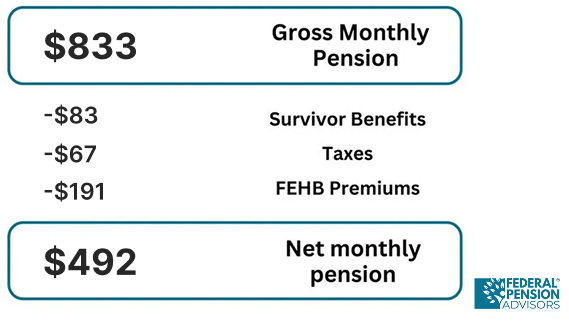
A common mistake federal employees make is planning around their gross pension without accounting for deductions. Your net pension — what actually hits your bank account — can be significantly lower. Here's a realistic breakdown using the example above ($100,000 High-3, 10 years, 1% multiplier):
Disclaimer: These figures are estimates for educational purposes only. Actual federal retirement, TSP, paycheck, tax, and benefit amounts may vary based on your agency records, locality pay, FEHB plan, tax situation, service history, and future law or policy changes.
Request an Appointment
Book your free 30-minute consultation call now! Schedule your appointment today at no cost and discover how we can assist you.
Planning for federal retirement can be a complex process, but using the FERS retirement calculator provided by Federal Pension Advisors can simplify it significantly. Gaining a clear understanding of how your FERS retirement is calculated is the first step toward securing your financial future. In this article, explain how to effectively use various FERS calculators and how they can assist you in preparing for retirement.
Understanding the FERS Pension Calculation
A crucial part of your retirement planning is understanding how your FERS retirement is calculated. The basic formula takes into account your years of service, your high-3 average salary, and a multiplier that depends on your retirement age and total years of service. Tools like the OPM FERS calculator and the Federal Pension Advisors' FERS Pension Calculator offer a simple way to input these variables and estimate your retirement benefits.
Maximizing Your Retirement with Federal Pension Advisors
Determining the ideal retirement date is a critical step in your financial planning. The FERS retirement calculator from Federal Pension Advisors helps you pinpoint the best time to retire, ensuring you maximize your benefits. Additionally, their retirement tax calculator estimates the taxes you'll owe on your retirement income, so you can plan ahead with confidence and avoid unexpected surprises.
Comprehensive Retirement Tools
For a more holistic view, the FERS retirement calculator offers detailed insights into your annuity and overall retirement plan. With tools like the FERS annuity calculator OPM and the FERS basic benefit plan calculator, you can gain a comprehensive understanding of your benefits. Practical guides, such as FERS calculation examples and how to calculate federal retirement pension?, further enhance your ability to plan effectively. And for your paycheck you checkout the tsp growth calculator.
Additional Considerations
Federal employees in specialized roles, such as law enforcement officers and firefighters, can use the FERS retirement calculator to understand their specific retirement benefits. For those in the Further Revised Annuity Employee (FRAE) category, the FERS FRAE calculator is essential. The Federal Retirement Calculator is also a valuable tool for these employees.
Utilizing the right tools, such as the FERS pension calculator, and the TSP retirement calculator, can significantly enhance your retirement planning experience. By taking advantage of these calculators, especially if you're a firefighter, you can make well-informed decisions, optimize your retirement benefits, and ensure a financially secure future. Remember, careful planning today paves the way for a comfortable and worry-free retirement tomorrow.
FERS Pension Calculation
To achieve a successful retirement, federal employees can greatly benefit from our Federal Government Retirement Calculator. This user-friendly tool allows you to input different scenarios and immediately view your potential benefits. Whether you're new to using a FERS retirement calculator or seeking to refine your retirement plan, our team of independent advisors is here to help you calculate FERS benefits accurately and efficiently. By leveraging our FERS benefit calculator, you'll gain a clear understanding of your retirement income, enabling you to make well-informed decisions for a secure financial future.
FERS Retirement Advisor for Federal Employees
Finding a FERS Retirement advisor near you is essential for federal employees who want to plan for a secure retirement. Our FERS retirement calculator is designed to make this process straightforward, featuring a detailed and user-friendly interface. With our tool, you can view a Federal Government Retirement Calculator example that guides you through each step of calculating your FERS pension.
FAQ Hub
Frequently Asked Questions
Find answers to common questions about FERS Retirement Calculator
Is a Federal Pension Good?
Yes, a federal pension can be a significant benefit for federal employees. It offers a reliable source of income in retirement, providing financial security and peace of mind. However, it's important to understand the specifics of the Federal Employees Retirement System (FERS) to maximize your benefits.
What is the Federal Retirement Calculator and why is it important?
The Federal Retirement Calculator is a comprehensive tool that provides estimates for federal employees' retirement benefits, including those under both FERS and CSRS.
How to Calculate Retirement Amount?
Calculating your exact retirement amount can be complex and involves several factors, including your years of service, average salary, and chosen retirement age. However, you can get a general estimate using the following steps:
1. Determine Your High-3 Average Salary: This is the average of your highest three consecutive years of salary.
2. Calculate Your Years of Service: This includes all creditable federal service, including military time.
3. Use a Pension Calculator: The Office of Personnel Management (OPM) provides a pension calculator on their website. You can input your high-3 average salary and years of service to get an estimate of your monthly annuity.
How to Calculate Years of Service for Retirement?
To calculate your years of service for retirement, you'll need to consider all creditable federal service, including:
1. Civilian Service: This includes time spent working for a federal agency.
2. Military Service: Time served in the military can be credited towards your federal service.
3. Certain Types of Leave: Some types of leave, such as military leave and maternity leave, may be credited.