

Published
Mar 19, 2026

Last Updated
Sep 1, 2026
Can Federal Employees Retire Early in Washington, DC Without Penalty
“Retirement is not about stopping work. It is about gaining control over your time.”
For federal employees, that control comes with one key question:
Can you pursue federal early retirement without paying a financial price?
The answer is yes but only if you understand the system. Under FERS, full retirement typically requires age and service combinations like 62 with 5 years, 60 with 20 years, or Minimum Retirement Age (56–57) with 30 years, as defined by the U.S. Office of Personnel Management.
Early options exist through Voluntary Early Retirement Federal (Vera), allowing retirement as early as age 50 with 20 years or any age with 25 years during approved agency programs.
What Does Early Retirement Mean for Federal Employees?
When we talk about federal early retirement, we are referring to leaving service before the standard retirement age while still accessing retirement benefits.
Under the fers early retirement system, this is often possible through options like voluntary early retirement federal (VERA), which allows eligible employees to retire as early as age 50 with at least 20 years of service, or at any age with 25 years, typically during agency restructuring or downsizing, as outlined by the U.S. Office of Personnel Management.
However, not all early retirement paths are equal. For example, the MRA + 10 option allows retirement with as little as 10 years of service but comes with a 5% reduction in annuity for each year under age 62, which can significantly impact long-term income.
This is why understanding your options is critical because early retirement for federal employees is not just about leaving sooner, but about doing it without sacrificing financial stability.
Standard FERS Eligibility vs Early Retirement
Understanding the difference between standard retirement and federal early retirement is not just about numbers. It is about how your timing directly shapes your income, benefits, and long-term financial comfort. Here is a more detailed breakdown to help you see the real picture.
Can You Retire Early Without Penalty?
Yes, but only under specific conditions.
Here are the main scenarios where early retirement for federal employees can happen without major penalties:

1. Voluntary Early Retirement Authority
The government sometimes offers Voluntary Early Retirement Authority to reduce workforce size during restructuring.
Under this option:
- You can retire at age 50 with at least 20 years of service
- Or at any age with 25 years of service
The best part is that this is one of the few ways to access federal early retirement without the usual age penalties.
This is why many employees actively wait for VERA opportunities, especially in Washington, DC where agency restructuring is common.
2. Special Provision Employees
Certain roles come with unique benefits under fers retirement options special provision employees.
These include:
- Law enforcement officers
- Firefighters
- Air traffic controllers
These employees can retire earlier than others due to the nature of their work.
Typically:
- Retirement is allowed around age 50 with 20 years of service
- Or at any age with 25 years
In many cases, they also face a federal government mandatory retirement age, usually around 57.
So for them, early retirement is not just an option. It is part of the system.
3. Minimum Retirement Age Plus 10 Option
Another route for early retirement federal is the MRA plus 10 option.
This allows you to retire:
- At your Minimum Retirement Age
- With at least 10 years of service
However, there is a catch.
Your pension is reduced by 5 percent for every year you are under age 62. This is where most people feel the impact of early retirement decisions.
You can delay your pension to reduce or avoid this penalty, but that requires financial discipline and planning.
Federal retirement planning is complex, with FERS vs CSRS rules, TSP withdrawals, Social Security timing, and IRMAA impacting your lifetime benefits.Even small mistakes can cost thousands.Get expert guidance on federal early retirement, FERS special provisions, and income planning.
Understanding the Early Withdrawal Penalty
One of the biggest concerns people have is the federal penalty for early retirement withdrawal.
This typically applies to your Thrift Savings Plan, not your FERS pension.
If you withdraw from TSP before age 59 and a half, you may face:
- A 10 percent early withdrawal penalty
- Income taxes on the withdrawn amount
However, there are exceptions.
If you retire during or after the year you turn 55, you can access your TSP without that 10 percent penalty.
This rule alone can change your retirement timeline significantly.

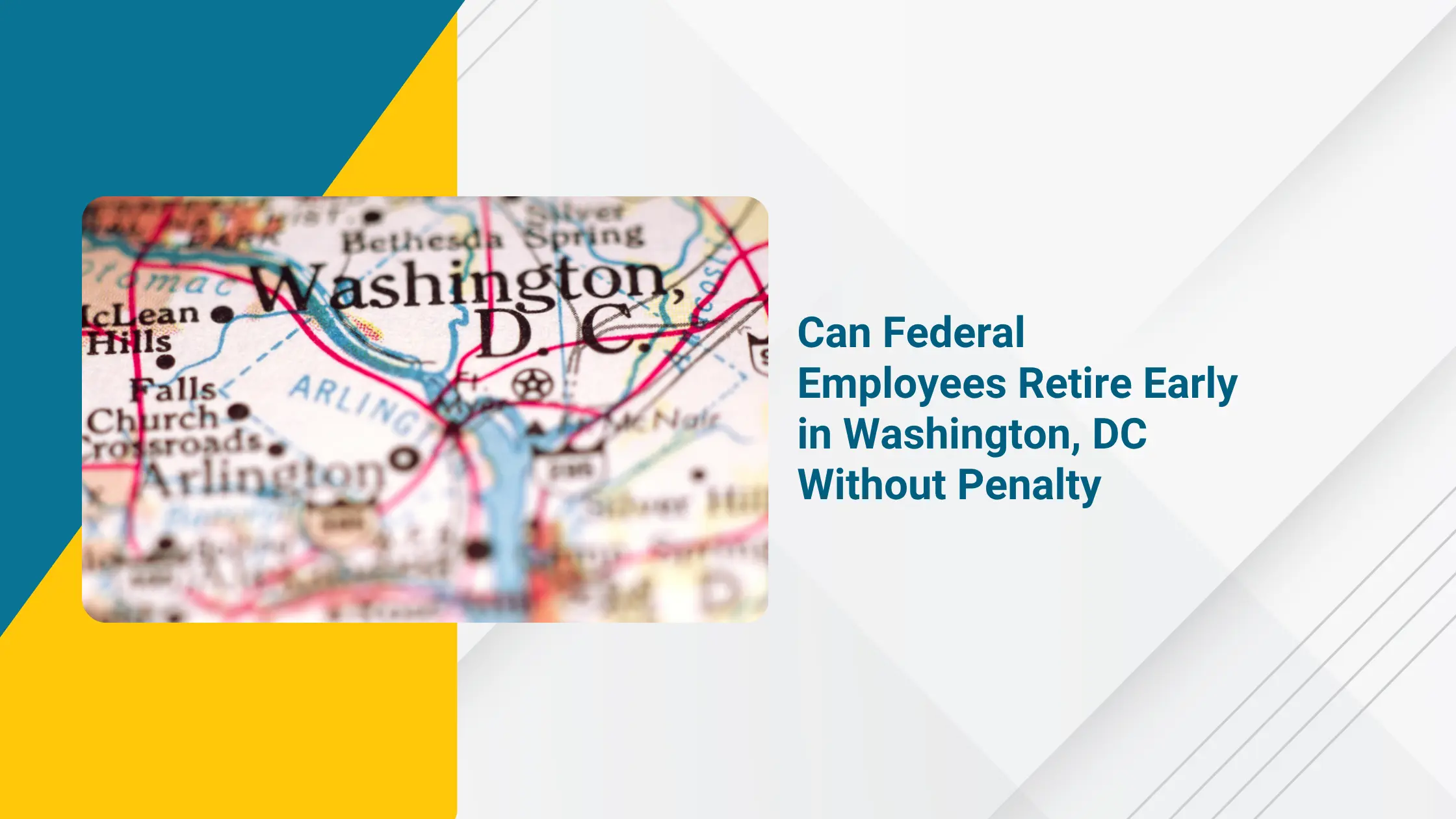
Washington, DC Context Matters
If you are working in Washington, DC, your retirement planning needs an extra layer of thought.
Because:
- Cost of living is higher: Regional price parities show DC is significantly more expensive than the national average in almost every category.
- Healthcare expenses are significant: With premiums rising, your choice of FEHB plan during retirement can make or break a monthly budget.
- Lifestyle expectations tend to be elevated in the capital region.
Early retirement here is not just about eligibility. It is about sustainability. A pension that works in a smaller city may not stretch the same way in DC, primarily because locality pay adjustments applied to your salary do not carry over to your FERS annuity.
A pension that works in a smaller city may not stretch the same way in DC.
How to Retire Early Without Regret
Let us get practical. If your goal is federal early retirement, here is how to approach it smartly.
- Start with clarity, not just excitement
Early retirement sounds freeing, but it only works when backed by a clear understanding of your expenses, income sources, and long-term needs. Define what your retired life actually looks like before you step into it.
- Build a strong financial bridge
If you are choosing federal early retirement, you will likely face a gap before full benefits align. Create a buffer through savings, investments, or secondary income so your lifestyle does not take a hit. - Maximize every benefit while you can
Take full advantage of TSP contributions, government matching, and yearly increases. The more you build now, the less pressure you carry later. - Time your exit strategically
A difference of even one or two years can impact your pension, reduce penalties, and improve long-term stability. Early should still be smart, not rushed. - Understand withdrawal rules deeply
Be mindful of the federal penalty for early retirement withdrawal, especially with TSP. Poor timing can lead to unnecessary tax burdens that eat into your savings.
Keep it Safe with Federal Pension Advisors
When it comes to federal early retirement, the difference between a smooth transition and a costly mistake often comes down to guidance. At Federal Pension Advisors, we help you move forward with clarity, not confusion.
We work closely with federal employees to simplify complex decisions around FERS eligibility requirements, pension calculations, and early retirement strategies. Whether you are considering options under Voluntary Early Retirement Authority or evaluating the impact of early withdrawals, our approach is built to protect what you have earned.
This is not just about retiring early. It is about retiring right. From minimizing penalties to aligning your benefits, investments, and long-term income, we ensure every step is intentional and secure.
Because your retirement should not feel like a risk. It should feel like a well-planned next chapter.
FAQs – Federal Early Retirement in Washington, DC
Q1: Can federal employees retire early in Washington, DC?
A: Yes. Federal employees can retire early under FERS early retirement rules or through Voluntary Early Retirement Authority (VERA) if eligible. Typical eligibility is age 50 with 20 years of service or any age with 25 years of service.
Q2: What is the MRA + 10 option?
A: The Minimum Retirement Age (MRA) + 10 option allows early retirement after reaching your MRA with at least 10 years of service. However, pension benefits are reduced by up to 5% per year for each year before age 62.
Q3: Who qualifies as a FERS special provision employee?
A: Certain roles like law enforcement officers, firefighters, air traffic controllers, and other high-risk positions are considered FERS special provisions employees. They may retire earlier and are sometimes subject to federal government mandatory retirement age rules.
Q4: Are there penalties for early retirement for federal employees?
A: Retiring before your standard retirement age without qualifying for special provisions can trigger reduced pension benefits or a federal penalty for early retirement withdrawal. Proper planning can minimize these financial impacts.
Q5: How can I plan for federal early retirement effectively?
A: Effective planning involves coordinating TSP withdrawals, Social Security timing, and pension benefits, spreading Roth conversions, and consulting a federal benefits advisor to avoid costly mistakes.


Get Updated
Subscribe to our weekly updates for the latest on retirement planning, federal benefits, exclusive webinars, and more!
Download Federal Retirement: Step-by-step Checklist
This comprehensive guide will help you understand your federal benefits, optimize your savings, and plan for a comfortable future.
Recent Post's