

Published
Mar 20, 2026

Last Updated
Sep 1, 2026
Complete Guide to Social Security Bridge Strategy for Federal Employees
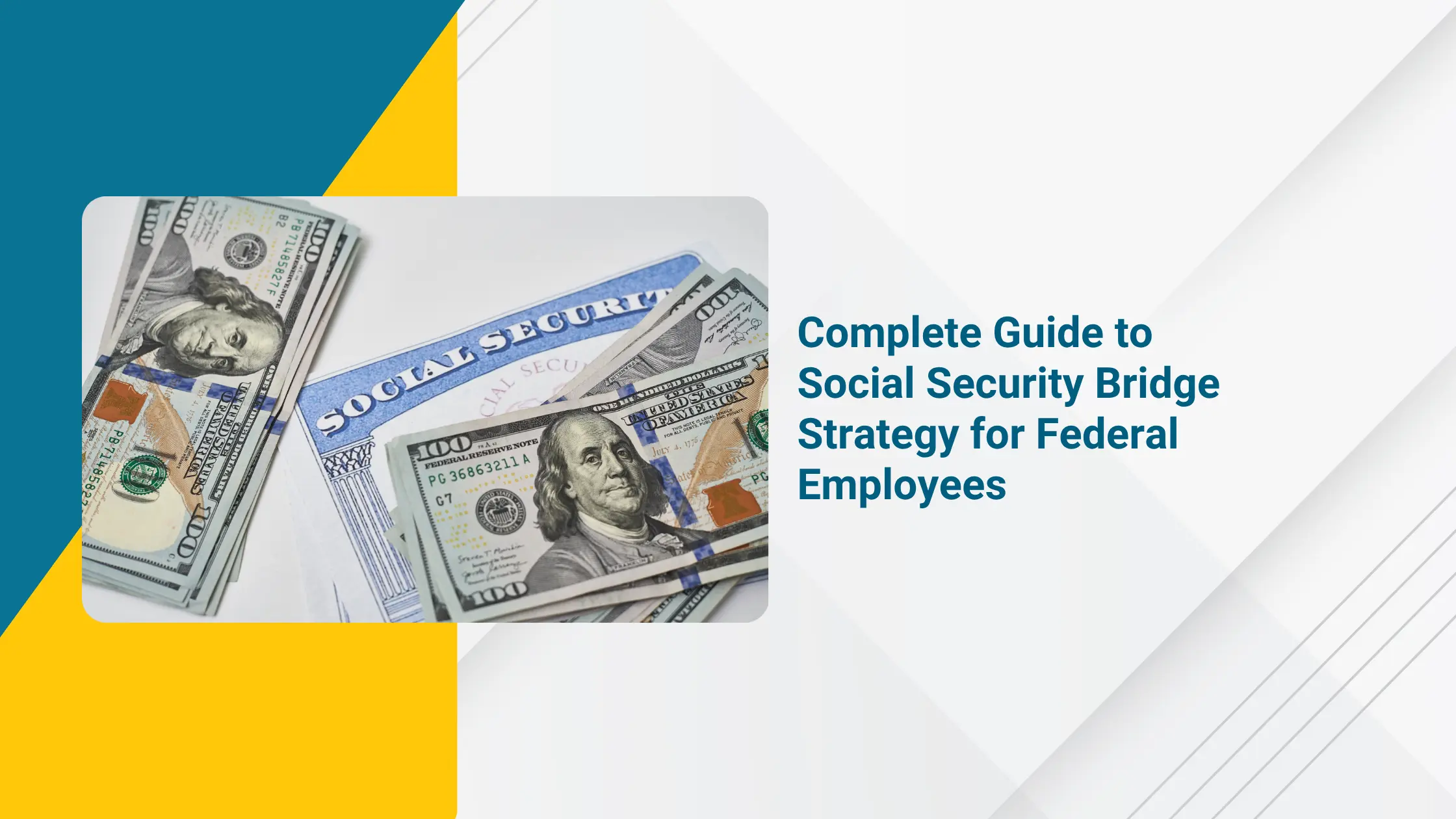
A social security bridge strategy is a retirement income approach used to replace income between the time you retire and when you begin receiving Social Security benefits.
Instead of claiming benefits early and permanently reducing your monthly income, retirees use savings such as the Thrift Savings Plan (TSP) or a 401(k) to generate temporary income. These withdrawals are often referred to as social security bridge payments.
The objective is straightforward: delay Social Security to secure higher, inflation-adjusted lifetime income.
What Is the Social Security Bridge for Federal Employees?
Federal employees are uniquely positioned to implement a bridge strategy due to multiple coordinated income sources:
- FERS pension (administered by the Office of Personnel Management)
- Thrift Savings Plan (TSP)
- FERS Supplement (available before age 62)
- Social Security benefits
Federal Retirement Income Timeline
This layered structure makes a social security bridge strategy more controlled and predictable compared to private-sector retirement planning.
How the Strategy Is Different for Federal Employees
Most retirement advice around bridge strategies is written for private-sector workers. Federal employees operate under a different system.
The FERS Supplement plays a critical role. It provides income that approximates Social Security until age 62, meaning many federal retirees are already partially “bridged.”
This changes the purpose of the strategy:
It is not just about replacing income
It is about optimizing when and how Social Security is claimed
Why a Bridge Strategy Matters (Factual Impact)
Claiming Social Security early can reduce benefits by up to 30%, depending on your age at filing.
Delaying benefits:
- Increases monthly payments permanently
- Provides stronger inflation protection
- Enhances survivor benefits
A bridge strategy allows federal employees to delay benefits without compromising early retirement income.
How the Strategy Works (Federal Example)
Consider a federal employee retiring at age 60:
- Social Security at 67: ~$2,500/month
- Social Security at 62: ~$1,800/month
Instead of claiming early, the retiree:
- Uses FERS pension + supplement
- Withdraws ~$1,500–$2,000/month from TSP
- Delays Social Security to full retirement age
Outcome
- Higher guaranteed lifetime income
- Better long-term financial stability
- Reduced dependence on early benefit reductions
Using TSP as a Social Security Bridge (2026 Context)
The Thrift Savings Plan (TSP) is central to implementing a bridge strategy for federal employees.
Why TSP Works Effectively
- Extremely low administrative costs
- Diversified investment structure (G, F, C, S, I Funds)
- Flexible withdrawal options
2026 Market Context
As of early 2026:
- Lifecycle funds, including the L Income Fund, continue to show modest, stable performance with lower volatility
- G Fund yields remain aligned with government securities, supporting capital preservation
- Fixed-income allocations continue to provide stability amid changing interest rate conditions
This reinforces TSP’s role as:
- A controlled income source during early retirement
- A stabilizing component within a broader retirement strategy

401(k) Bridge to Social Security (Comparison)
The same strategy is used in the private sector through a 401(k) bridge to Social Security, where retirees draw down savings before claiming benefits.
However, federal employees benefit from:
- Guaranteed pension income
- FERS supplement support
- More predictable income layering
As a result, federal bridge strategies are typically less aggressive and more structured.
How to Estimate a Social Security Bridge
There is no official social security bridge calculator, but the required bridge amount can be estimated using a simple framework.
Basic Formula
Monthly income gap × years to delay Social Security = required savings
Example
- Income needed: $2,000/month
- Duration: 5 years
Required bridge: $120,000
This calculation helps determine:
- Whether your TSP balance can support the strategy
- How long you can delay Social Security
Tax Strategy Considerations
A bridge strategy must be coordinated with tax planning.
Key Factors
- Traditional TSP withdrawals are taxable
- Roth TSP withdrawals may be tax-free
- Social Security taxation depends on combined income
Strategic Insight
Early retirement years often fall into lower tax brackets, creating opportunities for:
- Controlled withdrawals
- Income smoothing
- Reduced lifetime tax liability
Social Security Bridge Strategy Using Reverse Mortgage
Some retirees consider a social security bridge strategy using a reverse mortgage, where home equity is used to generate income while delaying Social Security.
When It May Apply
- High home equity
- Limited liquid retirement savings
- Desire to delay Social Security
Considerations
- Costs and fees
- Long-term impact on home value
- Suitability varies significantly
This is an advanced strategy and should be evaluated carefully within a broader retirement plan.
Common Mistakes Federal Employees Make
- Claiming Social Security early without evaluating long-term impact
- Over-relying on TSP withdrawals without sustainability planning
- Ignoring the role of the FERS supplement
- Failing to coordinate pension, TSP, and Social Security timing
A bridge strategy should be viewed as an optimization tool, not just an income replacement mechanism.
When a Bridge Strategy Makes Sense
This strategy is most effective when:
- You retire before full retirement age
- You have sufficient TSP or 401(k) savings
- You want to maximize guaranteed lifetime income
- You can manage withdrawals strategically
When It May Not Be Suitable
- Limited retirement savings
- Immediate need for Social Security income
- Shorter life expectancy considerations
- High withdrawal risk
Key Takeaway
A well-structured social security bridge strategy allows federal employees to replace income in early retirement while preserving higher Social Security benefits for later years.
When coordinated correctly, it improves:
- Income stability
- Tax efficiency
- Long-term financial outcomes
Final Thought
For federal employees, retirement planning is not just about accumulating savings—it is about structuring income across each phase of retirement.
A bridge strategy becomes significantly more effective when aligned with your FERS pension, TSP withdrawals, and Social Security timing. A structured approach ensures that early retirement decisions support long-term financial security rather than compromise it.


Get Updated
Subscribe to our weekly updates for the latest on retirement planning, federal benefits, exclusive webinars, and more!
Download Federal Retirement: Step-by-step Checklist
This comprehensive guide will help you understand your federal benefits, optimize your savings, and plan for a comfortable future.
Recent Post's