A federal workforce change can take several forms: a reduction in force, an early-out offer, a reorganization, or a transfer of function. When one lands on your desk, the question that follows is almost always the same: what happens to your retirement strategy?
Your FERS (Federal Employees Retirement System) annuity, TSP (Thrift Savings Plan) balance, and FEHB (Federal Employees Health Benefits Program) coverage each follow a separate rulebook once you leave early. The decisions you make around separation can meaningfully affect your retirement income, insurance coverage, and access to savings. Explore our federal retirement planning services to understand your options better.
Your FERS (Federal Employees Retirement System) annuity, your TSP (Thrift Savings Plan) balance, and your FEHB (Federal Employees Health Benefits Program) coverage each follow a separate rulebook once your service ends early. The decisions you make around separation can meaningfully affect your retirement income, insurance coverage, and access to savings.
Review the available pathways before you commit to a separation date. That's the step that matters most.
Federal Pension Advisors, a retirement planning firm specializing in federal employee benefits, wrote this guide to cover the common workforce-change scenarios a federal employee is likely to face. It walks through how each one affects your pension and savings, with practical steps and federal retirement planning checklists to help you review your options before you separate.
What Happens to Your Retirement Strategy When a Federal Workforce Change Occurs?
When a federal workforce change forces an early separation, three things happen to your retirement strategy at once.
First, your FERS or CSRS (Civil Service Retirement System) annuity may be payable immediately, reduced because of your retirement age, deferred until you meet the applicable eligibility requirements, or postponed to a later date under an eligible provision. The authority used to separate you and the eligibility rules you meet determine which outcome applies.
Second, your TSP account becomes portable but subject to withdrawal rules that depend on your age at separation.
Third, your FEHB and FEGLI (Federal Employees Group Life Insurance program) coverage can carry into retirement only if you meet the applicable continuous-enrollment and immediate-annuity requirements.
According to OPM, the U.S. Office of Personnel Management, each benefit follows its own eligibility pathway. A decision that protects one can inadvertently affect another.
Federal Workforce Change Scenarios That Reshape Retirement Planning
Not every workforce change triggers the same retirement outcome. The authority your agency uses to separate you, and whether the separation is voluntary or involuntary, determines which pension pathway you fall into. Four scenarios cover most situations.
Reduction in Force (RIF) is an involuntary separation. It happens when an agency faces a lack of work, lack of funds, reorganization, or a reduction in available positions. Under 5 CFR Part 351, RIF-separated employees may qualify for Discontinued Service Retirement (DSR) if they meet the age and service thresholds. For more information about our team and retirement planning services, visit Federal Pension Advisors.
Voluntary Early Retirement Authority (VERA) is a program OPM authorizes for agencies going through substantial restructuring, reshaping, downsizing, transfer of function, or reorganization. The agency then administers the offer under that authority. VERA lowers the age and service thresholds so eligible employees can retire with an immediate annuity.
Voluntary Separation Incentive Payment (VSIP) is a one-time cash buyout that encourages voluntary separations. Under 5 U.S.C. § 3523, the general statutory cap for most executive-branch agencies is $25,000, but the amount, eligibility, and conditions depend on the specific agency authority. Verify the exact terms in your offer letter.
Deferred Resignation Programs are agency-specific offers that place employees on paid administrative leave for a defined window before separation. They do not themselves create retirement eligibility. You still need to meet a separate FERS retirement provision to receive an annuity.
What Happens to Your Retirement Strategy Under a Reduction in Force?
A RIF puts you on one of several retirement tracks depending on your age, your years of creditable service at separation, and whether your record includes a CSRS component. The track determines whether you receive an immediate annuity, a postponed annuity, a deferred annuity, or a refund of your contributions. You should also review the latest 2027 FEHB changes for federal employees when evaluating your healthcare coverage options.
Standard FERS immediate-retirement eligibility generally includes age 62 with 5 years of service, age 60 with 20 years, your Minimum Retirement Age (MRA) with 30 years, or MRA with at least 10 years under the MRA+10 provision. The MRA+10 annuity is generally reduced if it begins before age 62, subject to the applicable service exceptions. If you meet one of these provisions at the time of the RIF, you retire with an immediate annuity, adjusted for any survivor elections, deposits, or service credit decisions.
You may qualify for Discontinued Service Retirement if you are at least age 50 with 20 years of creditable service, or any age with 25 years, including at least 5 years of creditable civilian service. The separation must also meet OPM's involuntary-separation requirements.
For FERS-only employees, there is no age-based reduction to the DSR annuity. The 2%-per-year-under-55 reduction that many sources cite applies only to the CSRS portion of the annuity for employees with a CSRS component, according to OPM's FERS DSR guidance.
If you don't meet those thresholds, your retirement options split into two related but separate pathways that many retirees confuse.
Deferred retirement applies when you separate without qualifying for an immediate annuity under any available provision. When a deferred annuity can begin depends on your service at separation.
According to OPM, with at least 5 years of creditable civilian service, your annuity is payable at age 62. With at least 20 years, you may begin it at age 60 with no age reduction. With at least 10 years, you may begin it as early as your MRA, subject to a 5% per year reduction for each year you are under age 62.
That reduction disappears if you have 20 or more years and the annuity starts at age 60 or later, or if you have 30 or more years at MRA.
A deferred annuity is different from a postponed MRA+10 annuity. Deferred retirees generally cannot continue or reinstate FEHB and FEGLI through the deferred annuity, whereas eligible postponed MRA+10 retirees may resume coverage when their annuity begins.
Postponed MRA + 10 retirement is a related FERS pathway available if you separate at or after your MRA with at least 10 but fewer than 30 years of creditable service. It also applies at age 60 to 61 with at least 10 but fewer than 20 years. You can take an immediate reduced annuity (5% for every year under 62) or postpone the start date to reduce or eliminate the penalty.
If you held FEHB and FEGLI coverage for the required period, a postponed MRA+10 retirement can allow reinstatement of coverage when the annuity begins. For guidance on your options, explore federal retirement advisors. That's the key difference from a deferred annuity.
VERA and VSIP: How Early-Out Offers Change Your FERS Annuity
When OPM authorizes an agency to offer VERA, the age and service thresholds for an immediate FERS annuity drop. According to OPM's VERA guidance, an employee qualifies for VERA at age 50 with at least 20 years of creditable federal service, or at any age with at least 25 years. At least 5 of those years must be creditable civilian service.
VERA's strategic value: the FERS portion of the annuity carries no age reduction. For employees with a CSRS component, the CSRS portion can face a 2% reduction for every year the retiree is under age 55.
This differs from the MRA+10 pathway, where the FERS annuity itself takes a 5% reduction for every year under age 62 if claimed immediately.
The FERS annuity formula stays the same under VERA: 1% of your High-3 average salary multiplied by your years of creditable service. Most VERA retirees cannot access the enhanced 1.1% multiplier that applies at age 62 with 20 or more years, because they separate before 62.
If your agency offers both VERA and VSIP and you qualify for each, the VSIP may provide a separate lump-sum payment, up to the statutory cap for most agencies. The full amount is taxable in the year you receive it.
According to OPM, a VSIP recipient who accepts compensated U.S. government employment within 5 years of separation generally must repay the full payment before beginning the new employment, subject to statutory exceptions and any authorized waiver.
What Happens to Your TSP After a Federal Workforce Change?
Your TSP account belongs to you once you've vested. Under TSP vesting rules, your own contributions and the agency matching contributions vest immediately.
The agency automatic 1% contribution generally vests after 3 years of service, though a 2-year period applies to certain positions.
Separation doesn't force you to withdraw. You have four main choices: leave the balance in the TSP, roll it over to an IRA (Individual Retirement Account) or an eligible employer plan, begin installments or partial withdrawals, or purchase a TSP life annuity.
Age at separation determines whether the 10% early withdrawal penalty from the IRS Internal Revenue Service applies.
Under the Rule of 55, federal employees who separate from service in or after the calendar year they turn 55 can take penalty-free withdrawals from the TSP.
For qualifying public-safety employees, including law enforcement officers, firefighters, and air traffic controllers, the exception may apply at age 50 or after 25 years of service under the plan, whichever occurs first, subject to the statutory conditions.
A rollover to an IRA ends the Rule of 55 exception for the rolled funds, because IRAs use the age 59½ rule instead.
For 2026, the TSP elective deferral limit is $24,500, according to IRS Notice 2025-67. An $8,000 catch-up applies for participants age 50 and older. An enhanced $11,250 catch-up applies for ages 60 through 63.
If you're still earning federal pay, review your TSP contributions for each remaining pay period so you can receive the agency matching contributions available to you. Check your agency's rules and your remaining pay before changing your contribution rate.
FEHB, FEGLI, and Insurance Benefits After Separation
Health and life insurance continuity deserves particular attention during a workforce change.
According to OPM's FEHB handbook, to carry FEHB into retirement you must retire under a qualifying immediate-annuity provision and meet the applicable 5-year continuous-coverage requirement. That means either continuous enrollment in any FEHB plan during the 5 years of service immediately before the date your annuity starts, or for the full period of service since your first opportunity to enroll if shorter.
For a postponed MRA+10 retirement, the 5-year coverage test applies at separation. Coverage then terminates and may resume when the annuity begins if you meet the applicable continuation requirements.
Switching plans or options during Open Season doesn't reset the clock.
OPM may grant pre-approved waivers of the 5-year rule under specific conditions. According to OPM's FEHB waiver guidance, the employee generally must have been continuously enrolled in FEHB since the beginning date of the agency's latest statutory VSIP authority or OPM-approved early retirement/buyout authority. The employee must also retire during that window under a qualifying provision.
Qualifying provisions include receiving a VSIP, taking early optional retirement, or taking DSR based on an involuntary separation such as a RIF, directed reassignment, reclassification to a lower grade, or abolishment of position.
DoD employees have slightly different continuous-enrollment criteria. Confirm with your agency HR office that your specific circumstances meet the pre-approved waiver conditions, and don't rely on a waiver as a planning assumption.
For a postponed MRA+10 retirement, your FEHB and FEGLI coverage does not remain active automatically during the postponement. Coverage terminates at separation. Eligible FEHB and FEGLI coverage may resume when the annuity begins if you meet the applicable continuation requirements. FEHB temporary continuation of coverage may be available for up to 18 months, subject to its rules and premiums. OPM handles reinstatement when you file the annuity application.
FEGLI follows its own rules. OPM's FEGLI guidance requires Basic coverage to have been in force for the 5 years immediately before retirement (or for all periods available if less than 5 years), with no waiver authority.
Optional coverages, including Option A, B, and C, have their own continuation rules and post-retirement reduction schedules in the FEGLI Program Booklet.
Temporary Continuation of Coverage (TCC) can bridge FEHB gaps for up to 18 months, but you pay 102% of the full premium. Use the FERS supplement calculator to estimate your potential retirement income.
Comparing Your Retirement Pathways After a Workforce Change
The table below compares the most common retirement pathways a federal employee faces after a workforce change. Use it as a reference for discussion with HR and a credentialed planner, not as a substitute for an individualized annuity estimate.
Sources: OPM FERS Information guides, OPM Workforce Restructuring publications, and OPM FEHB Handbook, 2026 plan year.
The FERS Special Retirement Supplement and Workforce Changes
The FERS Special Retirement Supplement (SRS) is one of the most misunderstood pieces of a workforce-change retirement.
According to OPM's SRS guidance and CSRS/FERS Handbook Chapter 51, the SRS is a temporary monthly payment that approximates the Social Security benefit a retiree earned during federal service.
The supplement generally ends by age 62. Under OPM's rules, it stops at the earlier of the end of the month in which you reach age 62 or the end of the month before you'd first be entitled to Social Security benefits.
The specific FERS retirement provision you use to separate defines SRS eligibility, plus a baseline service test applies. Read our client testimonials to learn about others’ experiences with retirement planning guidance.
Per OPM, the retiree must have at least one full calendar year (January 1 through December 31) of civilian service subject to FERS computation rules. The retiree must also retire with entitlement to an immediate annuity under one of several provisions.
Qualifying provisions include retirement at or after MRA with 30 years, at age 60 with 20 years, under one of the special-category provisions (law enforcement officer, firefighter, air traffic controller, or military reserve technician), under VERA, or at or after MRA under DSR.
MRA+10 retirees (immediate or postponed), deferred retirees, and disability retirees aren't eligible. For VERA and DSR separations before MRA, payments don't begin until the retiree reaches their MRA, even if the FERS annuity itself begins earlier.
Once the SRS enters pay status, the Social Security earnings test applies. OPM confirms that wages and net self-employment earnings above the annual Social Security exempt amount reduce the SRS using the same ratio Social Security applies. Generally, that means $1 withheld for every $2 earned above the limit the Social Security Administration sets each year.
The reduction applies only to the SRS. It doesn't affect your FERS basic annuity.
Steps to Review Your Retirement Strategy After a Federal Workforce Change
Reviewing a retirement strategy after a workforce change follows a practical sequence. Work through these steps before signing any separation paperwork.
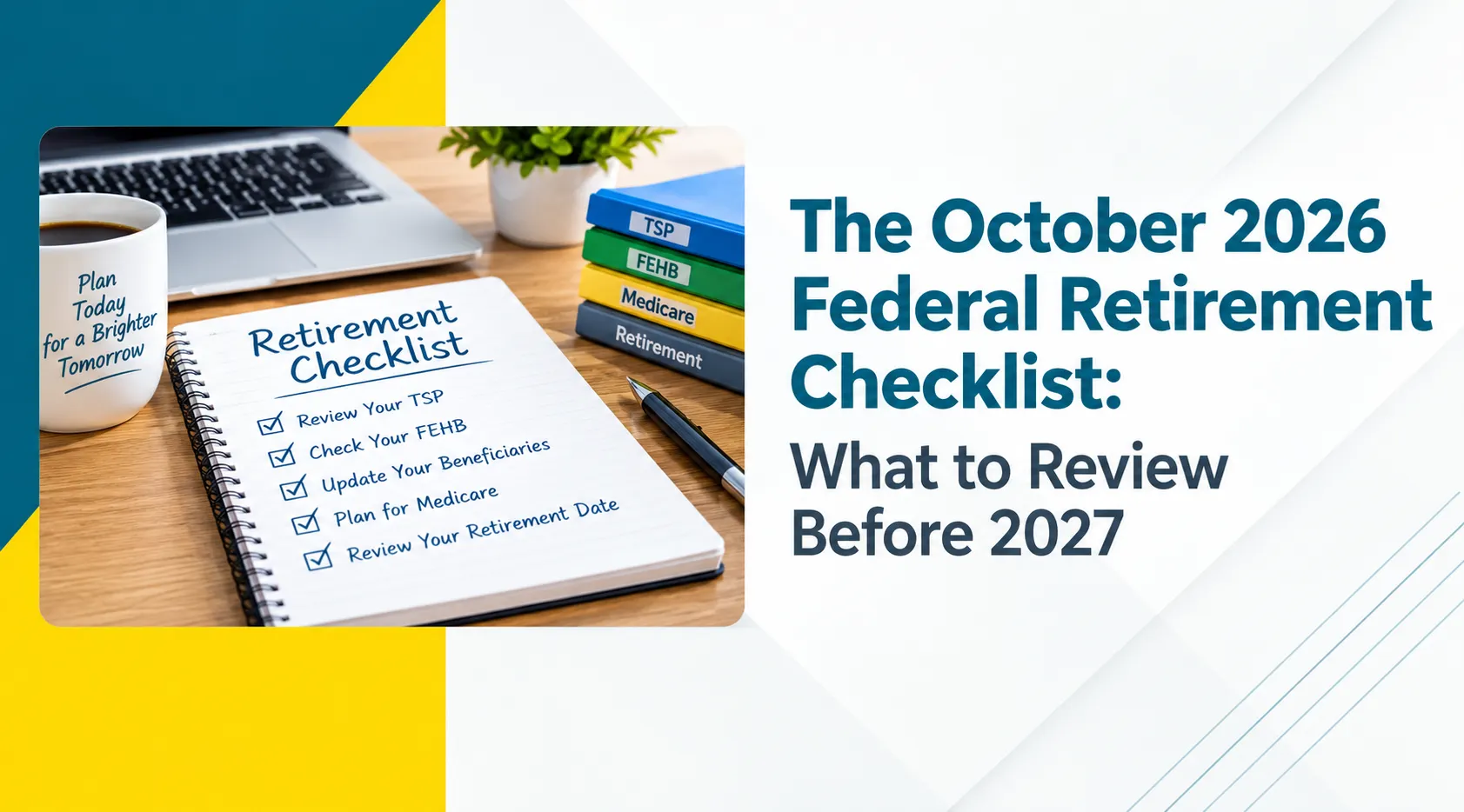
- Verify your Service Computation Date (SCD). Request a written annuity estimate from HR or OPM. Confirm every year of creditable civilian and military service, including any deposits or redeposits owed.
- Model your annuity under each applicable pathway. Compare numbers under VERA, DSR, MRA+10 immediate, MRA+10 postponed, and deferred retirement. CSRS-component employees have different age-reduction rules.
- Confirm your FEHB enrollment history. The applicable 5-year coverage test varies by pathway, and the waiver authority is narrow.
- Decide your TSP strategy. Keep the balance in the TSP, roll to an IRA, begin installments, or combine. The right choice depends on your age, tax situation, and whether you want Rule-of-55 access.
- Plan your bridge income. If a VSIP, severance, or lump-sum payment is involved, model the tax impact across two calendar years when possible.
- Reconcile Social Security timing. Decide whether to claim at 62, at Full Retirement Age, or later. Align the choice with the SRS cutoff and the earnings test.
- Update beneficiary designations. TSP, FEGLI, FERS, and unpaid compensation all use separate forms.
Reviewing your options with a planner who specializes in federal benefits can help you understand the potential trade-offs.
Reviewing Your Retirement Strategy With Confidence
A federal workforce change doesn't have to derail retirement, but it will usually change the shape of it. The FERS pathway you qualify for, the FEHB 5-year test, the TSP withdrawal rules, and the SRS eligibility criteria all interact. Reviewing your federal paycheck and estimated take-home pay before signing separation paperwork can help you understand the potential trade-offs.
Federal Pension Advisors, a retirement planning firm specializing in federal employee benefits, works with federal employees facing RIF, VERA, VSIP, and deferred resignation decisions. We compare each pathway side by side using current OPM and TSP figures. Schedule a federal benefits consultation to review your options with a planner who specializes in federal benefits.
Frequently Asked Questions
What happens to my federal pension if I'm laid off?
If a Reduction in Force separates you and you meet the age and service thresholds, you may qualify for Discontinued Service Retirement with an immediate annuity. If you have at least 5 years of creditable civilian service but don't qualify for an immediate annuity, your pension becomes a deferred retirement. According to OPM, it's payable at age 62, at age 60 with 20 years, or at MRA with 10 years.
Can I keep my FEHB after a RIF or VERA?
Yes, if you meet the applicable 5-year continuous-coverage requirement and retire on an immediate annuity, according to OPM. A pre-approved waiver of the 5-year rule may apply under specific conditions for employees separating under VERA, DSR, or a VSIP buyout. Confirm your eligibility with your agency HR office.
What is the difference between VERA and VSIP?
VERA is the Voluntary Early Retirement Authority, which lowers age and service thresholds so eligible employees can retire with an immediate annuity. VSIP is the Voluntary Separation Incentive Payment, a one-time cash buyout under 5 U.S.C. § 3523. According to OPM, agencies sometimes offer both together, but they produce different benefits, tax outcomes, and repayment obligations.
Can I collect FERS and Social Security at the same time?
Yes. Your FERS annuity is a separate benefit from Social Security, and you can collect both concurrently once you reach eligibility. FERS retirees under 62 who meet the specific SRS eligibility rules, including the one-full-calendar-year FERS service requirement, may also receive the FERS Special Retirement Supplement. The supplement bridges to age 62. MRA+10, deferred, and disability retirees aren't eligible.
What happens to my TSP if I accept an early-out?
Your TSP balance remains yours. You can leave it in the TSP, roll it to an IRA, take partial or installment withdrawals, or purchase a TSP life annuity. If you separate in or after the year you turn 55, you can take penalty-free TSP withdrawals under the Rule of 55, according to IRS and TSP guidance. Rolling the balance to an IRA ends that exception for the rolled funds.
How much notice does an agency have to give for a RIF?
Agencies generally must provide at least 60 full days of specific written notice before a RIF release under 5 CFR § 351.801. If the RIF results from circumstances that were not reasonably foreseeable, OPM may approve a shorter notice period of at least 30 full days.
Disclaimer:
This article is for educational and informational purposes only and does not constitute financial, legal, or tax advice. Federal retirement eligibility, pension benefits, TSP withdrawal options, and health and life insurance coverage depend on individual circumstances and applicable rules, which may change. Verify your eligibility and benefits with the U.S. Office of Personnel Management (OPM), your agency’s HR office, and other relevant official sources before making retirement decisions. Federal Pension Advisors is not affiliated with or endorsed by OPM or any U.S. government agency. Consider consulting qualified financial, tax, or legal professionals regarding your specific situation.

Colin David McLaughlin
Colin David McLaughlin grew up in Plymouth, MA, and graduated from Plymouth South High in 2009. He earned a bachelor’s degree in criminal justice from Bridgewater State University and a master’s degree in business administration with a concentration in IT Management from Southern New Hampshire University.