
.png)


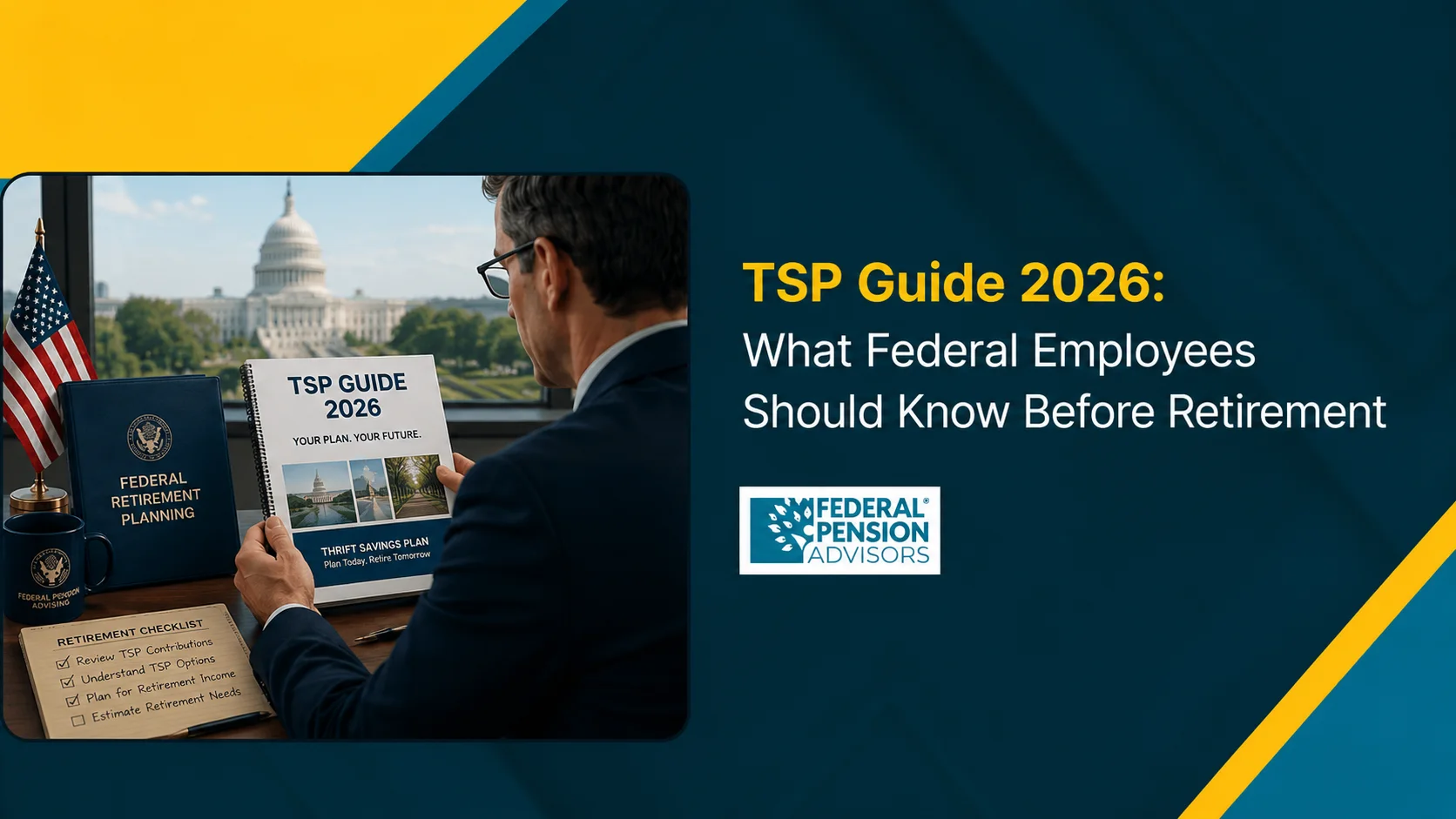
TSP Guide 2026: What Federal Employees Should Know Before Retirement
The Thrift Savings Plan (TSP) is the federal government's tax-advantaged retirement savings program. For many federal employees, it becomes one of the largest sources of retirement income alongside their pension and Social Security. This TSP Guide 2026 explains the contribution limits, agency matching, the Roth versus traditional decision, the investment funds, withdrawal rules, and how the TSP works with your Federal Employees Retirement System (FERS) pension. According to the IRS in Notice 2025-67, the 2026 elective deferral limit for the TSP is $24,500. That's the maximum you can contribute from your own pay during the year.
Federal Pension Advisors, a retirement planning firm specializing in federal employee benefits, wrote this guide. Every figure below is current for the 2026 plan year and sourced from the IRS, the Federal Retirement Thrift Investment Board (FRTIB), and the Office of Personnel Management (OPM).
Key Takeaways
- The 2026 TSP elective deferral limit is $24,500, according to IRS Notice 2025-67.
- FERS employees who contribute at least 5% of basic pay receive the full agency contribution: a 1% automatic contribution plus up to a 4% match.
- Workers age 50 and older can add $8,000 in catch-up contributions. Those age 60 to 63 can add $11,250 under the SECURE 2.0 Act.
- The TSP offers five individual funds (G, F, C, S, I) and a series of Lifecycle (L) target-date funds, all low-cost options.
- Beginning in 2026, high earners must make catch-up contributions as Roth, according to the FRTIB.
What Is the Thrift Savings Plan?
The Thrift Savings Plan (TSP) is a defined contribution retirement savings plan for federal civilian employees and members of the uniformed services. It works much like a private-sector 401(k). The FRTIB administers it as an independent federal agency.
You contribute a portion of your pay, choose how it's invested among a small set of low-cost funds, and the balance grows tax-advantaged until you withdraw it in retirement. The TSP is one of the three pillars of FERS retirement, alongside the FERS basic annuity and Social Security. Because your contributions and any agency money are invested in the market, your eventual balance depends on how much you save and how your investments perform.
How the TSP Fits Into FERS Retirement
The Federal Employees Retirement System (FERS) covers most federal employees hired after 1983, and it rests on three sources of income. The first is the FERS basic annuity, a defined-benefit pension based on your years of service and your High-3 average salary, which is the average of your highest three consecutive years of base pay. The second is Social Security, which FERS employees pay into and earn like any other worker.
The third is the TSP, the only one of the three you control directly through your own contributions and investment choices. The FERS pension is relatively modest compared with the older Civil Service Retirement System (CSRS), which covered many employees hired before 1984. So the TSP is designed to carry a larger share of your retirement income. Building a TSP balance large enough to supplement your pension is the core of FERS retirement planning.
2026 TSP Contribution Limits
The 2026 elective deferral limit is $24,500, according to IRS Notice 2025-67. This is the most you can contribute from your own salary across traditional and Roth contributions combined during the calendar year, up from $23,500 in 2025. Catch-up contributions let older workers save more on top of that limit.
The table below summarizes the 2026 TSP contribution limits 2026 as published by the IRS and the FRTIB.
The overall annual additions limit counts your contributions plus all agency contributions. According to the IRS, it rose to $72,000 for 2026, up from $70,000 in 2025. A new rule also takes effect this year. Beginning in 2026, the FRTIB states that catch-up contributions must be made as Roth if your prior-year wages from TSP-eligible positions exceed $150,000. To estimate how a given contribution rate affects your paycheck and long-term balance, a TSP calculator can model different scenarios.
How TSP Matching Works for FERS Employees
The federal TSP match gives FERS employees up to 5% of their basic pay in agency contributions when they contribute at least 5% themselves. The match has two parts: an automatic 1% agency contribution you receive even if you contribute nothing, plus a matching contribution on the money you put in. According to the FRTIB, the agency matches dollar-for-dollar on the first 3% of pay you contribute and 50 cents on the dollar for the next 2%.
So contributing 5% of your salary earns the full 5% agency contribution. Contributing less than 5% leaves part of this federal TSP match unclaimed.
One common and costly mistake is front-loading contributions to hit the $24,500 limit early in the year. Because matching is calculated each pay period, employees who max out before December can stop receiving the match for the remaining pay periods. Spreading contributions evenly across all 26 pay periods protects the full match. Your own contributions are always yours immediately, while agency matching contributions vest after three years of FERS service (two years for some positions), according to the FRTIB.
Traditional TSP vs Roth TSP
The difference between Traditional TSP and Roth TSP comes down to when you pay taxes. Traditional TSP contributions are made before tax, lowering your taxable income now, and you pay ordinary income tax when you withdraw the money in retirement. Roth TSP contributions are made after tax, giving you no deduction today, but qualified withdrawals in retirement, including all investment earnings, are completely tax-free once you're age 59½ and meet the holding requirement.
Your choice depends largely on whether you expect your tax rate to be higher now or in retirement. The comparison below outlines the core tradeoffs. For a deeper analysis, see our dedicated guide on Roth TSP vs Traditional TSP.
Here's a detail many federal employees miss: even if you contribute entirely to Roth, all agency matching contributions land in your account as traditional (pre-tax) money. Since the SECURE 2.0 Act took effect, the Roth balance is no longer subject to required minimum distributions during your lifetime, according to the FRTIB. If you have an existing traditional balance you want to shift, a TSP in-plan Roth conversion is one strategy to weigh with a tax professional.
TSP Funds Explained
The TSP offers five individual TSP funds, each tracking a specific index or asset class, according to the FRTIB. The Government Securities Investment Fund (G Fund) holds specially issued U.S. Treasury securities and never loses nominal value, making it the most conservative option. The Fixed Income Index Investment Fund (F Fund) tracks a broad U.S. bond index.
The Common Stock Index Investment Fund (C Fund) tracks the S&P 500, representing large U.S. companies. The Small Capitalization Stock Index Investment Fund (S Fund) covers small and mid-size U.S. companies. The International Stock Index Investment Fund (I Fund) tracks developed international markets.
One major advantage of the TSP is its low-cost fund structure. The FRTIB reports that TSP funds carry low expenses compared with many retail retirement funds, which compound into meaningful savings over a multi-decade career. Low fees mean more of your money stays invested and works for you.
Lifecycle Funds vs Individual Funds
Lifecycle (L) Funds are professionally managed target-date funds that hold a diversified mix of the five individual TSP funds. They automatically shift toward more conservative investments as your target retirement date approaches. You pick the L Fund closest to the year you expect to begin withdrawals, and the fund handles the rebalancing for you.
This "set it and forget it" structure suits employees who prefer not to manage their own allocation. Choosing individual funds, by contrast, gives you full control to build a custom mix of G, F, C, S, and I. It also requires you to rebalance periodically yourself and to resist reacting emotionally to market swings. The L Funds carry no additional fee beyond the underlying funds' expense ratios, according to the FRTIB. If you prefer not to actively manage investments, an age-appropriate Lifecycle Fund may be a practical hands-off option.
How Much Should Federal Employees Contribute?
As a starting point, contribute at least 5% of your basic pay to capture the full agency contribution. Contributing less may leave part of the agency contribution unclaimed. Beyond that floor, the right amount depends on your retirement timeline, other savings, and how much income you'll need to supplement your FERS pension and Social Security.
To reach the full $24,500 limit in 2026 spread evenly across 26 pay periods, you'd contribute roughly $943 per pay period, according to federal payroll guidance. A practical approach is to start at 5%, then raise your contribution by one or two percentage points with each pay raise until you reach a level you're comfortable with. Modeling your number with a TSP calculator helps you see whether your current rate is on track for the retirement income you want.
Common TSP Mistakes to Avoid
Several avoidable errors can cost federal employees money over a career. The most expensive is contributing less than 5% and leaving agency matching on the table. The second is front-loading contributions early in the year and triggering an unintended pause in matching, as described above.
A third is parking a long career's savings entirely in the G Fund. The G Fund protects principal, but it may not provide enough long-term growth for younger investors if used alone, which can erode purchasing power over time. A fourth common mistake is reacting to market downturns by moving everything into the G Fund, which can lock in losses and miss the recovery. Finally, many employees skip the work of understanding each acronym and rule before acting. Knowing how the match, the limits, and the funds actually work is the foundation of good decisions.
TSP Withdrawal Rules
You can generally begin withdrawing from your TSP without the early-withdrawal penalty once you reach age 59½, and standard separated-employee withdrawals are available after you leave federal service. The TSP allows installment payments, single partial withdrawals, and full withdrawals, and you can take separate elections from your traditional and Roth balances.
These TSP withdrawal rules include an important exception. Federal employees who separate from service in or after the year they turn 55 (age 50 for certain public-safety positions) can access their TSP without the 10% early-withdrawal penalty under the age-55 rule. Earlier access is possible through Substantially Equal Periodic Payments under IRS rule 72(t), but breaking that schedule triggers retroactive penalties. Because withdrawal sequencing affects your lifetime taxes, the rules deserve careful planning. Our full TSP withdrawal guide walks through each option in detail.
TSP and Taxes in Retirement
How your TSP is taxed in retirement depends on whether the money is traditional or Roth. Traditional TSP withdrawals are taxed as ordinary income in the year you take them, which can push you into a higher bracket if you withdraw large amounts at once. Qualified Roth TSP withdrawals are entirely tax-free, including earnings, once you're age 59½ and have met the five-year holding requirement.
Required minimum distributions apply to your traditional balance once you reach the applicable RMD age. Under the SECURE 2.0 Act, though, the Roth balance is exempt from RMDs during your lifetime, according to the FRTIB. Coordinating which balance you draw from each year, and in what order relative to your pension and Social Security, is one of the most valuable parts of retirement tax planning. Federal Pension Advisors, a retirement planning firm specializing in federal employee benefits, helps federal employees evaluate options for structuring withdrawals to manage their lifetime tax exposure.
How to Use Your TSP With FERS Pension and Social Security
Your TSP is meant to work in concert with the other two pillars of FERS retirement, not in isolation. The FERS basic annuity provides a predictable lifetime income stream and may receive cost-of-living adjustments under FERS rules once you're eligible. Social Security adds a second guaranteed stream once you claim it.
The TSP fills the gap between those guaranteed sources and the income you actually need, and it gives you flexibility the other two lack. You decide how much to withdraw and when. A common strategy is to use TSP withdrawals to bridge the years between retirement and the age at which you claim Social Security, letting the Social Security benefit grow. Because the FERS pension and Social Security are largely fixed once they begin, the TSP often becomes one of the most flexible parts of retirement-income planning. Federal Pension Advisors, a retirement planning firm specializing in federal employee benefits, can help review and coordinate all three sources.
When to Review Your TSP Strategy
Review your TSP allocation and contribution rate at least once a year, and any time a major life or career event occurs. Promotions and pay raises are natural moments to increase your contribution percentage. Approaching retirement, generally within five to ten years, is the time to consider shifting toward a more conservative allocation or an age-appropriate Lifecycle Fund.
Marriage, divorce, the birth of a child, or a change in your spouse's retirement savings can all change how much you should be saving. Otherwise, resist the urge to tinker constantly. Frequent changes driven by market headlines tend to hurt long-term returns. A steady, automatic contribution combined with an annual review is a common approach for many federal employees, and it remains the backbone of sound TSP retirement planning.
Frequently Asked Questions
1. What is the maximum TSP contribution for 2026?
The 2026 elective deferral limit is $24,500, according to IRS Notice 2025-67. Participants age 50 and older can add $8,000 in catch-up contributions for a total of $32,500. Those who turn 60 to 63 during 2026 can add $11,250 under the SECURE 2.0 Act, for a total of $35,750.
2. How does TSP matching work for federal employees?
FERS employees receive an automatic 1% agency contribution plus matching when they contribute. According to the FRTIB, the agency matches dollar-for-dollar on the first 3% of pay and 50 cents per dollar on the next 2%. Contributing at least 5% earns the full 5% agency contribution each pay period.
3. Should I choose Roth or Traditional TSP?
Choose Roth TSP if you expect a higher tax rate in retirement or are early in your career, since qualified withdrawals are tax-free. Choose Traditional TSP if you're in a high bracket now and expect a lower rate later. Many federal employees split contributions between both to diversify future tax exposure.
4. Can I withdraw from my TSP before age 59½?
Yes, but withdrawals before age 59½ generally face a 10% early-withdrawal penalty. Employees who separate in or after the year they turn 55 can avoid the penalty under the age-55 rule. Substantially Equal Periodic Payments under IRS rule 72(t) offer another penalty-free path with strict requirements.
5. Are Roth TSP withdrawals taxed in retirement?
No. Qualified Roth TSP withdrawals are completely tax-free, including all investment earnings, once you're age 59½ and have held the account at least five years, according to the FRTIB. Under the SECURE 2.0 Act, the Roth TSP balance is also exempt from required minimum distributions during your lifetime.
6. How much should I contribute to my TSP?
Contributing at least 5% of your basic pay can help you capture the full agency match. Beyond that, the right amount depends on your retirement goals and other savings. To reach the $24,500 limit in 2026, you'd contribute about $943 per pay period.
Disclaimer
This article is provided by Federal Pension Advisors, a retirement planning firm specializing in federal employee benefits, for general educational purposes only. It is not financial, tax, or legal advice, and it does not account for your individual circumstances. Contribution limits, benefit rules, and tax thresholds change and are set by the IRS, the FRTIB, and OPM; verify all figures against IRS.gov, TSP.gov, and OPM.gov for the current plan year. Consult a qualified financial planner or tax professional before making decisions about your retirement accounts.


Get Updated
Subscribe to our weekly updates for the latest on retirement planning, federal benefits, exclusive webinars, and more!

Brad Myers
Brad Myers is a Federal Benefits Specialist with 17 years of experience helping federal employees better understand and maximize their retirement benefits. As a ChFEBC professional, Brad specializes in FERS and CSRS retirement planning, pension maximization strategies, Thrift Savings Plan (TSP) guidance, and federal employee benefits education designed to support long-term financial security.

Download Federal Retirement: Step-by-step Checklist
This comprehensive guide will help you understand your federal benefits, optimize your savings, and plan for a comfortable future.
Recent Post's