Retiring in 2027? Why Your Retirement Date Could Matter More Than You Think
- Retiring in 2027? Your retirement date may affect your annual leave payout, annuity payment timing, tax-year income, and other federal retirement planning decisions. The best date depends on your individual circumstances.
- Eligible retirees are expected to receive a 3.6% CSRS COLA and a 2.6% FERS COLA in January 2027. These adjustments apply to eligible annuities that began in 2026 or earlier; employees retiring in 2027 will generally receive their first annual COLA based on the December 2027 adjustment.
- The 2027 TSP contribution limits are not yet official. Current third-party estimates suggest a $25,500 regular contribution limit, an $8,500 catch-up limit for eligible participants aged 50 and older, and an $11,750 catch-up limit for participants aged 60–63. Confirm the final amounts with the IRS and TSP.
- FEHB enrollee premiums are increasing by an average of 10.9% for the 2027 plan year, according to OPM. Open Season runs from November 9 through December 14, 2026, making it important to compare plan options and costs before retiring.
- The FERS Annuity Supplement remains available under current rules for eligible retirees, but legislative proposals could affect future benefits. Before choosing a retirement date, review your age, service history, High-3 salary, annual leave balance, FEHB eligibility, and expected retirement income with your HR office or a qualified federal benefits specialist.
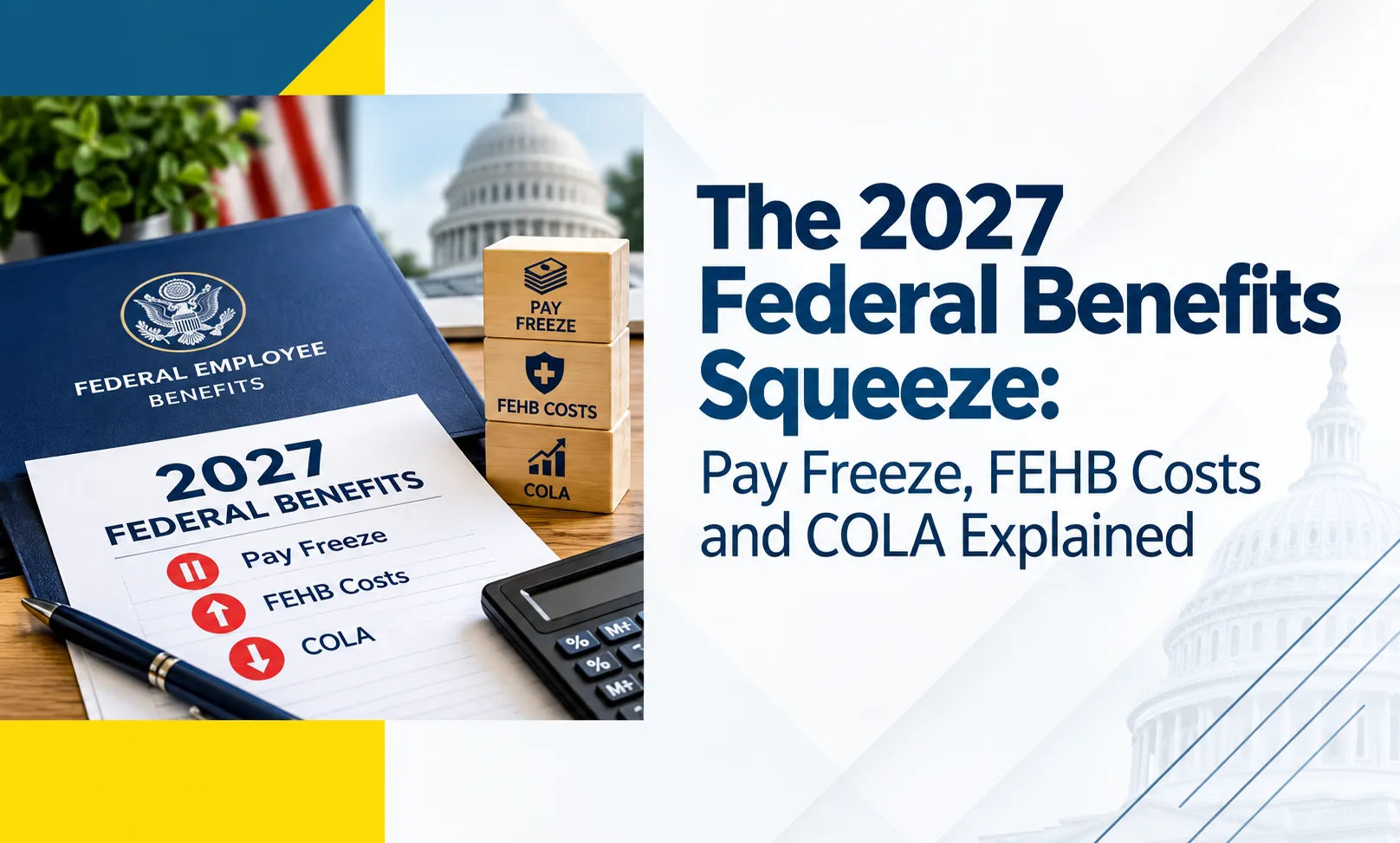
Retiring in 2027? Your separation date can affect your retirement income in ways that are easy to overlook. 2027 is landing in an unusual combination of a proposed federal civilian pay freeze, a split Cost-of-Living Adjustment (COLA) between the two main federal retirement systems, projected but not yet official Thrift Savings Plan (TSP) contribution increases, another above-average Federal Employees Health Benefits (FEHB) premium increase, and ongoing legislative discussion about the FERS Annuity Supplement.
The right date depends on your own facts: your age, retirement system, High-3 salary, annual leave balance, FEHB enrollment history, and whether specific pay or legislative changes become final. This guide, prepared by Federal Pension Advisors, a retirement planning firm specializing in federal employee benefits, lays out the latest 2027 figures. It separates confirmed amounts from proposals and projections and names the questions that should drive your date decision. For additional context, see our guide to the federal retirement backlog in 2026.
Why 2027 Is a Year to Plan Carefully
Four moving parts are hitting at once in 2027.
A proposed civilian pay freeze. According to Federal News Network, President Trump issued an alternative pay plan in August 2026, setting the 2027 civilian pay raise at 0% for most federal employees. The plan proposes a 3.8% special salary-rate increase for covered federal law enforcement personnel.
The U.S. Office of Personnel Management (OPM) will implement that increase through its special salary-rate authority rather than as a universal law-enforcement raise. Coverage, timing, and salary-cap limits apply. Federal employees considering major financial decisions can also learn about using a TSP loan to buy a house.
Final 2027 pay schedules are expected closer to year-end. General pay adjustments depend on the applicable executive order, while OPM will announce covered law-enforcement positions and special-rate tables after agency consultations. Congress has previously overridden a proposed freeze through appropriations.
A split COLA between the two main federal retirement systems. According to the Social Security Administration (SSA), the 2027 Social Security COLA announced on October 14, 2026, is 3.6%.
OPM administers the matching federal annuity adjustments under 5 U.S.C. § 8340 (CSRS) and § 8462 (FERS). Eligible CSRS retirees receive the full 3.6%, and eligible FERS retirees receive a reduced "diet" COLA of 2.6%. For more details, see the 2027 FERS COLA estimate. OPM publishes the official amounts in its annual Benefits Administration Letter.
Rising health insurance costs. According to OPM's Open Season Highlights for the 2027 Plan Year, the enrollee share of FEHB premiums is rising an average of 10.9% in 2027. That follows a 12.3% average increase for 2026.
Those are program-wide averages. The actual change for any specific plan and enrollment tier varies, and your household impact depends on plan choice, enrollment tier, and whether government contribution rules apply.
Legislative uncertainty. The FERS Annuity Supplement, which many pre-62 FERS retirees count on, has been proposed for elimination in budget cycles since 2025. None of those proposals is current law. Federal employees whose plans depend on the supplement should still know what the current proposals say.
Each factor affects retirement decisions differently, so comparing dates against your individual circumstances is more useful than relying on a universal rule.
Key 2027 Numbers You Need to Know
Before setting a date, these are the current figures to work from.
Table 1. Federal retirement figures: 2026 vs. 2027 (as of October 23, 2026)
| Figure | 2026 | 2027 | Source |
|---|---|---|---|
| Civilian base pay raise (most employees) | 1.0% (final) | 0% (White House alternative pay plan; not final until Dec. executive order) | Federal News Network, Aug. 2026 |
| Law enforcement officer pay | 3.8% special salary-rate increase | Proposed 3.8% special salary-rate increase for covered law-enforcement personnel (coverage and caps apply) | OPM; Federal News Network |
| Social Security COLA | 2.8% | 3.6% | SSA, Oct. 14, 2026 |
| CSRS annuity COLA | 2.8% | 3.6% | OPM Benefits Administration Letter, per 5 U.S.C. § 8340 |
| FERS annuity COLA (eligible retirees) | 2.0% | 2.6% | OPM Benefits Administration Letter, per 5 U.S.C. § 8462 |
| TSP elective deferral limit | $24,500 (official, IRS Notice 2025-67) | ~$25,500 (third-party estimate; not official) | TheFinanceBuff estimate; IRS 2027 notice pending |
| TSP catch-up (age 50+) | $8,000 (official) | ~$8,500 (third-party estimate; not official) | TheFinanceBuff estimate; IRS 2027 notice pending |
| TSP SECURE 2.0 catch-up (ages 60–63) | $11,250 (official) | ~$11,750 (third-party estimate; not official) | TheFinanceBuff estimate; IRS 2027 notice pending |
| FERS Supplement earnings limit | $24,480 | $25,560 | SSA, Oct. 2026 (same limit OPM applies to the supplement test) |
| FEHB enrollee-share average increase | 12.3% | 10.9% | OPM, 2027 Open Season Highlights |
| FEHB Open Season (for 2027 coverage) | — | Nov. 9–Dec. 14, 2026 | OPM |
The TSP figures remain third-party estimates until the IRS publishes the official 2027 cost-of-living notice, typically in November 2026. Use the IRS's official figures for your final planning.
How the 2027 COLA Actually Works
The 2027 COLA is the headline retirement-income number this year. How it applies to any one retiree depends on retirement system, age, annuity commencement date, and which proration rules apply. Alongside COLA considerations, federal employees can also review how to maximize TSP agency matching in 2026 as part of their broader retirement savings strategy.
Three separate rules interact here. Don't collapse them into one.
Rule 1: Retiree COLA eligibility by system
CSRS retirees are COLA-eligible from the start of their annuity.
Eligible FERS retirees receive the 2.6% adjustment. This group generally includes retirees age 62 or older plus retirees under special provisions (law enforcement officers, firefighters, air traffic controllers), survivors, and most disability annuitants.
Regular non-special-provision FERS retirees under age 62 aren't yet COLA-eligible. Their basic annuity COLA generally doesn't begin until the January following the year they turn 62.
Rule 2: First-year proration when the retiree is already COLA-eligible
According to OPM's annual Benefits Administration Letter and the CSRS and FERS Handbook (Chapter 2), a COLA-eligible retiree who hasn't been on the annuity roll for a full year as of December 1 receives a prorated COLA.
The amount is one-twelfth of the full COLA rate for each month the annuity has been in payment before December 1. OPM publishes a reference table each year showing exact prorated percentages by annuity-commencement month.
Important timing note for 2027 retirees. The 3.6% CSRS and 2.6% FERS percentages announced in October 2026 are the December 1, 2026 COLA. They apply to annuities that commenced during 2026 or earlier.
An employee retiring in 2027 isn't affected by this adjustment. Your first annual COLA will be the December 1, 2027 adjustment, whose percentage won't be announced until October 2027.
The illustration below shows the mechanics of first-year proration using the known December 2026 COLA. The same mechanics will apply to your first-year proration against the not-yet-known December 2027 percentage.
Illustration only: December 2026 CSRS COLA (3.6%) applied to annuities that commenced during 2026. Not applicable to a 2027 retirement. See OPM's annual Benefits Administration Letter for the official table.
| Annuity commencement month (2026) | Full months in payment by Dec 1, 2026 | Prorated share of the 3.6% CSRS COLA |
|---|---|---|
| January 2026 | 11 | 11/12 of 3.6% ≈ 3.3% |
| April 2026 | 8 | 8/12 of 3.6% = 2.4% |
| July 2026 | 5 | 5/12 of 3.6% = 1.5% |
| November 2026 | 1 | 1/12 of 3.6% = 0.3% |
Rule 3: The special FERS pre-62 rule
If you're a regular FERS retiree who retires before age 62, you aren't COLA-eligible on your basic annuity until the January following the year you turn 62.
When that first FERS COLA finally arrives, it's generally applied as the full COLA. Rule 2 first-year proration doesn't apply, because you've already been on the annuity roll for more than a year by the time you become COLA-eligible.
A FERS retiree who retires at or after age 62 is COLA-eligible immediately and so is subject to Rule 2 proration in the first year.
The practical takeaway: for most pre-62 FERS retirees, retiring earlier in 2027 doesn't produce an earlier or larger first FERS COLA. Eligibility turns on age 62, not on retirement date.
For CSRS retirees and FERS retirees already 62 or older, Rule 2 proration means the specific month of retirement will affect the first adjustment. That percentage will be set by the October 2027 COLA announcement.
The FERS Supplement in 2027: Current Rules and Open Questions
The FERS Annuity Supplement, also called the Special Retirement Supplement (SRS), is a monthly payment designed to approximate the Social Security benefit a FERS retiree would have earned from their federal service. It's paid only to eligible retirees and stops at age 62. When planning for retirement, it's also important to review your health insurance costs and understand the differences between FEHB Self Plus One and Self and Family coverage.
Eligibility, in summary
Eligibility depends on the applicable immediate-retirement provision under FERS and on qualifying FERS service. Confirm your eligibility against OPM's Special Retirement Supplement guidance.
The supplement generally goes to retirees who leave with an immediate, unreduced annuity before age 62. That includes a FERS employee retiring at MRA with 30 years, at age 60 with 20 years, or under special provisions.
You must also have at least one full calendar year of service creditable under FERS computation rules. Meeting the age and service requirements for retirement alone doesn't guarantee eligibility for the supplement.
Several groups aren't eligible: MRA+10 retirees, deferred retirees, CSRS employees, and anyone retiring at age 62 or older. This list isn't exhaustive, so verify your specific eligibility with OPM.
The 2027 status
The supplement remains available. According to the Congressional Research Service, Section 90001 of the One Big Beautiful Bill Act (H.R. 1), as passed by the House in May 2025, would have eliminated the supplement effective January 1, 2028, for individuals not already entitled to it. Federal employees should also understand how Required Minimum Distributions (RMDs) affect their TSP retirement savings as part of their broader retirement planning.
The Senate struck that provision before the bill was signed. No enacted law currently eliminates the supplement.
The idea has reappeared in several budget discussions since. Whether a future bill revives it is a policy question, not a prediction (status as of October 23, 2026).
The 2027 earnings test
The supplement is subject to an annual earnings test tied to the Social Security retirement earnings limit for beneficiaries under full retirement age. According to the SSA's October 2026 release, that limit is $25,560 for 2027, up from $24,480 in 2026.
According to OPM's FERS Annuity Supplement Survey guidance, if your earned income exceeds the limit after you reach your Minimum Retirement Age (MRA), the supplement is reduced by $1 for every $2 over the limit.
OPM's guidance defines what counts. Wages and net self-employment earnings (after business expenses) generally count. FERS annuity payments, TSP distributions, Social Security disability benefits, investment income, and most pensions generally don't.
The reduction applies to the supplement itself. It doesn't reduce the basic FERS annuity. Confirm specifics against OPM's published definition before you structure post-retirement work.
The timing lag
OPM mails the annual earnings survey in the spring. OPM reviews reported earnings and adjusts the supplement as applicable. Check the current OPM survey instructions for the reporting deadline and the effective date of any reduction.
In practice, earnings over the limit in one year affect supplement payments in the following year, not the year in which the earnings occurred.
Special-provision retirees
Law enforcement officers, firefighters, and air traffic controllers who retire under special provisions aren't subject to the earnings test until they reach their MRA.
Once they reach MRA, the earnings test applies to them the same as to regular FERS retirees. The supplement itself continues until age 62 in both groups.
TSP Contribution Strategy for a 2027 Retirement
The TSP, the federal government's tax-advantaged retirement savings program, is a central lever in a final-year retirement plan. Understanding your TSP investment options, including the Mutual Fund Window, can help you evaluate your choices. The 2027 figures should be treated as estimates until confirmed.
Projected limits. Third-party estimates from TheFinanceBuff and other practitioners suggest the 2027 elective deferral limit rising to about $25,500 from $24,500 in 2026. Age-50 catch-up is projected at $8,500 and the SECURE 2.0 Act "super catch-up" for ages 60–63 at $11,750.
These numbers aren't official. The IRS publishes final 2027 retirement plan limits in its annual cost-of-living notice, usually in November 2026. Use the published figures for your final planning.
Mandatory Roth catch-up for higher earners, when it took effect. The SECURE 2.0 Roth catch-up requirement took effect January 1, 2026. It applies to catch-up contributions made by participants age 50 or older whose prior-year FICA wages from their TSP-sponsoring employer exceeded an indexed threshold.
The applicable threshold. According to IRS Notice 2025-67, the threshold for the 2026 plan year is $150,000. If your 2025 FICA wages (Box 3 of Form W-2) from your TSP-sponsoring employer exceeded $150,000, your 2026 catch-up contributions must be made on a Roth basis.
The threshold is indexed annually. The applicable 2027 threshold, based on 2026 wages, will appear in the IRS 2027 cost-of-living notice.
When the final regulations become applicable. Separately from the requirement's effective date, the IRS/Treasury final regulations under SECURE 2.0 become applicable for most plans in 2027. The requirement itself has been in effect since January 1, 2026, and the 2027 applicability of the final regulations doesn't change that start date. Federal employees can use a TSP calculator to estimate their retirement savings and evaluate their long-term planning needs.
If you're at or near the threshold, check the TSP website and your payroll office for the applicable 2027 figure and TSP implementation details before the first 2027 pay period.
Final-year mechanics
Three practical items matter in a retirement year:
- Contribution timing. If you want to reach the annual limit before retirement, adjust your election early enough to spread contributions across remaining pay periods. Payroll systems stop deferrals once the limit is reached.
- Agency contributions. FERS participants receive agency automatic (1%) contributions each pay period in which they're in a pay status. Agency matching (up to an additional 4%) requires at least a 5% employee contribution during the pay period to capture the full match. The specific amount captured depends on pay rate, pay-period schedule, and your contribution election.
- Election type. If 2026 wages put you above the applicable Roth catch-up threshold, your 2027 catch-up contributions must go to the Roth TSP. Confirm with your payroll office before the plan year begins.
Specific dollar outcomes depend on your pay, pay-period schedule, and plan features. These mechanics are general, not guarantees of a dollar gain from any particular date.
FEHB and Open Season Before You Retire
If you plan to retire in 2027, your FEHB plan choice during the current Open Season deserves careful review. Alongside reviewing your health coverage, you may also want to check the September 2026 TSP fund performance to better understand how your retirement investments have performed. One common misconception needs to be addressed up front.
The five-year rule and the Open Season rule are separate. To continue FEHB coverage into retirement, you must generally be enrolled in FEHB for the five years of service immediately before your retirement date, or since your first opportunity to enroll.
Once that eligibility is established, OPM lets annuitants change FEHB enrollment during each year's Open Season and make certain changes outside Open Season for qualifying life events.
The plan you have on the day you retire isn't a lifetime lock-in. You can change plans in future Open Seasons as an annuitant.
A caution about canceling coverage. OPM also lets annuitants cancel FEHB coverage. A cancellation by an annuitant generally can't be reversed later. Reenrollment after cancellation is only permitted in specific, limited circumstances defined by OPM. Confirm the consequences with OPM before you cancel.
Why Open Season still matters for 2027 retirees. According to OPM, Open Season for the 2027 plan year runs November 9 through December 14, 2026. Nine FEHB plans and one Postal Service Health Benefits (PSHB) plan won't be available in 2027, so enrollees in those plans must select a new plan.
According to OPM's 2027 Open Season Highlights, the enrollee-share premium increase averages 10.9% program-wide. Plan comparisons matter more this year than in low-increase years.
Starting retirement with a plan that fits your post-retirement medical needs and a fixed-income budget is easier when you choose deliberately during this Open Season rather than defaulting into your current plan. If you need to change later, you can do so in a subsequent Open Season.
Picking the Right Day: Late 2027 vs. Early 2028
For FERS employees, retirement timing can affect several factors:
- Annual leave payout: The payment depends on your unused leave, applicable pay rates, and rules in effect during the projected leave period.
- Interim annuity: Your retirement date affects when interim and full annuity payments arrive.
- Annuity commencement: Voluntary FERS annuities generally begin the first day of the month after separation.
- Tax-year impact: Retiring in December or January may shift leave payouts and other income between tax years.
Bottom line: Compare both dates using your actual pay, leave balance, annuity estimate, and tax situation. No single retirement date is best for everyone.
Legislative Items Worth Monitoring (status as of October 23, 2026)
Three items could still shift the 2027 picture, each with its own status and uncertainty:
- The FAIR Act (Federal Adjustment of Income Rates Act). According to Federal News Network, the bill was reintroduced in 2026 proposing a 4.1% average 2027 pay raise. It hasn't advanced out of committee. Whether it passes is unknown.
- Appropriations overrides. Congress has, on prior occasions, overridden a presidential pay freeze through spending legislation. Whether that happens for 2027 is unknown.
- Future FERS Supplement proposals. The supplement survived the 2025 One Big Beautiful Bill Act, but similar proposals could reappear in future budget cycles. These remain hypothetical until enacted.
Confirm current status immediately before any date decision. Legislative conditions can change quickly.
Final Thoughts: Why 2027 Rewards Individualized Planning
A 2027 retirement isn't inherently better or worse than one in a nearby year. The specific combination of a proposed civilian pay freeze, a split COLA structure, pending TSP limit changes, continued FEHB premium growth, and ongoing legislative discussion makes this year unusually sensitive to individual facts. Schedule a retirement planning consultation to discuss how these developments may affect your individual federal retirement plans.
The right retirement date depends on your retirement system, age at separation, High-3 salary, leave balance, FEHB history, TSP position, and tolerance for legislative uncertainty. There is no universal rule.
You can compare potential retirement dates using your own service history, annuity estimates, leave balance, and expected income. Federal Pension Advisors, a retirement planning firm specializing in federal employee benefits, can help model those comparisons. No analysis can guarantee future government pay, COLA, or legislative outcomes. A careful review can make the trade-offs for a given date explicit, so you decide deliberately.
Before you file your SF-3107, confirm the current OPM, TSP, and SSA figures. Consider attending our TSP webinars to learn more about your retirement benefits, and book a consultation to discuss your retirement date with a qualified federal benefits specialist or your HR benefits office.
Frequently Asked Questions
When can I qualify for an immediate, unreduced FERS retirement annuity?
An immediate, unreduced FERS annuity is generally available at age 62 with 5 years of service, age 60 with 20 years, or at the Minimum Retirement Age (MRA, 55–57 depending on birth year) with 30 years. MRA+10 retirement is available with 10 years of service but may carry a permanent age-based reduction. Confirm your specific eligibility with OPM or your HR office.
What is the 2027 COLA for federal retirees?
The December 2026 COLA, reflected in January 2027 payments, is 3.6% for eligible CSRS retirees and 2.6% for eligible FERS retirees, per OPM COLA rules and the SSA's October 14, 2026 announcement. That adjustment applies to annuities that commenced during 2026 or earlier. If you retire in 2027, you won't receive it. Your first annual COLA will be the December 2027 adjustment, announced in October 2027.
Will I still get the FERS Supplement if I retire in 2027?
Yes, if you're eligible. The FERS Annuity Supplement remains available in 2027 for retirees who meet the eligibility rules. Those include retiring under a qualifying immediate-retirement provision and having at least one full calendar year of service creditable under FERS. MRA+10 and deferred retirees don't qualify. A proposed elimination in the 2025 One Big Beautiful Bill Act was removed before enactment.
How much can I contribute to the TSP in 2027?
The 2027 TSP contribution limits aren't yet official. Third-party estimates suggest a regular limit of about $25,500, an age-50 catch-up of $8,500, and a SECURE 2.0 catch-up of $11,750 for ages 60 through 63. The IRS is expected to publish the final 2027 figures in its November cost-of-living notice.
Will federal employees get a pay raise in 2027?
Most civilian federal employees are currently slated for a 0% pay raise in 2027 under the alternative pay plan the White House issued in August 2026, according to Federal News Network. A 3.8% special salary-rate increase is proposed for covered federal law enforcement personnel, subject to OPM coverage rules and pay caps. Final 2027 pay rates aren't set until the president signs the December executive order.
How much will FEHB premiums increase in 2027?
According to OPM's 2027 Open Season Highlights, the enrollee share of FEHB premiums increases an average of 10.9% in 2027. That's a program-wide average, and the actual increase for any specific plan and enrollment tier varies. FEHB Open Season for the 2027 plan year runs November 9 through December 14, 2026.
Disclaimer
This article is for educational and informational purposes only and does not constitute financial, legal, or tax advice. Federal retirement benefits, pay adjustments, COLA rates, TSP contribution limits, and legislative provisions may change. Verify current information with OPM, TSP, SSA, and the IRS, and consult qualified professionals regarding your individual circumstances.

Colin David McLaughlin
Colin David McLaughlin grew up in Plymouth, MA, and graduated from Plymouth South High in 2009. He earned a bachelor’s degree in criminal justice from Bridgewater State University and a master’s degree in business administration with a concentration in IT Management from Southern New Hampshire University.