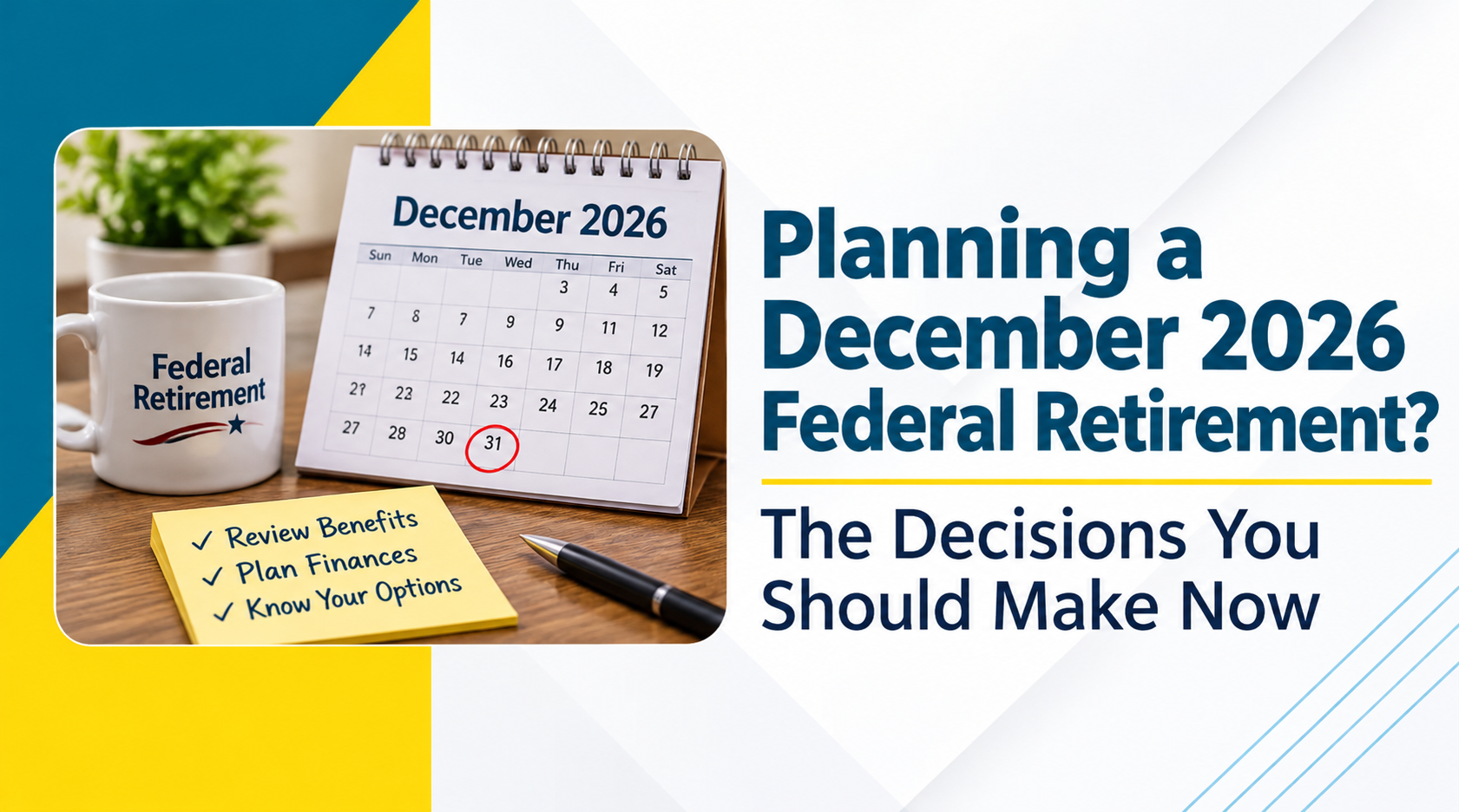
Planning a December 2026 federal retirement means making six time-sensitive decisions in the next few weeks. Those six decisions are: locking in your exact retirement date, choosing your 2027 Federal Employees Health Benefits (FEHB) coverage before Open Season closes December 14, 2026, finalizing your 2026 Thrift Savings Plan (TSP) contributions, verifying your service record with the U.S. Office of Personnel Management (OPM), planning for the income gap before your first full annuity check, and confirming your Social Security, survivor, and life insurance elections.
Each decision has a hard calendar deadline. Reversing a wrong choice after separation is either expensive or impossible.
This guide, updated November 2026, walks through each one in the order a federal employee should handle them.
Planning a December 2026 Federal Retirement: Why the Next Six Weeks Matter
A December 2026 federal retirement looks simple on paper. You pick a date, hand in the paperwork, start the next chapter. In practice, it concentrates five independent decision tracks into one narrow window.
Open Season for the 2027 Federal Benefits plan year runs November 9 through December 14, 2026, according to OPM, the U.S. Office of Personnel Management. The 2026 leave year ends January 9, 2027, as published in OPM's leave year table.
According to the Internal Revenue Service (IRS) in Notice 2025-67, the 2026 TSP elective deferral limit is $24,500. Your remaining pay periods are the last chance to hit that cap. Your retirement application will land at OPM during one of its busier processing windows.
Each of these calendars is independent, and together they define whether your first year in retirement is comfortable or stressful. The right sequence is simple: pick the date, make the Open Season election, pace your TSP contributions, scrub the service record, model the income gap, and submit the paperwork. As part of reviewing your TSP strategy, understand how the TSP Mutual Fund Window works and whether its investment options fit your retirement goals. The sections below work through each in order.
Federal Pension Advisors, a retirement planning firm specializing in federal employee benefits, works with federal employees through this exact sequence every fall.
Choose the Right December 2026 Retirement Date
The best federal retirement date aligns the end of a pay period, the end of a calendar month, and your personal tax and leave priorities. For a late-2026 target, two dates realistically remain in play: December 31, 2026 and January 9, 2027. October 31, 2026 is already past and appears below only for historical comparison.
Under the Federal Employees Retirement System (FERS), the annuity does not begin to accrue until the first day of the month after separation. A retirement on December 31, 2026 means pension accrual starts January 1, 2027.
According to FedWeek, December 31 remains the most popular federal retirement date because it allows the employee to remain on the payroll through the end of the calendar year and starts the pension the very next day.
Here's the complication: December 31, 2026 falls on a Thursday, mid-pay period under every major federal payroll calendar.
According to OPM's annual leave accrual schedule, employees who separate mid-period may forfeit the leave they would otherwise have accrued at the end of that period. That lost accrual runs 4, 6, or 8 hours depending on years of service and leave category.
January 9, 2027, the end of the 2026 leave year, captures that final accrual. It pushes pension accrual start to February 1 and the first full check further into the first quarter.
Here is how the three options compare for a federal employee planning a December 2026 federal retirement. Pay-period numbering varies by payroll provider (NFC, GSA, IBC), so confirm the exact calendar for your agency before locking in a date.
December 31 generally shifts the annual leave lump sum into the 2027 tax year, when you expect no federal salary. Actual payment timing depends on agency payroll processing and leave-account audits, which OPM notes can take several months. To better understand how changes in income and tax withholding may affect your take-home pay, use this Federal Paycheck Calculator.
January 9, 2027 captures the final leave accrual. Which one fits depends on the size of your leave balance, your years of service, and the income you expect in each tax year.
Lock In Your 2027 FEHB Coverage Before the December 14 Deadline
Open Season for the 2027 plan year runs November 9 through December 14, 2026, according to the OPM announcement. For a federal employee retiring December 31, 2026, this is the first plan-year election of the retirement transition, and it closes 17 days before the retirement date.
Three facts drive the decision.
First, according to OPM's 2027 Open Season Highlights, the average enrollee share of FEHB premiums will rise 10.9% for the 2027 plan year.
Second, FEHB follows you into retirement at the same premium share your agency paid as an active employee, provided you meet the five-year rule.
Third, under 5 U.S.C. § 8905(b), you must have been continuously enrolled in an FEHB plan for the five years immediately preceding the date your annuity commences. That rule comes from the OPM FEHB Handbook.
You also satisfy the requirement if you were covered as a family member under another FEHB enrollment. TRICARE coverage may count toward the five-year requirement, provided you are enrolled in FEHB when you retire. For a December 31, 2026 FERS retirement, that measurement date is generally January 1, 2027.
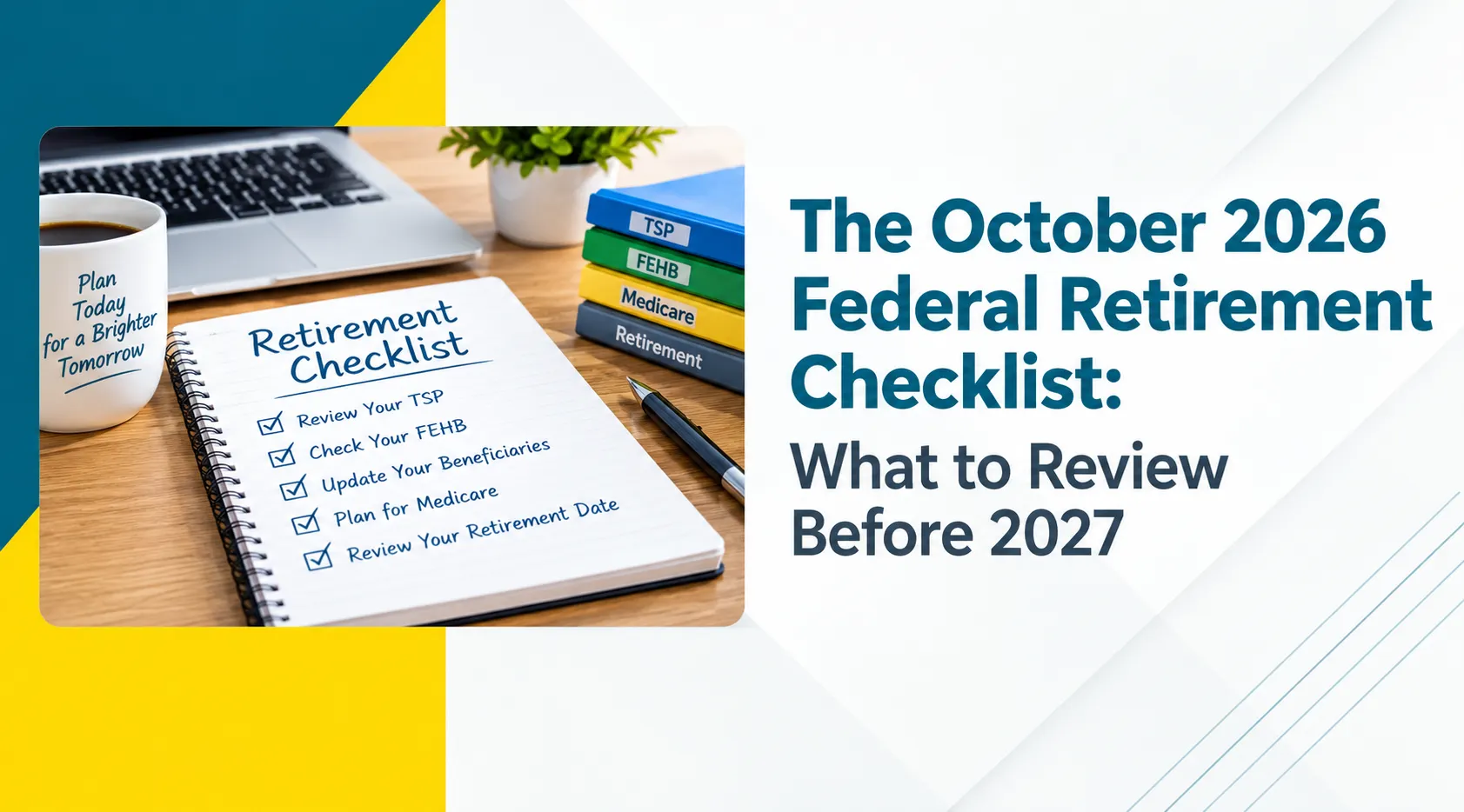
The practical checklist for Open Season this month:
- Confirm you meet the five-year FEHB enrollment requirement measured to your annuity commencement date, generally January 1, 2027.
- Review the 2027 brochure for your current plan. Benefits, formulary, and network change year to year.
- Compare plans now; eligible annuitants can also change plans during future Open Seasons, but reviewing options while you still have agency HR support is easier.
- If you're Medicare-eligible, model how FEHB and Medicare Part B coordinate under your plan's 2027 rules.
- Submit the election through your agency's self-service system before the December 14, 2026 deadline.
- Employee Express closes at 11:59 p.m. Eastern Time; some agency systems close at 11:59 p.m. local time, so confirm your system's cutoff.
Finalize Your 2026 TSP Contributions and Decide on Early Withdrawals
The TSP, or Thrift Savings Plan, the federal government's tax-advantaged retirement savings program, deserves attention across your remaining pay periods. If you want to better understand contribution strategies, investment options, and retirement planning considerations, explore these TSP educational webinars for additional guidance.
According to the IRS in Notice 2025-67, the 2026 TSP elective deferral limit is $24,500. Employees age 50 or older can add an $8,000 catch-up contribution. Those age 60 to 63 qualify for an enhanced $11,250 catch-up under the SECURE 2.0 Act, which replaces (rather than stacks on top of) the $8,000 standard catch-up. These limits apply to combined traditional and Roth TSP contributions.
Three decisions matter for a December 2026 retirement:
1. Pace contributions to capture the full agency match. FERS employees who contribute at least 5% of basic pay in every pay period receive the full agency contribution.
That contribution has three parts: a 1% automatic contribution, a dollar-for-dollar match on the first 3% of your pay, and a 50-cent match on the next 2%. You get the 1% automatic contribution regardless of whether you contribute.
If you front-load contributions and hit the $24,500 cap before your final pay period, matching contributions generally stop for any pay period in which you make no qualifying contribution. The 1% automatic contribution continues, but the matching portion does not. Spread contributions evenly across your remaining pay periods instead.
2. Decide on withdrawals before you separate. You don't have to take money from the TSP immediately on retirement.
According to TSP.gov, retired participants can leave balances in the plan, roll them to an Individual Retirement Account (IRA), take partial withdrawals, or set up installment payments. Each option has different tax and estate-planning consequences, and the right answer depends on your other income sources and your Required Minimum Distribution (RMD) age.
3. Confirm your beneficiary designation. Review your Form TSP-3 beneficiary designation before you separate.
The TSP doesn't follow your will. The TSP-3 on file governs who receives the account.
Verify Your FERS Annuity Estimate and Service Record with OPM
OPM calculates your FERS annuity using the High-3 average salary multiplied by your years of creditable service and a per-year multiplier. The High-3 is the average of your highest three consecutive years of base pay, including locality pay and other amounts that count as basic pay.
The per-year multiplier is 1%, or 1.1% if you retire at age 62 or later with at least 20 years of service, according to the OPM FERS retirement benefits guide. The math is simple. The inputs often aren't.
Pull your eOPF (Electronic Official Personnel Folder) now and verify every line of service.
Common issues that surface late in the retirement process include unposted part-time service, uncredited military deposits, and missed credit for a prior period of temporary employment. Sick leave balances that haven't been reconciled with current payroll are another frequent gap. Any one of these can shift your annuity. Reviewing your current federal pay and deductions can also help you better understand your income before retirement. Use this federal employee paycheck calculator to estimate your paycheck and review your current earnings and deductions.
Request a formal retirement estimate from your agency HR office if you haven't already. Incomplete service documentation can delay OPM processing. A December 2026 retirement with a complete package that reaches OPM promptly generally enters interim pay sooner than one submitted with gaps.
Plan for the Income Gap Between Retirement and Your First Full Annuity Check
Many federal retirees experience an income transition after separation. OPM pays an interim annuity while it finalizes the calculation, then adjusts to the final amount.
According to OPM's Retirement Quick Guide, interim payments are a partial amount of the estimated annuity, with the exact percentage varying by case. Interim payments typically exclude the FERS Annuity Supplement, survivor reductions, and FEHB and FEGLI premiums until finalization. Understanding what happens after OPM receives your federal retirement application can help you prepare for the interim payment period and understand what to expect before your annuity is finalized.
For a December 31, 2026 retirement, the sequence often looks like this. Your last paycheck covers the December pay period. Your annual leave lump sum arrives separately as supplemental wages.
Your first interim annuity begins after OPM accepts your package, with timing that varies by case complexity and current OPM workload. Final adjudication, when OPM calculates the full annuity and pays a retroactive true-up, generally takes longer than the start of interim pay.
Three practical steps help:
- Hold three to six months of expenses in cash before separating.
- Model the lump-sum tax hit at your actual marginal rate. The IRS's 22% rate may apply under the supplemental-wage flat-rate withholding method, but that is withholding, not your final tax rate. Higher earners often owe more in April.
- Confirm that your TSP, IRA, or taxable account can bridge any shortfall without triggering avoidable taxes or early-withdrawal penalties.
Confirm Social Security, Survivor, and FEGLI Elections
A December 2026 retirement forces three more decisions that are often rushed and sometimes permanent.
FERS Annuity Supplement. Some, not all, FERS employees who retire before age 62 qualify for the FERS Annuity Supplement. The supplement is a bridge payment that approximates the Social Security benefit earned from federal service, paid monthly until age 62. Because retirement application processing can affect when federal employees receive their finalized annuity and related benefits, it's also worth understanding the latest federal retirement backlog trends when preparing for retirement.
According to OPM, eligibility is limited to specific immediate-retirement categories. Those categories include employees retiring at their Minimum Retirement Age (MRA) with at least 30 years of service, plus employees retiring at age 60 with at least 20 years of service.
Certain special-category retirees also qualify, including law enforcement officers, firefighters, air traffic controllers, and some qualifying early retirements. MRA+10 retirements, deferred retirements, and disability retirements do not qualify.
The supplement also requires at least one full calendar year of FERS service. It is subject to the Social Security earnings test and does not receive cost-of-living adjustments.
Social Security filing. If you're at or near age 62, model your Social Security claiming age carefully.
According to the Social Security Administration, each year you defer Social Security past Full Retirement Age increases the benefit by roughly 8% per year up to age 70, for workers born in 1943 or later. Early filing permanently reduces the benefit.
Cost-of-living adjustments for 2026 and 2027. Two separate COLAs matter here.
According to OPM, the 2026 COLA (payable in January 2026 annuity payments) is 2.8% for Civil Service Retirement System (CSRS) annuitants. FERS annuitants receive 2.0% under the capped "diet COLA" formula.
Writing
The 2027 COLA, also announced by OPM, is 3.6% for CSRS and 2.6% for FERS, effective December 1, 2026. An annuity that commences on January 1, 2027 falls after that effective date, so it generally receives no portion of the December 2026 COLA. The next applicable COLA would be the one that takes effect the following December, subject to the rules for new annuitants.
Healthcare expenses are another important factor when estimating retirement income. Federal employees approaching retirement should compare their FEHB coverage options and understand how enrollment choices affect their ongoing costs. Review our guide to FEHB Self Plus One vs. Self & Family to understand the coverage differences and 2027 premium considerations.
One further point for FERS retirees: most FERS annuitants do not receive COLAs before age 62, subject to exceptions for disability retirees, survivor annuitants, and certain special-category retirees. Check OPM's annuity-payment guidance for your specific situation.
Survivor benefit election. At retirement, you choose whether to provide a survivor annuity to your spouse.
Under FERS, a full survivor annuity reduces your monthly annuity by 10% and provides 50% of the unreduced annuity to the spouse for life. A partial election reduces it by 5% and provides 25%.
According to OPM, this election is largely irrevocable after retirement, and you need spousal consent to elect less than the full survivor benefit. One factor worth weighing carefully: a surviving spouse's FEHB coverage continues only if the spouse meets OPM's survivor-annuitant eligibility rules, which generally require that a qualifying survivor annuity be in place.
The right election depends on the household's overall financial picture, the spouse's own health coverage options, and the cost of the annuity reduction.
FEGLI. You may continue Basic and Optional Federal Employees Group Life Insurance (FEGLI) coverage into retirement if you qualify for an immediate annuity and meet the five-year or all-opportunity requirement for each coverage type.
The test generally looks at the five years of service immediately before your annuity starts, or the full period during which you were eligible if that period was shorter than five years. The requirement applies separately to Basic and each Optional coverage type (Option A, Option B, Option C), so review each one before you separate.
Your continuation options, post-65 reductions, and election choices are governed by the FEGLI election rules. Not every option carries the same continuation or reduction choices, so confirm your specific elections with OPM.
Why Sequence Matters More Than the Math
Planning a December 2026 federal retirement is a sequencing problem more than a math problem. The FERS annuity formula is fixed, the 2026 TSP limits are fixed, the Open Season dates are fixed, and both the 2026 and 2027 COLAs are already announced. Coordinating these decisions can be easier with help from professionals familiar with federal retirement benefits. Explore federal retirement advisors who work with FERS, CSRS, TSP, and Social Security considerations.
What you control is the order in which you handle the decisions. That sequence covers the date, the FEHB election, the TSP pacing, the service record, the cash bridge, and the survivor and FEGLI choices. If you want help reviewing these decisions and understanding how they fit into your retirement timeline, schedule a free federal retirement consultation.
Federal Pension Advisors, a retirement planning firm specializing in federal employee benefits, works with federal employees on each of these decisions. Reach out before the December 14, 2026 Open Season deadline.
FAQ: Planning a December 2026 Federal Retirement
When should I submit my federal retirement application for a December 2026 retirement date?
OPM recommends starting the retirement application process with your agency benefits office at least 60 days before separation. Earlier is better. Submitting a complete package that reaches OPM promptly after your separation date generally shortens the wait for interim pay.
Is December 31, 2026 the best date to retire from the federal government?
December 31, 2026 is the most popular date because it keeps you on the payroll through the end of the calendar year and starts the FERS annuity accrual the very next day. According to FedWeek, it's not the only strong option. January 9, 2027 aligns with the end of the leave year and the end of a pay period, which December 31, 2026 does not.
What is the 2026 COLA for FERS and CSRS retirees?
According to OPM, the 2026 COLA is 2.8% for retirees under CSRS, the Civil Service Retirement System, and 2.0% for retirees under FERS, the Federal Employees Retirement System. The FERS adjustment is reduced because inflation exceeded 2%, under the capped "diet COLA" formula set in statute. OPM has also announced the 2027 COLA at 3.6% for CSRS and 2.6% for FERS, effective December 1, 2026.
How much can I contribute to the TSP in 2026 before I retire?
According to IRS Notice 2025-67, the 2026 TSP elective deferral limit is $24,500. Participants age 50 or older can add an $8,000 catch-up contribution. Those age 60 to 63 qualify for an enhanced $11,250 catch-up under the SECURE 2.0 Act, which replaces the $8,000 standard catch-up for those ages. The maximum combined contribution for an eligible age 60 to 63 participant is $35,750 in 2026.
Can I collect my FERS annuity and Social Security at the same time?
Yes. FERS is designed as a three-tier system (basic annuity, Social Security, and the Thrift Savings Plan) that you draw from concurrently. Some retirees who separate before age 62 under qualifying immediate-retirement categories also receive the FERS Annuity Supplement until age 62, when Social Security filing becomes available, according to OPM.
Disclaimer:
This article is for educational and informational purposes only and should not be considered financial, legal, tax, or investment advice. Federal retirement benefits, eligibility requirements, contribution limits, and deadlines are subject to change. Individual circumstances may affect retirement decisions and benefit calculations. Always verify current information with the U.S. Office of Personnel Management (OPM), the Thrift Savings Plan (TSP), the Social Security Administration (SSA), and your agency's benefits office before making retirement decisions. Federal Pension Advisors is not affiliated with or endorsed by OPM or any U.S. government agency.

Colin David McLaughlin
Colin David McLaughlin grew up in Plymouth, MA, and graduated from Plymouth South High in 2009. He earned a bachelor’s degree in criminal justice from Bridgewater State University and a master’s degree in business administration with a concentration in IT Management from Southern New Hampshire University.