
.png)


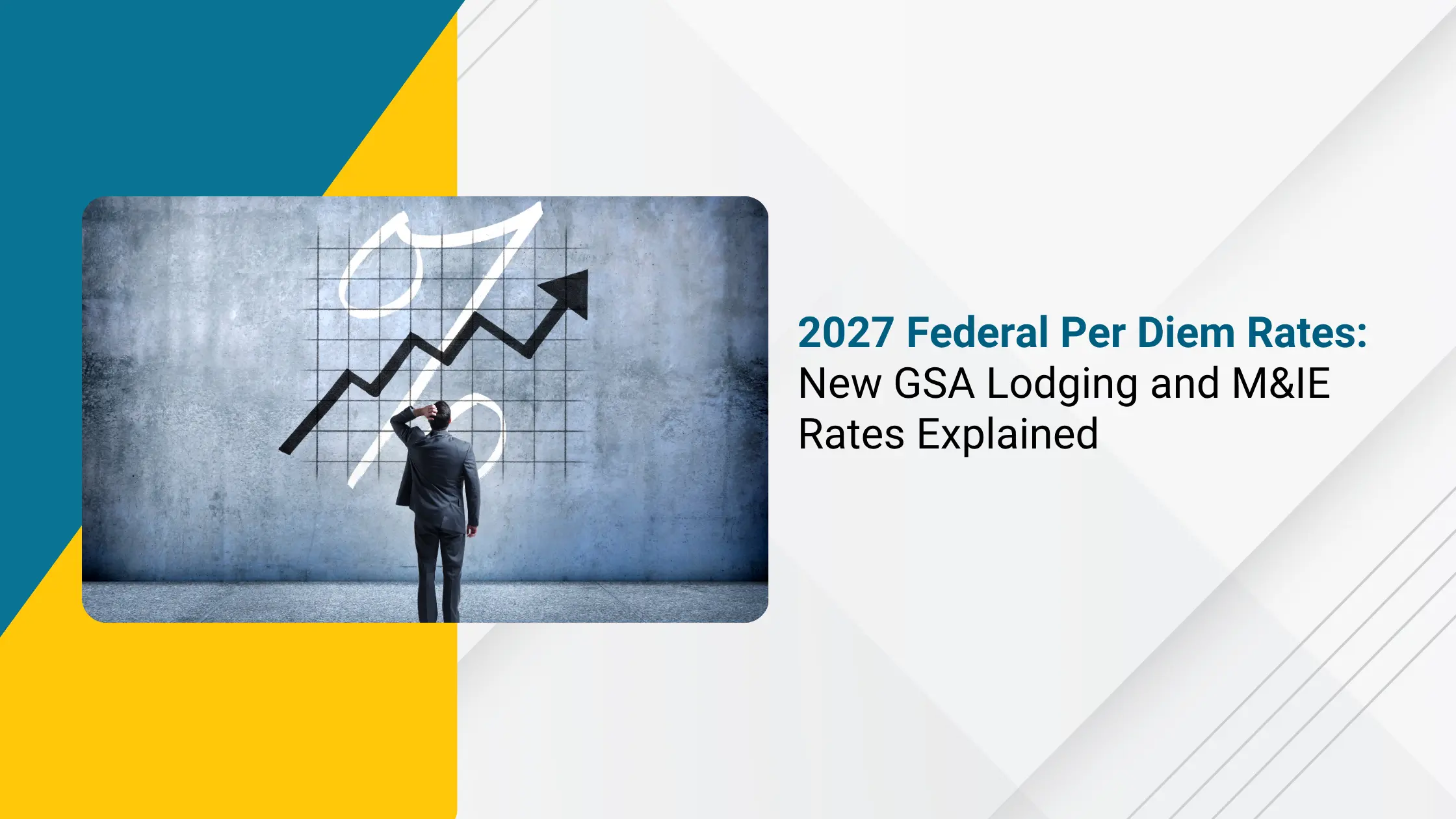
2027 Federal Per Diem Rates: New GSA Lodging and M&IE Rates Explained
For FY 2027, the standard Continental United States (CONUS) per diem consists of a maximum lodging allowance of $113 per night plus a $68 meals and incidental expenses (M&IE) allowance, for a combined listed rate of $181 per day, effective October 1, 2026, through September 30, 2027. The General Services Administration (GSA) Per Diem Bulletin FTR 27-01 raised the standard lodging rate $3, from $110 to $113. The M&IE rate held steady at $68.
The $113 is a ceiling, not a flat payment. You are reimbursed your actual lodging cost up to that maximum. If you travel on official government business, these are the standard GSA rates federal agencies use to determine lodging and M&IE reimbursement for official CONUS travel, subject to applicable Federal Travel Regulation (FTR) and agency rules.
This guide breaks down what changed, how the numbers are structured, and how to calculate your reimbursement. That includes the first-and-last-day partial M&IE rule that can cause reimbursement mistakes.
At Federal Employee Advisor Network, a retirement planning firm specializing in federal employee benefits, we track these adjustments because travel reimbursement, like most federal benefit figures, is regulation-anchored. GSA reviews and publishes rates for each fiscal year, and they may change from year to year.
What Are the 2027 Federal Per Diem Rates?
The 2027 federal per diem rates are the daily allowances the GSA sets to reimburse federal civilian employees for lodging, meals, and incidental expenses during official travel within CONUS, the Continental United States. For fiscal year (FY) 2027, the standard rate combines a $113 nightly lodging ceiling with a $68 M&IE allowance, totaling $181 for a full travel day. These rates apply from October 1, 2026, through September 30, 2027, in locations without a listed non-standard rate.
A per diem, Latin for "per day," is a fixed reimbursement amount for meals rather than a receipts-based one. The lodging portion reimburses actual costs up to the ceiling. You collect the M&IE portion as a flat daily allowance without receipts. GSA publishes the rates ahead of the new federal fiscal year, which begins October 1.
What Changed From 2026 to 2027?
The headline change for FY 2027 is a modest $3 increase in the standard CONUS lodging rate. The FY 2026 standard amounts were $110 for lodging and $68 for M&IE, so the standard total climbed from $178 to $181 per day. The M&IE rate itself did not move.
This increase follows an unusual pause the prior year, according to Federal News Network. GSA kept per diem rates flat during fiscal 2026 for the first time in five years, citing the Trump administration's cost efficiency goals. The FY 2027 adjustment marks a return to annual movement, though a small one.
Here is a direct comparison of the standard CONUS figures across the two fiscal years:
Source: GSA Per Diem Bulletins FTR 26-01 and FTR 27-01.
One structural note accompanied the change. According to the American Payroll Association, Allentown, Pennsylvania, was a non-standard area in fiscal year 2026 and has moved into the standard CONUS rate category for FY 2027. It is the only location to shift out of individualized-rate status this year.
How Non-Standard Area (NSA) Rates Work
Most of the country falls under the single standard CONUS rate. High-traffic and high-cost destinations receive their own individualized allowances. For FY 2027, the GSA identified 295 non-standard-rate locations where locality-specific lodging rates apply, often above the standard CONUS lodging ceiling of $113. About 300 destinations still carry their own lodging rates, some of which vary by season.
NSA lodging rates vary widely. According to the American Payroll Association, the combined per diem rates for listed NSA locations range from a low of $181 in the off-season to a high of $591 in peak season for Park City, Utah.
The single largest percentage jump this year went to Albuquerque, New Mexico. According to FedSmith, Albuquerque saw the largest percentage increase in its peak lodging ceiling, rising 44% from $144 in FY 2026 to as much as $208 per night in FY 2027. That is the steepest CONUS lodging increase of the year.
Check both the city and county in GSA's rate table. If neither is listed, the location falls under the standard CONUS rate.
Understanding the M&IE Tiers and the Meal Breakdown
The M&IE rate covers meals plus incidental expenses such as fees and tips to porters, baggage carriers, hotel staff, and staff on ships. According to the GSA Per Diem Bulletin FTR 27-01, the M&IE reimbursement rate tiers for FY 2027 remain at $68 to $92, and the standard M&IE rate remains at $68. The government uses five fixed CONUS M&IE tiers: $68, $74, $80, $86, and $92. What varies by location is which tier applies, not the tier amounts themselves.
GSA last revised the M&IE tiers in FY 2025, according to FedSmith, when the standard M&IE rate rose from $59 to $68. GSA generally reviews M&IE rates on a three-year cycle, so the next review would ordinarily fall around FY 2028. The current tier structure has now carried through three consecutive fiscal years.
Within every tier, $5 goes to incidental expenses. According to DATABASICS, which cites the GSA M&IE breakdowns, incidental expenses account for $5 in every CONUS tier. The rest splits across breakfast, lunch, and dinner.
When the government furnishes a meal or includes it in a registration fee, you generally must deduct the applicable meal amount from M&IE. Complimentary hotel meals and meals provided by a common carrier generally do not reduce the allowance.
How to Calculate Your Per Diem: The 75% First and Last Day Rule
One part of federal per diem that can cause confusion is the first-and-last-day partial M&IE rule. On your first and last travel days, you do not receive the full M&IE allowance. According to the GSA's official per diem FAQs, you are only eligible for 75 percent of the total M&IE rate for your temporary duty travel location on those days, not your official duty station location.
This rule applies regardless of what time you depart or return. For the standard $68 M&IE rate, 75% works out to $51. According to PerDiemWorld, the standard M&IE amount remains $68, so 75% is still $51 for the first and last days of an eligible overnight CONUS trip. At a $92 M&IE locality, the corresponding amount is $69.
The 75% proration applies to M&IE, not lodging. According to the GSA per diem FAQs, you are generally reimbursed the actual authorized lodging cost, up to the applicable nightly lodging ceiling. The $113 standard rate is a maximum, and lodging receipts are required. CONUS lodging taxes fall outside the lodging per diem ceiling and are generally reimbursed separately as a miscellaneous travel expense on reimbursable lodging costs.
Here is a worked example for a standard-rate destination:
Illustrative calculation using FY 2027 standard CONUS rates ($113 lodging, $68 M&IE). A four-day trip has three lodging nights. Source: GSA per diem rates and M&IE breakdowns.
Your actual reimbursement may be lower if your lodging cost falls below the $113 nightly ceiling. If normal per diem is insufficient, an agency may authorize actual-expense reimbursement under the FTR in qualifying circumstances, subject to agency approval and applicable limits.
Trips That Cross the October 1 Fiscal-Year Boundary
The new rates take effect October 1, 2026, so any trip spanning late September into early October may use two rate schedules. According to DATABASICS, a traveler who leaves September 28 and returns October 3 has three lodging nights, September 28, 29, and 30, under the FY 2026 schedule. The nights of October 1 and 2 fall under FY 2027. Submitting the expense report in October does not move the September nights onto the newer schedule. Each night is reimbursed at the rate in effect on that date.
Why Federal Per Diem Rates Matter for Your Retirement Planning
Per diem reimbursement is not retirement income, and it does not count toward your High-3 average salary. Your High-3 is your highest average basic pay over any three consecutive years of creditable service, and it is used to calculate a federal annuity. Reimbursements are not basic pay. But travel policy is part of the broader picture of managing your total federal compensation efficiently while you are still working.
Federal Employee Advisor Network, a retirement planning firm specializing in federal employee benefits, encourages you to treat every annually adjusted figure as something to verify each year rather than recall from memory. That applies to per diem rates, to TSP contribution limits, and to Federal Employees Retirement System (FERS) benefit thresholds. The same discipline that keeps a travel voucher accurate keeps a retirement plan accurate.
The Bottom Line
The 2027 federal per diem rates bring a small but real increase for federal travelers: a $113 standard lodging ceiling and an unchanged $68 M&IE allowance, for a combined listed rate of $181 per day, effective October 1, 2026. The tier structure, the 295 non-standard areas, and the 75% first-and-last-day rule all carry forward. The mechanics of filing a voucher stay familiar even as the numbers tick up. Always verify your specific destination against the official rate tables at gsa.gov/perdiem, since NSA rates and seasonal adjustments vary widely.
For help fitting travel policy, TSP strategy, and FERS planning into one coherent retirement picture, Federal Employee Advisor Network works exclusively with federal employees navigating these interlocking rules. Understanding the small annual figures is the same skill set that protects the large ones.
Frequently Asked Questions
1. What are the 2027 federal per diem rates?
The 2027 federal per diem rates set the standard CONUS listed rate at $181 per day: a maximum lodging allowance of $113 plus a $68 meals and incidental expenses allowance. According to GSA Bulletin FTR 27-01, these rates apply from October 1, 2026, through September 30, 2027, for locations without a non-standard rate.
2. How much did the federal per diem rate increase for 2027?
The standard CONUS lodging rate increased $3, from $110 to $113 per night, according to the General Services Administration. The M&IE rate stayed at $68, so the combined standard daily total rose from $178 to $181. This followed a full rate freeze during fiscal year 2026.
3. What is the standard M&IE rate for 2027?
The standard meals and incidental expenses (M&IE) rate for fiscal year 2027 is $68 per day, according to GSA Bulletin FTR 27-01. M&IE tiers range from $68 to $92 depending on location. Within every tier, $5 goes specifically to incidental expenses such as tips for hotel staff.
4. How is per diem calculated on the first and last day of travel?
On the first and last travel day, you receive 75 percent of the destination's M&IE rate, according to the GSA. For the standard $68 rate, that equals $51 per day. This proration applies only to M&IE. You are reimbursed your actual authorized lodging cost, up to the applicable nightly ceiling.
5. When do the 2027 federal per diem rates take effect?
The 2027 federal per diem rates take effect October 1, 2026, and run through September 30, 2027, matching the federal fiscal year. GSA publishes the coming fiscal year's rates before they take effect on October 1. Travel before October 1, 2026, uses the FY 2026 rate schedule.
6. What is a non-standard area (NSA) for per diem purposes?
A non-standard area (NSA) is a location the GSA assigns a locality-specific per diem rate, often above the standard CONUS rate. For fiscal year 2027 there are 295 NSAs, according to GSA. If a city and its county are both absent from the rate table, that location defaults to the standard $181 combined rate.
Disclaimer
This article is for informational and educational purposes only and does not constitute financial, tax, legal, or travel-policy advice. Federal per diem rates, reimbursement rules, and agency procedures can change. Verify current rates and requirements with GSA.gov, the Federal Travel Regulation, and your agency before making travel or reimbursement decisions.

Get Updated
Subscribe to our weekly updates for the latest on retirement planning, federal benefits, exclusive webinars, and more!

Colin David McLaughlin.
Colin David McLaughlin is a federal retirement planning professional who specializes in helping federal employees and mixed-career couples navigate FERS, FEHB, TSP, Social Security, and survivor benefits. His work focuses on coordinating federal and private-sector retirement benefits to help couples make informed long-term retirement decisions.

Download Federal Retirement: Step-by-step Checklist
This comprehensive guide will help you understand your federal benefits, optimize your savings, and plan for a comfortable future.
Recent Post's