

Published
Mar 5, 2026

Last Updated
Sep 1, 2026
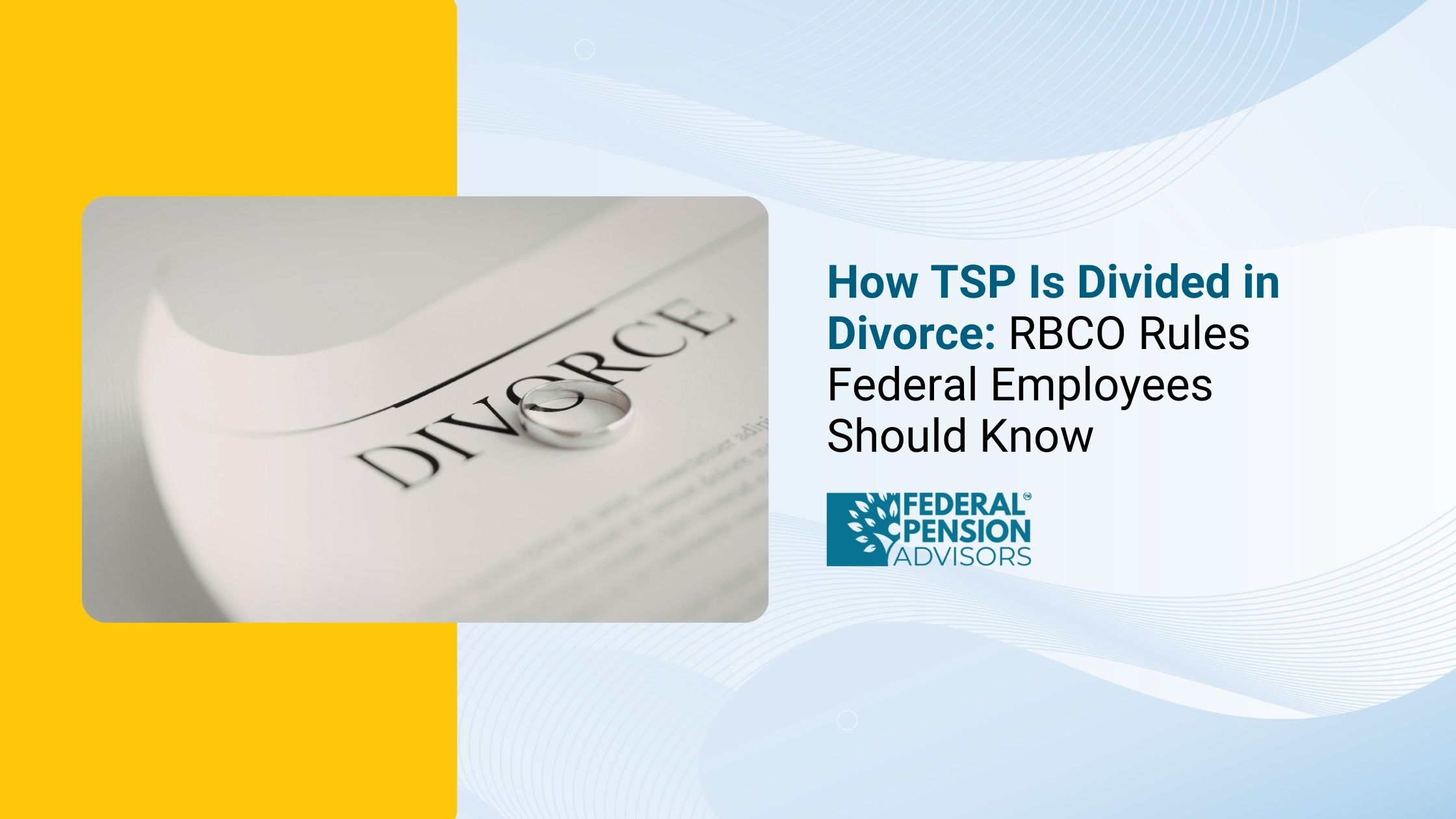
How TSP Is Divided in Divorce: RBCO Rules Federal Employees Should Know
For federal employees, divorce can raise serious financial questions especially when retirement savings are involved. One of the most common concerns is how the Thrift Savings Plan (TSP) is treated during divorce proceedings.
The Thrift Savings Plan divorce process works differently from private-sector retirement plans. While 401(k) plans are divided through Qualified Domestic Relations Orders (QDROs), the TSP requires a Retirement Benefits Court Order (RBCO) that follows federal rules.
Because the TSP operates under federal law governing government retirement programs, court orders dividing the account must meet strict legal standards before the plan administrator will process them.
For federal employees navigating divorce and tsp matters, understanding these rules is essential for protecting retirement savings and avoiding costly mistakes.
How Is the Thrift Savings Plan Divided in Divorce?
The Thrift Savings Plan (TSP) division in divorce is the legal process of splitting a federal employee's or uniformed service member's retirement account using a specific court order called a Retirement Benefits Court Order (RBCO).
The Thrift Savings Plan divorce process requires a Retirement Benefits Court Order (RBCO) issued by a court.
Unlike private retirement accounts that use QDROs, the TSP only accepts an RBCO that specifically references the plan and clearly states how the account should be divided.
The process typically works as follows:
- A court issues a Retirement Benefits Court Order (RBCO).
- The order is submitted to the Thrift Savings Plan.
- The TSP reviews the order for compliance with federal rules.
- The account may be temporarily frozen during review.
- Once approved, the plan calculates the tsp divorce payout and transfers the awarded amount to the former spouse.
Detailed requirements for drafting and submitting a qualifying order are outlined in the official TSP booklet on court orders and retirement benefits
What Is a Retirement Benefits Court Order (RBCO)?
A Retirement Benefits Court Order (RBCO) is a legally binding court order that directs the Thrift Savings Plan to pay a specified portion of a federal employee’s retirement account to another party.
In divorce proceedings, the awarded amount is typically paid to:
- A current spouse
- A former spouse
- A dependent
This distribution is commonly referred to as a TSP divorce payout.
For an RBCO to be accepted and processed, it must strictly comply with federal requirements. The order must clearly identify the Thrift Savings Plan and precisely state the amount to be awarded. The division must be expressed in one of the following approved formats:
- A specific dollar amount
- A percentage of the total account balance
- A percentage of the marital portion of the account
The language of the order must be clear, specific, and unambiguous. If the court order contains vague instructions, missing information, or improper terminology, the TSP will reject it. In such cases, the court must issue a corrected order before any funds can be distributed.
Because the TSP operates under federal law rather than private retirement plan rules, strict compliance is essential to avoid delays in processing.

How TSP Is Divided During Divorce: a Step-by-Step approach
Understanding how the process works allows federal employees to anticipate delays, protect their retirement savings, and ensure court documents are properly drafted from the beginning.
Step 1: Identification of Marital Assets
During divorce proceedings, both parties disclose financial assets. For many federal employees, the Thrift Savings Plan is one of the largest assets accumulated over the course of their career.
The court will determine whether the TSP account or a portion of it is considered marital property under applicable state law. In many cases, only the contributions made during the marriage, along with associated investment growth, are subject to division.
At this stage, accurate account records and contribution history are critical.
Step 2: Drafting the Retirement Benefits Court Order (RBCO)
If the court determines that the TSP will be divided, a Retirement Benefits Court Order must be carefully drafted.
Because the TSP operates under federal regulations, the order must meet strict legal standards. It must clearly:
- Identify the Thrift Savings Plan
- Specify the exact dollar amount or percentage awarded
- Define how gains or losses will be treated
- State the valuation date used for calculation
Precision is essential. Ambiguous or incomplete language is one of the most common reasons court orders are rejected.
Step 3: Court Review and Certification
Once drafted, the order must be formally approved and certified by the court.
Without a properly certified Retirement Benefits Court Order, the TSP will not process any division of funds. Federal requirements leave no room for informal agreements or improperly executed documents.
Step 4: Submission and Administrative Review
The certified order is then submitted to the Thrift Savings Plan for administrative review.
Upon receipt, the TSP may temporarily freeze the account while determining whether the order complies with federal standards. During this review period, the account holder may be restricted from:
- Taking withdrawals
- Requesting loans
- Transferring funds
This temporary restriction protects the integrity of the account while compliance is evaluated.
Step 5: Calculation and Distribution
If the Retirement Benefits Court Order satisfies all federal requirements, the TSP calculates the awarded amount based on the terms specified in the order.
The approved amount becomes the official TSP divorce payout and is distributed accordingly. The recipient may then choose an eligible transfer or distribution option consistent with federal regulations.
By understanding each step in advance, federal employees can work more effectively with legal professionals and reduce the likelihood of delays or rejected court orders during the division of retirement assets.
Why TSP Divorce Rules Are Different for Federal Employees
Many people assume all retirement accounts are divided the same way during divorce. That is not the case for federal employees.
The Thrift Savings Plan operates under federal law and is part of the broader federal retirement framework, which also includes the Federal Employees Retirement System (FERS) and the Civil Service Retirement System (CSRS). Because it is a government-sponsored retirement plan, the TSP is governed by federal statutes rather than the ERISA rules that apply to private-sector 401(k) plans.
This distinction has important legal consequences during divorce proceedings:
- A Qualified Domestic Relations Order (QDRO) cannot divide a TSP account.
- Courts must issue a Retirement Benefits Court Order (RBCO) instead.
- The order must strictly comply with federal drafting and processing standards.
If these federal requirements are not met, the TSP will reject the order. When that happens, the court must issue a corrected version before any funds can be distributed potentially delaying the divorce settlement and prolonging financial uncertainty
RBCO Rules Federal Employees Must Know
For federal employees, the division of a Thrift Savings Plan divorce settlement must follow specific legal rules established by the TSP. These rules determine whether the plan will accept and process a Retirement Benefits Court Order (RBCO).
If the order does not meet these requirements, the TSP will reject it and request corrections before any tsp divorce payout can be issued.
Some of the most important RBCO rules include the following:
The Order Must Clearly Identify the Thrift Savings Plan
The court order must specifically reference the Thrift Savings Plan. Orders that refer only to “retirement accounts” or “federal benefits” may not be accepted.
The Order Must Specify a Dollar Amount or Percentage
The RBCO must clearly state the portion of the account awarded. This can be written as a fixed dollar amount or a percentage of the account balance.
Only Certain Individuals Can Receive the Payment
Under federal rules, an RBCO may direct payment only to a spouse, former spouse, or dependent child.
The Order Must Be Issued by a Court With Proper Jurisdiction
The court issuing the order must have legal authority over the divorce proceedings.
The Court Order Must Be Certified
The TSP requires a certified copy of the order before it can process the tsp divorce payout.
The Order Should Address Investment Earnings
If the order awards a percentage of the account, it should clarify whether the recipient will receive any associated investment gains or losses.
Understanding these RBCO rules is essential for federal employees going through tsp and divorce proceedings. Even minor drafting errors in the court order can delay the division of retirement savings.

What Federal Employees Should Know About TSP and Divorce
For federal employees, understanding how tsp and divorce rules work can prevent costly mistakes during divorce proceedings.
Here are several key issues that federal employees should understand before a court order is finalized.
1. Not All TSP Contributions Are Always Divided
In many divorce cases, courts divide only the marital portion of the TSP.
This usually includes:
- contributions made during the marriage
- investment growth from those contributions
Funds contributed before the marriage may be treated as separate property depending on state law.
Example:
A federal employee has:
- Total TSP balance: $400,000
- Contributions before marriage: $120,000
- Contributions during marriage: $280,000
If the court awards 50% of the marital portion, the tsp divorce payout would be:
$280,000 × 50% = $140,000
Maintaining detailed contribution records can help federal employees establish which portion of their TSP may be protected.
2. The TSP May Freeze the Account During Divorce
When the Thrift Savings Plan receives a qualifying court order, it may place temporary restrictions on the account while reviewing the order for compliance with federal requirements.
During this review period, the account holder may be prohibited from:
- Taking withdrawals
- Requesting loans
- Making interfund transfers
This temporary freeze is a protective measure. It ensures that funds remain intact while the Retirement Benefits Court Order is evaluated and prevents either party from altering the account balance before the division is finalized. This step protects the funds while the Thrift Savings Plan divorce order is reviewed.
3. The Court Order Must Be Written Correctly
One of the most common problems in tsp divorce cases is improperly drafted court orders.
To qualify, the RBCO must clearly:
- identify the Thrift Savings Plan
- specify the amount or percentage awarded
- be issued by a court with proper jurisdiction
If the order contains errors, the TSP will reject it until a corrected order is submitted.
4. Taxes Can Affect the Final TSP Divorce Payout
Taxes can significantly impact the value of a tsp divorce payout.
Depending on how the funds are distributed:
- Transfers to an IRA may not trigger immediate taxes
- Cash distributions may be taxable
- Early withdrawal penalties may apply depending on age
How Federal Employees Can Protect TSP in Divorce
For many federal employees, the TSP represents decades of retirement savings.
Understanding how to protect tsp in divorce can help preserve long-term financial security.
Key steps include:
Maintain Clear Contribution Records
Documentation of contributions before and during marriage helps determine which portion of the account is marital property.
Understand Federal Retirement Rules
Because the TSP operates under federal regulations, tsp and divorce cases often involve different legal procedures compared with private retirement plans.
Ensure the RBCO Is Properly Drafted
Errors in court orders are one of the most common causes of delays in Thrift Savings Plan divorce cases.
The order must clearly specify:
- the TSP account
- the percentage or dollar amount awarded
- how investment gains or losses should be treated
Work With Professionals Familiar With Federal Benefits
Dividing federal retirement accounts requires specialized expertise. Attorneys and financial professionals experienced in divorce and tsp matters can help ensure the court order complies with federal requirements.
Final Thoughts
For federal employees, dividing retirement savings during divorce requires careful attention to the rules governing the Thrift Savings Plan.
The Thrift Savings Plan divorce process relies on a Retirement Benefits Court Order (RBCO) that must meet federal requirements before the plan will divide the account.
Understanding how tsp divorce rules work, how the tsp divorce payout is calculated, and how courts determine the marital portion of retirement savings can help federal employees navigate divorce more confidently.
By learning how tsp and divorce laws apply to federal retirement accounts, employees can take informed steps toward how to protect tsp in divorce and safeguard their long-term financial security.


Get Updated
Subscribe to our weekly updates for the latest on retirement planning, federal benefits, exclusive webinars, and more!
Download Federal Retirement: Step-by-step Checklist
This comprehensive guide will help you understand your federal benefits, optimize your savings, and plan for a comfortable future.
Recent Post's