
.png)


IRS Layoffs 2026: What Federal Employees Should Know About Retirement, RIFs, and Buyout Options
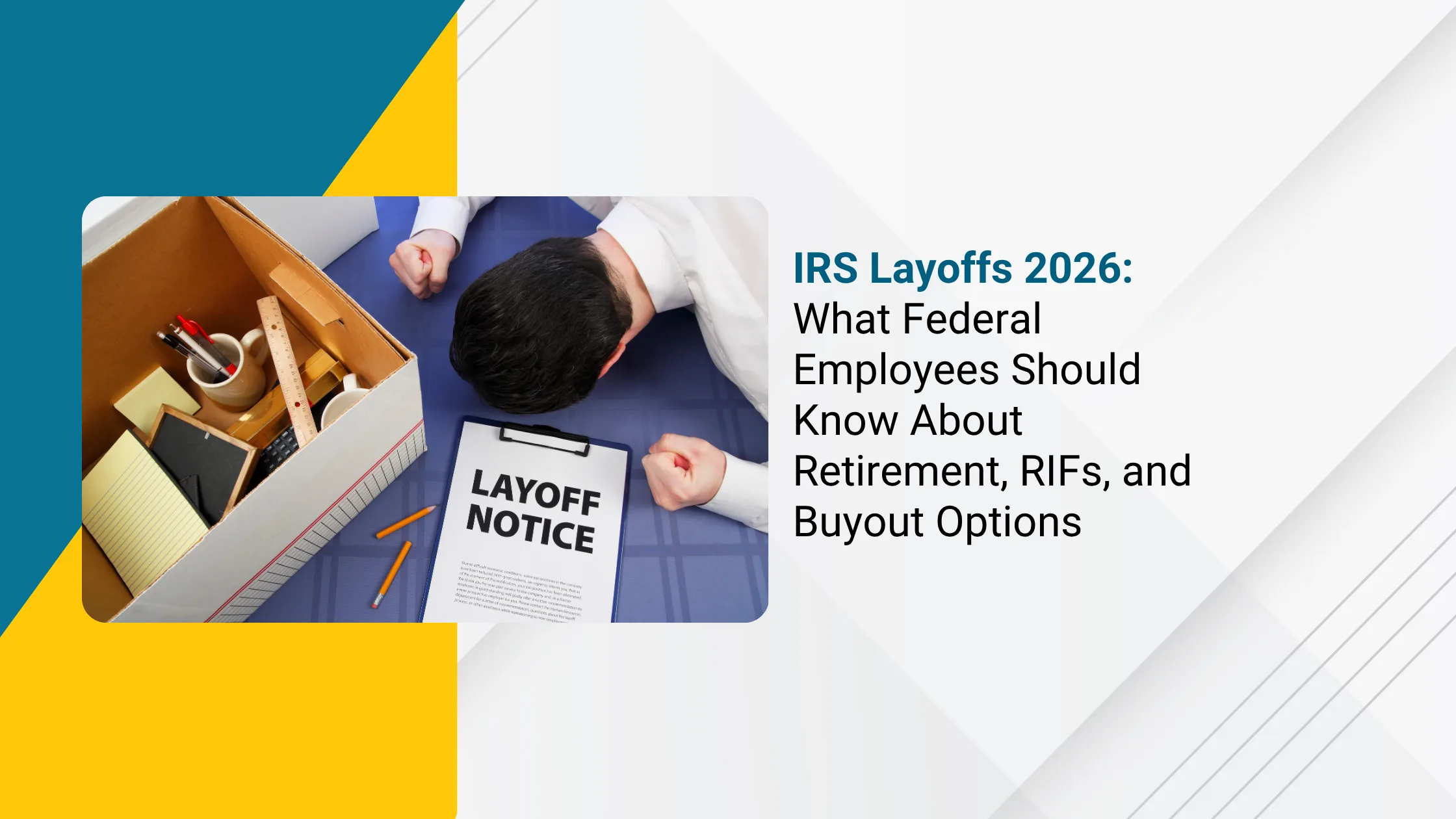
IRS layoffs in 2026 are part of a broader IRS workforce reduction that began in 2025, with additional staffing cuts still proposed in later budget documents. If you work at the Internal Revenue Service, your most important first step is knowing which separation path applies to you: reduction in force (RIF), voluntary separation incentive, early retirement, reassignment, or attrition. Each one affects your Federal Employees Retirement System (FERS) pension, Thrift Savings Plan (TSP), and health coverage differently. This guide separates what already happened in 2025, what stays active or proposed in 2026, and what is projected for fiscal year (FY) 2027. Then it walks through your options.
What Changed With IRS Layoffs 2026
The IRS workforce shrank sharply over 2025. Further reductions remain on the table for 2026 and beyond.
The IRS started 2025 with about 102,000 employees and finished with roughly 74,000 after a series of firings and layoffs, according to PBS News. The White House has described this as roughly a 27% staffing reduction.
Most of those 2025 departures came through voluntary programs, not involuntary firings. The Treasury Inspector General for Tax Administration (TIGTA) reported that 25,386 employees separated, took a deferred resignation program (DRP) offer, or used another incentive to leave as of May 2025. Another 294 employees received termination notices as part of a reduction in force. TIGTA reported these departures represented about 25% of the IRS workforce at that point.
More cuts are proposed for FY 2027, which runs from October 2026 through September 2027. The administration is proposing a $9.8 billion budget for the IRS, a $1.4 billion cut from current spending levels, with the FY 2027 request calling for further staffing reductions. The IRS estimates that staffing reductions of 4,875 employees would yield savings of over $777 million. Reporting has also summarized that figure as a net cut of roughly 4,000 positions, depending on how it is counted.
Why IRS Employees Worry About Workforce Reductions
IRS employees are concerned because the reductions have been uneven across offices, tied to ongoing budget pressure, and paired with leadership turnover. The cuts have not fallen equally.
TIGTA documented the disproportionate impact. As of May 2025, 27% of tax examiners and 26% of revenue agents had separated from the IRS. An earlier TIGTA snapshot found that as of March 2025, certain business units took the heaviest hits. The Tax Exempt & Government Entities and Large Business & International divisions lost 31% and 25% of their workforces respectively.
Reports also indicate that the IRS technology and leadership teams were heavily affected, with some outlets reporting large losses among IT staff and senior technology leadership. For many IRS employees, the practical question now is whether future changes will come through RIF actions, voluntary separation incentives, early retirement offers, reassignment, or attrition.
What a RIF Means for Federal Employees
A reduction in force (RIF) is the formal, regulated process the federal government uses to eliminate positions. Office of Personnel Management (OPM) rules govern it. It is not the same as being fired for performance. In a RIF, objective retention factors determine your standing.
Four factors decide your position in a RIF: your tenure group (permanent vs. probationary), your veterans’ preference, your length of creditable federal service, and your performance ratings. Employees with more service, veterans’ preference, and strong ratings rank higher. They may be retained, or they may “bump” or “retreat” into a position held by a lower-standing employee.
A RIF can result in separation, but it can also mean a downgrade or reassignment. If you receive a RIF notice, you are generally entitled to a notice period, written reasons, and appeal rights through the Merit Systems Protection Board (MSPB). Read that notice carefully and get help interpreting it. The options attached to it are often time-limited.
Early Retirement, VERA, VSIP, and Deferred Resignation: Key Differences
When an agency downsizes, it often prefers voluntary departures to involuntary RIFs. The four main tracks are Voluntary Early Retirement Authority (VERA), Voluntary Separation Incentive Payment (VSIP), the deferred resignation program (DRP), and standard RIF separation. People confuse them often, but they are legally distinct.
VERA lowers the age and service thresholds so you can retire early. VSIP adds a one-time cash incentive payment to encourage voluntary separations. An agency may offer VERA and VSIP together or separately, depending on its approved authority and workforce needs.
The VSIP buyout is capped by statute. The amount has been capped at $25,000 since the 1990s, and that cap remained in place as of early 2026. The Department of Defense operates under a higher cap. The deferred resignation program, by contrast, generally lets you stop working while remaining on the payroll for a set period before formally separating.
Comparison of the four main federal separation tracks during a workforce reduction. Eligibility and terms vary by agency authority and individual circumstances; confirm with your HR benefits officer.
A critical caution: if you retire under VERA before your Minimum Retirement Age (MRA), you generally do not receive the Special Retirement Supplement (SRS). The SRS is the bridge benefit that supplements income until Social Security eligibility. Your MRA is the earliest age a FERS employee can retire with an immediate annuity, ranging from 55 to 57 depending on birth year.
How IRS Layoffs Can Affect FERS Retirement
FERS calculates your pension on a fixed formula. The main risk from an early departure is losing service years that would otherwise grow your annuity. VERA does not change the formula. It only changes when you can collect.
The standard FERS annuity is your High-3 average salary, which is the average of your highest three consecutive years of base pay, multiplied by your years of service, times 1%. If you retire at age 62 or older with at least 20 years of service, that multiplier rises to 1.1%.
Consider a 52-year-old with 22 years of service and a High-3 of $90,000. Under a VERA, that employee would have an annual pension of roughly $19,800 (1% × 22 × $90,000). Fewer years of service means a smaller pension, permanently.
The trade-off is rarely just “now vs. later.” Leaving early can reduce your pension by cutting service years, and employees who retire before MRA generally do not receive the Special Retirement Supplement. If you are weighing a buyout against staying, the difference in lifetime income often exceeds the cash incentive offered. Before you commit, compare your projected pension at different retirement dates and review how the decision affects your TSP, FEHB, and long-term income.
What Happens to Your TSP During a Layoff or Separation
Your Thrift Savings Plan (TSP) is the federal government’s tax-advantaged retirement savings program, and it is fully yours regardless of how you leave the IRS. A layoff, RIF, or buyout does not forfeit your TSP balance. It does change your options, and it can trigger penalties if you handle it carelessly.
When you separate, you generally have four choices: leave the money in the TSP, roll it into an Individual Retirement Arrangement (IRA) or a new employer plan, take partial withdrawals, or cash out. Cashing out before age 59½ typically triggers a 10% early-withdrawal penalty plus ordinary income tax, though certain separation circumstances and the “rule of 55” can create exceptions.
Outstanding TSP loans matter especially here. If you separate with a loan balance and do not repay it, the unpaid amount is generally treated as a taxable distribution. Before you move any funds, review your TSP withdrawal options carefully. A rushed rollover can cost thousands in avoidable tax.
FEHB, Life Insurance, and Benefits After Separation
The Federal Employees Health Benefits Program (FEHB) and Federal Employees Group Life Insurance (FEGLI) can follow you into retirement, but only if you meet the enrollment-duration rules. This is one of the most consequential and most misunderstood parts of any separation decision.
The core rule is the five-year test. To continue FEHB coverage into retirement, you must have been enrolled for the last 5 years of federal civilian service, or for all service since you were first eligible, if less than 5 years.
There is an important exception during buyout periods. Employees retiring during an approved VERA or VSIP period may qualify for a pre-approved waiver of the FEHB five-year rule if OPM conditions are met. Your agency’s benefits officer can request the waiver from OPM.
FEGLI can continue into retirement if you carried the coverage for at least 5 years prior to retirement, with cost depending on the elections you make at retirement. If you separate without meeting these thresholds and without a waiver, you can lose the ability to carry coverage permanently. Our guide to FEHB in retirement explains how to confirm your eligibility before you act.
Questions IRS Employees Should Ask Before Accepting a Buyout
Before you accept any VSIP, VERA, or deferred resignation offer, get concrete answers to these questions. A buyout that looks generous can be the wrong financial choice once the full picture is clear.
- What will my actual FERS pension be at this date versus two to three years from now? Pull your Personal Benefits Statement and run both numbers.
- Will I lose the Special Retirement Supplement? If you are under MRA, you likely will.
- Do I meet the five-year FEHB and FEGLI rules, or do I need a waiver? Confirm in writing with your benefits officer.
- What is the VSIP worth after taxes? The net amount from a $25,000 VSIP can be much lower after federal, state, and local taxes and withholding, so estimate the after-tax value before accepting.
- What happens to my TSP loan, if I have one?
- What are the tax consequences of my chosen TSP withdrawal path?
How to Prepare Before a RIF Notice Arrives
The best time to prepare for a RIF is before any notice lands. Employees who organize their records early make faster, better decisions when timelines compress to days.
Start by requesting your Personal Benefits Statement and verifying your Service Computation Date. Your creditable service drives both your RIF retention standing and your pension. Confirm your FEHB and FEGLI enrollment history against the five-year rule, and gather your most recent performance ratings, which factor into RIF retention.
Build a simple cash-flow plan for a gap in income, and model your pension at two or three different retirement dates. Finally, identify which separation tracks your agency is currently authorized to offer, because eligibility for VERA and VSIP depends on active agency authority approved by OPM. Doing this groundwork early means that if a notice arrives with a short decision window, you are choosing from analysis rather than under pressure.
When to Get Federal Retirement Planning Help
Professional guidance can help when a RIF, buyout, or early retirement offer affects your pension, FEHB, FEGLI, or TSP decisions. Federal benefits are governed by interlocking OPM, IRS, and agency rules. Mistakes with FEHB enrollment or TSP rollover timing can create long-term financial consequences.
Federal Pension Advisors, a retirement planning firm specializing in federal employee benefits, focuses on the federal systems: FERS, CSRS (the Civil Service Retirement System), TSP, FEHB, and FEGLI, rather than general financial planning. If you face a decision window, or simply want to understand your options before one arrives, our federal retirement planning team can help. You can schedule a consultation to review your specific numbers. This article is educational and informational; it does not constitute individualized financial, tax, or legal advice.
FAQs About IRS Layoffs and Retirement Options
1. Are IRS employees being laid off in 2026?
IRS reductions in 2025 came mostly through voluntary buyouts and early retirements, not mass firings. TIGTA reported that 294 employees received RIF termination notices as of May 2025. The FY 2027 budget proposes further staffing cuts, so the situation remains active rather than settled.
2. How many employees has the IRS lost?
According to PBS News, the IRS began 2025 with about 102,000 employees and ended with roughly 74,000, about a 27% reduction. TIGTA reported that 25,386 employees had separated or taken an incentive to leave as of May 2025, representing about 25% of the workforce at that time.
3. What is the difference between VERA and VSIP?
VERA, the Voluntary Early Retirement Authority, lets eligible employees retire earlier than normal age and service rules allow. VSIP, the Voluntary Separation Incentive Payment, is a one-time cash buyout capped at $25,000. Agencies may offer them together or separately, and each affects your benefits differently, so review your specific offer carefully.
4. Can I keep my health insurance if I take a buyout?
You can keep FEHB in retirement only if you were enrolled for the five years immediately before separating. During VERA or VSIP periods, OPM may grant a waiver of that requirement. Your agency benefits officer must request the waiver, so confirm your eligibility in writing before accepting any offer.
5. What happens to my TSP if I am laid off from the IRS?
Your Thrift Savings Plan balance is always yours and is not forfeited in a layoff or RIF. You can leave it in the TSP, roll it to an IRA, or withdraw it. Withdrawing before age 59½ usually triggers a 10% penalty plus taxes, and unpaid TSP loans may become taxable distributions.
6. Will an early retirement reduce my FERS pension?
Yes. Your FERS pension equals your High-3 salary times years of service times 1%, so leaving early permanently reduces it by cutting your service years. If you retire before your Minimum Retirement Age under VERA, you also generally lose the Special Retirement Supplement that bridges income until Social Security eligibility.
Disclaimer
This article is for educational and informational purposes only and does not constitute individualized financial, tax, legal, or retirement advice. Federal benefits rules can vary based on your employment history, agency status, retirement eligibility, and separation terms. Verify all benefit details with OPM.gov, TSP.gov, IRS guidance, and your agency HR or benefits office before making any decision.


Get Updated
Subscribe to our weekly updates for the latest on retirement planning, federal benefits, exclusive webinars, and more!

Thomas A. Doherty
Thomas A. Doherty is a retirement planning consultant with 35 years of experience helping federal employees, academic professionals, business owners, and families navigate complex retirement decisions. His expertise includes retirement planning, federal benefits, pension strategies, tax-efficient retirement income planning, and risk management, with a focus on helping clients build greater financial stability and confidence for the future.

Download Federal Retirement: Step-by-step Checklist
This comprehensive guide will help you understand your federal benefits, optimize your savings, and plan for a comfortable future.
Recent Post's