

Published
Oct 15, 2026

Last Updated
Oct 15, 2026
2026 IRA Contribution Limits (and Roth IRA Limits Explained for Federal Employees)
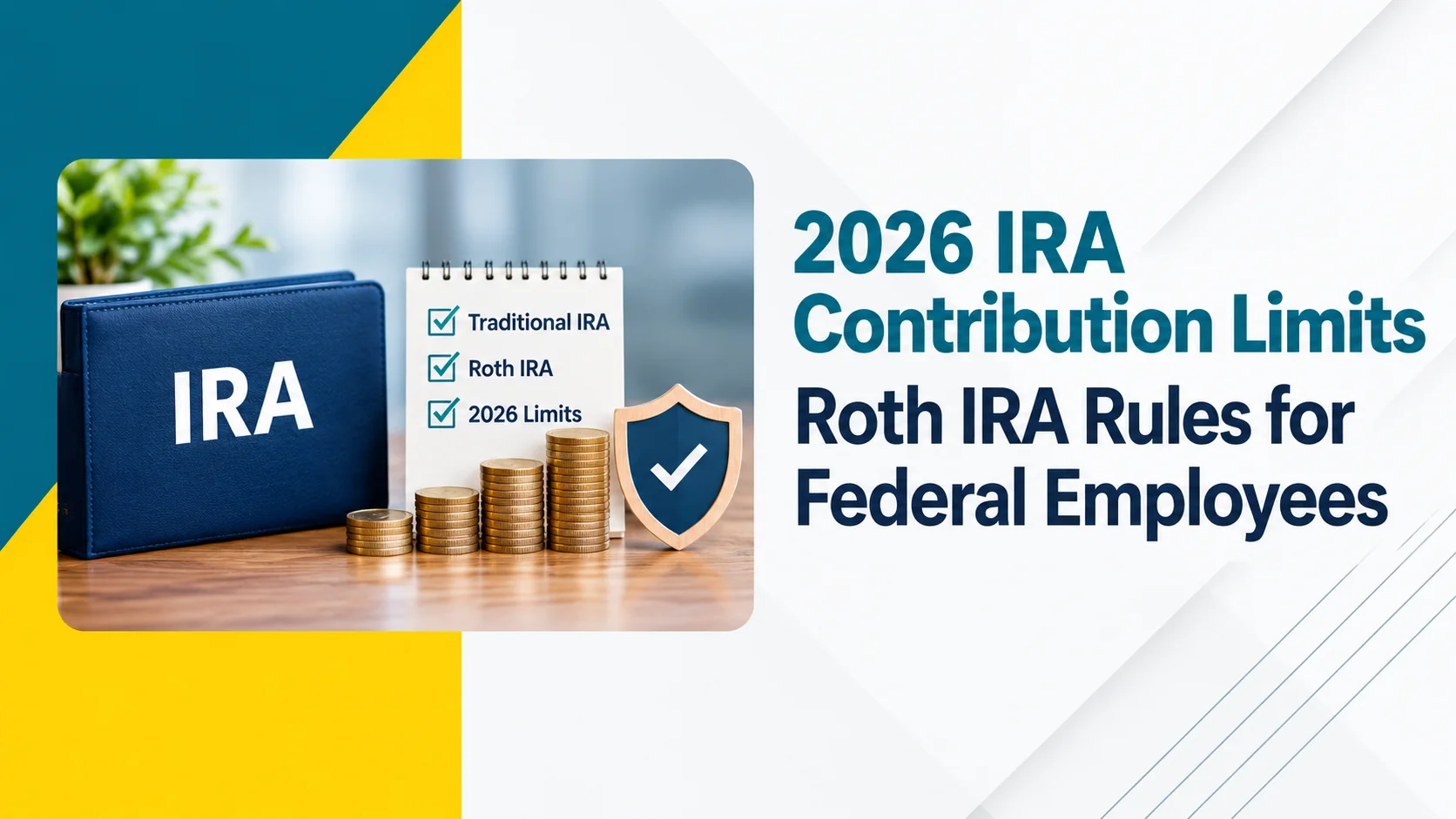
The 2026 IRA contribution limits increase to $7,500 per year, up from $7,000 in 2025. Savers age 50 and older qualify for an additional $1,100 catch-up contribution, bringing their total allowable amount to $8,600.
IRS Notice 2025-67, released in November 2025, applies these new limits equally to Traditional and Roth Individual Retirement Arrangements (IRAs).
For federal employees already contributing to the TSP (Thrift Savings Plan), an IRA is a separate, parallel bucket of tax-advantaged savings, not a replacement. Coordinating both accounts can meaningfully improve your long-term retirement outcome, especially when planning for rising federal retirement costs. Learn more through these TSP webinars.
What Are the 2026 IRA Contribution Limits?
The Internal Revenue Service (IRS) has set the 2026 IRA contribution limit at $7,500 for savers under age 50 and $8,600 for savers age 50 and older. The higher figure reflects a $1,100 catch-up contribution for the 50-and-above group.
According to IRS Notice 2025-67, these are combined limits. The total you contribute across all Traditional and Roth IRAs you own cannot exceed the annual cap.
Under the SECURE 2.0 Act of 2022, the catch-up amount is now adjusted annually for inflation, replacing the previous flat $1,000.
These limits apply equally to private-sector workers, self-employed individuals, and federal employees covered by FERS, the Federal Employees Retirement System, or CSRS, the Civil Service Retirement System. As part of a broader retirement plan, federal employees can review this retirement benefits checklist to identify other areas that may need attention.
You need earned income to contribute, and your total contributions cannot exceed your taxable compensation for the year.
Under IRS Publication 590-A rules, you can generally make IRA contributions for the 2026 tax year up to the federal tax filing deadline in April 2027, not including extensions.
Traditional vs. Roth IRA: 2026 Side-by-Side
The 2026 IRA contribution limits are identical whether you choose a Traditional IRA, a Roth IRA, or both. The difference is when you pay income tax and whether you can deduct the contribution in the year you make it. You should also understand how required minimum distributions (RMDs) affect federal employees' retirement accounts as you plan your withdrawals.
Source: IRS Notice 2025-67; IRS Publication 590-A (2026 figures).
An important distinction: contributing to a Traditional IRA and deducting that contribution on your tax return are two separate questions.
Any federal employee with earned income can contribute to a Traditional IRA regardless of salary. Whether that contribution is tax-deductible depends on your filing status, your Modified Adjusted Gross Income (MAGI), and whether you or your spouse are covered by a workplace retirement plan.
2026 Roth IRA Income Limits: Who Can Contribute Directly?
Your MAGI determines whether you can contribute directly to a Roth IRA. If your 2026 MAGI exceeds the upper limit for your filing status, you cannot contribute to a Roth IRA directly. A backdoor Roth IRA conversion may be worth evaluating in that case.
According to IRS Notice 2025-67, the 2026 Roth IRA income phase-out ranges are:
- Single filers and heads of household: $153,000 to $168,000, up from $150,000 to $165,000 in 2025.
- Married filing jointly: $242,000 to $252,000, up from $236,000 to $246,000 in 2025.
- Married filing separately (lived with spouse during the year): $0 to $10,000. This range isn’t adjusted for inflation.
Within the phase-out zone, your allowable Roth IRA contribution shrinks proportionally. Use the worksheet in IRS Publication 590-A, which includes specific rounding rules, to calculate the exact amount.
For example, a single filer with 2026 MAGI near the midpoint of the $153,000 to $168,000 phase-out range would see a meaningful reduction from the full $7,500 contribution. Calculate the exact amount using the official IRS worksheet, because small MAGI changes can shift the result.
Above $168,000 (single) or $252,000 (married filing jointly), direct Roth IRA contributions aren’t permitted.
Federal employees nearing these thresholds should run the calculation each fall. Any end-of-year promotion, locality pay adjustment, bonus, or spousal income change can push MAGI higher than expected.
For dual-income federal households, the married-filing-jointly ceiling arrives faster than many employees realize. That’s especially true when both spouses are GS-14 or above in high-cost locality pay areas.
2026 Traditional IRA Deduction Phase-Out Ranges
There is no income limit to contribute to a Traditional IRA. However, if you or your spouse are covered by a workplace retirement plan, your ability to deduct the Traditional IRA contribution phases out at certain income levels.
Federal employees who contribute to the TSP are generally considered covered by a workplace retirement plan for this purpose. That includes employees who make no employee deferral but still receive the FERS Agency Automatic 1% contribution.
According to IRS Notice 2025-67, the 2026 Traditional IRA deduction phase-out ranges are:
- Single filers covered by a workplace plan: $81,000 to $91,000, up from $79,000 to $89,000 in 2025.
- Married filing jointly, contributor covered by a workplace plan: $129,000 to $149,000, up from $126,000 to $146,000 in 2025.
- Married filing jointly, contributor not covered but spouse is: $242,000 to $252,000, up from $236,000 to $246,000 in 2025.
- Married filing separately (covered): $0 to $10,000, unchanged.
If your income exceeds the top of the applicable range, you can still make a non-deductible Traditional IRA contribution. You’ll need to file IRS Form 8606 and track your basis carefully to avoid being taxed twice on the same dollars at withdrawal.
For federal employees in this situation, a direct Roth IRA contribution (if MAGI allows) or a backdoor Roth IRA conversion is often worth evaluating.
A backdoor Roth isn’t automatically the right answer, however. The IRS pro-rata rule aggregates all Traditional IRA balances when determining the taxable portion of any conversion. A federal employee who rolled a prior-employer 401(k) into a Traditional IRA may find their planned backdoor conversion partly taxable.
How 2026 IRA Contribution Limits Work Alongside Your TSP
The IRA contribution limit and the TSP elective deferral limit are entirely separate. You can fund both in the same year.
IRS Notice 2025-67 raised the 2026 annual elective deferral limit to $24,500, up from $23,500 in 2025. The limit covers employees in 401(k), 403(b), governmental 457 plans, and the TSP.
For federal employees age 50 and older, the TSP catch-up contribution is $8,000.
Under the SECURE 2.0 Act, a higher catch-up contribution limit applies for employees aged 60, 61, 62, and 63 who participate in these plans. For 2026, that higher limit remains $11,250.
The table below shows the maximum amount a federal employee can shelter in tax-advantaged retirement accounts in 2026 by age bracket.
Source: IRS Notice 2025-67; Federal Retirement Thrift Investment Board (FRTIB) 2026 contribution schedule.
Agency matching contributions to the TSP for FERS employees, up to 5% of basic pay, don’t count against the $24,500 elective deferral limit.
Contribution deadlines also differ between the two accounts. TSP contributions must come through payroll deduction during the 2026 calendar year, while IRA contributions can generally be made until the April 2027 tax filing deadline.
New for 2026: Mandatory Roth Catch-Up for Higher-Paid Federal Employees
Final IRS regulations implementing Section 603 of the SECURE 2.0 Act change how catch-up contributions work for higher earners starting January 1, 2026.
Employees age 50 or older who earned more than $145,000 in prior-year FICA wages from their employer must now make catch-up contributions on a Roth (after-tax) basis. FICA wages refer to the Social Security wages reported in Box 3 of your Form W-2.
For federal employees, this means many GS-14s and GS-15s in higher locality pay areas are affected. If their 2025 FICA wages from the federal government exceeded $145,000, they must direct 2026 TSP catch-up contributions to Roth TSP rather than Traditional TSP.
The IRS indexes the $145,000 threshold for inflation in future years.
The rule applies to the catch-up contribution only, not to the regular $24,500 elective deferral, and doesn’t affect IRA contributions. Use these retirement planning checklists to help review your retirement savings and prepare for retirement.
Affected employees should confirm their TSP election with their payroll office before the start of the 2026 leave year.
Strategic Order of Operations for Federal Employees
With the 2026 IRA contribution limits confirmed, where should each additional dollar of savings go?
Federal Pension Advisors, a retirement planning firm specializing in federal employee benefits, generally suggests the following framework for FERS employees. The right order depends on your tax situation, cash flow, and other goals.
- Contribute at least 5% to the TSP to capture the full agency matching contribution. The match is 100% on the first 3% and 50% on the next 2%, which may represent a significant portion of your long-term retirement savings. Review your pay-period contribution schedule with your payroll office so contributions continue throughout the year and the match isn’t interrupted.
- Consider funding a Roth IRA up to the 2026 limit ($7,500 under 50 or $8,600 at 50+), provided your MAGI is below the phase-out range. The Roth IRA offers qualified tax-free withdrawals in retirement, no RMDs during the owner’s lifetime, and investment choice beyond the TSP’s core funds and mutual fund window.
- Return to the TSP and increase contributions toward the $24,500 elective deferral limit. Choose between Traditional and Roth TSP based on your current and projected future marginal tax rates.
- Consider a Health Savings Account (HSA) if you meet all IRS HSA eligibility requirements. Enrollment in a High Deductible Health Plan through FEHB, the Federal Employees Health Benefits Program, is only one condition. HSA eligibility also requires that you have no disqualifying other coverage and are not enrolled in Medicare.
- For high-income households above the Roth IRA MAGI ceiling, evaluate whether a backdoor Roth IRA conversion makes sense in light of the pro-rata rule and any existing Traditional IRA balances.
CSRS employees, who don’t receive TSP agency matching, often adjust this order based on their CSRS annuity projection and any voluntary contributions.
Why the Roth IRA Deserves Consideration for Federal Employees
Three features of the Roth IRA map unusually well to federal benefits. Whether it’s the right vehicle for you depends on your tax situation, retirement timeline, and legacy goals.
First, no Required Minimum Distributions during the owner’s lifetime. FERS and CSRS annuities are already taxable, and Traditional TSP balances trigger RMDs beginning at age 73. A Roth IRA sits outside this stack.
Second, flexible access to contributions. Roth IRA contributions (not earnings) can generally be withdrawn at any age without tax or penalty, subject to applicable IRS rules. Federal employees considering how a Roth IRA fits into their retirement strategy can schedule a retirement planning consultation to review their options.
For federal employees retiring under the Minimum Retirement Age plus 10 years provision, commonly called MRA+10, this flexibility may help bridge income gaps. The FERS Supplement isn’t payable under MRA+10, and Social Security typically starts years later, so penalty-free access to Roth IRA contributions can smooth those early retirement years.
Third, tax diversification. Federal retirees often find that their FERS annuity, FERS Supplement, Social Security benefit, and Traditional TSP withdrawals together push them into a higher tax bracket than they anticipated.
Qualified Roth IRA distributions stay out of provisional income for Social Security taxation calculations and don’t count as income for Medicare IRMAA tiers. That can help retirees manage both calculations at the same time.
Tax outcomes depend on the distribution being qualified and on the individual’s full tax picture. Run projections against your specific circumstances before relying on these features.
Common Mistakes Federal Employees Make with IRA Contributions
Three recurring errors show up in reviews of federal retirement accounts.
- Front-loading TSP contributions and interrupting the agency match. If you hit the $24,500 cap before your final pay period of 2026, agency matching may stop for the remainder of the year depending on your agency’s payroll rules. Review your pay-period contribution schedule with your payroll office to spread contributions appropriately.
- Over-contributing across multiple IRAs. The $7,500 (or $8,600) limit is combined across all IRAs you own. Contributing $7,500 to a Traditional IRA and $7,500 to a Roth IRA in the same year typically creates an excess contribution subject to a 6% excise tax until corrected under IRS rules.
- Missing the Roth IRA phase-out at year-end. A bonus, award, or spousal pay change can push MAGI over the limit. Many savers wait until W-2 income is substantially known before making their Roth IRA contribution, or correct excess amounts before the tax filing deadline.
Planning Your 2026 Retirement Contributions
The 2026 IRA contribution limits give federal employees meaningful room to accelerate tax-advantaged savings, especially when paired with the higher TSP elective deferral of $24,500. The SECURE 2.0 catch-up and super catch-up provisions, and the new mandatory Roth catch-up rule for higher-paid employees, add further room.
Several factors shape both the right split between Traditional and Roth and the best order of contributions. These include your retirement system (FERS or CSRS), current and projected tax bracket, spouse’s income, and planned retirement date.
Federal Pension Advisors, a retirement planning firm specializing in federal employee benefits, works with federal employees to build integrated contribution strategies. Those strategies account for the TSP, IRA phase-out ranges, FEHB enrollment choices, and projected FERS or CSRS annuity income.
To review your 2026 contribution plan with a federal benefits specialist, [schedule a complimentary consultation — INSERT ACTUAL CTA URL BEFORE PUBLICATION].
Frequently Asked Questions About 2026 IRA Contribution Limits
What is the IRA contribution limit for 2026?
The 2026 IRA contribution limit is $7,500 for savers under age 50 and $8,600 for those age 50 and older, who qualify for an additional $1,100 catch-up contribution. These limits apply across Traditional and Roth IRAs combined, meaning total contributions to all IRAs you own cannot exceed the annual cap in a single year.
Can I contribute to both a TSP and an IRA in 2026?
Yes. The TSP and IRA have separate contribution limits that don’t offset each other. A federal employee under age 50 may contribute up to $24,500 to the TSP and an additional $7,500 to an IRA in 2026. That’s a combined $32,000 of tax-advantaged retirement savings. Catch-up contributions raise these totals further at ages 50 and above.
What is the income limit for a Roth IRA in 2026?
For 2026, the Roth IRA income phase-out range is $153,000 to $168,000 for single filers and $242,000 to $252,000 for married couples filing jointly, as published in IRS Notice 2025-67. Above the upper limit, direct Roth IRA contributions aren’t allowed, though a backdoor Roth conversion may still be an option worth evaluating.
How much can a federal employee save in retirement accounts in 2026?
A FERS employee under age 50 may contribute up to 32,000in2026acrosstheTSP(24,500) and an IRA ($7,500), not counting agency matching. Employees age 50 to 59 or 64 and older may contribute up to $41,100. Employees age 60 to 63 may contribute up to $44,350 under the SECURE 2.0 Act super catch-up provision.
Can I contribute to a Roth IRA if I have a Roth TSP?
Yes. Roth TSP contributions and Roth IRA contributions follow separate rules. Roth TSP has no income limit and shares the $24,500 TSP elective deferral cap. Roth IRA contributions have an income phase-out starting at $153,000 for single filers in 2026. Many federal employees contribute to both in the same year.
What happens if I contribute too much to my IRA in 2026?
The IRS generally applies a 6% excise tax to excess contributions above the 2026 IRA limit for each year the excess remains in the account. You can usually avoid the excise tax by withdrawing the excess amount and any earnings on it before your tax filing deadline, including extensions. The IRS requires reporting on Form 5329, and your IRA custodian can assist with the removal.
Disclaimer:
This article is for informational and educational purposes only and should not be considered individualized financial, tax, or legal advice. IRA and TSP contribution limits, income eligibility thresholds, tax deductions, and withdrawal rules are subject to IRS regulations and may change. Individual circumstances can affect eligibility and tax treatment. Consult a qualified financial or tax professional regarding your specific situation.


Get Updated
Subscribe to our weekly updates for the latest on retirement planning, federal benefits, exclusive webinars, and more!

Colin David McLaughlin
Colin David McLaughlin grew up in Plymouth, MA, and graduated from Plymouth South High in 2009. He earned a bachelor’s degree in criminal justice from Bridgewater State University and a master’s degree in business administration with a concentration in IT Management from Southern New Hampshire University.

Download Federal Retirement: Step-by-step Checklist
This comprehensive guide will help you understand your federal benefits, optimize your savings, and plan for a comfortable future.
Recent Post's