

Published
Oct 14, 2026

Last Updated
Oct 14, 2026
The 2027 Federal Benefits Squeeze: Pay Freeze, FEHB Costs and COLA Explained
FEHB costs and COLA explained: if you're a federal employee or retiree, you face three issues heading into 2027. First, under the announced 2027 pay plan, base and locality pay are frozen for most covered civilian employees.
Second, FEHB enrollees will pay a program-wide average of 10.9% more toward premiums. Third, the projected retirement COLA (cost-of-living adjustment) is about 3.5% for CSRS annuitants and 2.5% for most eligible FERS annuitants.
CSRS is the Civil Service Retirement System, and FERS is the Federal Employees Retirement System. OPM has published the premium figures, but the official COLA depends on September 2026 CPI-W data due October 14. For more details, read our 2027 FERS COLA estimate to understand the projected adjustment for federal retirees.
Updated October 2026.
Those three forces hit at once: flat paychecks for most covered employees, higher health premiums, and an inflation adjustment that may not fully cover living costs for FERS retirees. This guide breaks down each number and explains who it affects.
It also lays out what to review before Open Season begins on November 9. Open Season is the annual window to change your FEHB coverage.
What Is the 2027 Federal Benefits Squeeze?
The 2027 federal benefits squeeze combines three things: an announced civilian pay freeze, double-digit average FEHB premium increases, and a projected COLA that treats CSRS and FERS retirees unequally. Each factor affects household finances differently.
Together, these changes could put pressure on purchasing power. That's especially true if your pay stays flat, or if you're retired and your benefit increase lags behind your personal cost increases.
In this article, "squeeze" means costs rise while income stays flat or grows more slowly than inflation. According to OPM, the U.S. Office of Personnel Management, FEHB enrollees will pay an average of 10.9% more in 2027. These rising healthcare costs make it important for federal employees and retirees to understand how required minimum distributions (RMDs) from the TSP may affect their retirement income planning.
President Trump's announced alternative pay plan, meanwhile, holds base and locality pay at 2026 levels for most civilians.
The 2027 Federal Pay Freeze: What Is Planned
Most civilian federal employees are slated to receive no pay raise in 2027 under the announced pay plan. According to Federal News Network, President Trump's alternative pay plan keeps most civilian employees on track for a freeze in base pay and locality pay.
The plan exempts covered law enforcement positions. According to OPM's 2027 law enforcement pay guidance, those positions may receive up to a 3.8% increase through special pay authorities, subject to eligibility and applicable salary caps.
According to Government Executive, the president wrote that he decided "to set at zero the pay adjustment to be made for the 2027 pay year." He called raising most federal employees' pay unacceptable and unfair, given inflation during the previous administration.
If you're budgeting for next year, plan on the paycheck you have now unless your position is covered by an exception.
Why a freeze requires an alternative pay plan
The Federal Employees Pay Comparability Act (FEPCA) of 1990 sets a formula for annual raises. To block the formula increases, a president must submit an alternative plan by September 1.
According to the president's August 26, 2026 letter to Congress, locality pay would otherwise rise an average of 20.6% in January 2027, costing $26 billion in the first year. The base General Schedule would also get a 3.1% across-the-board increase.
That 20.6% reflects the full statutory locality formula. FedSmith notes that no administration has let the formula's locality increase take effect since FEPCA passed, so treat it as a legal benchmark, not a raise you were likely to see.
Your job category matters here. Law enforcement status, salary caps, and eligibility rules determine whether any increase applies to you.
Can the pay freeze still change?
The president announced the 2027 base and locality pay freeze in an Alternative Pay Plan on August 26, 2026. Final special salary tables and the coverage of law enforcement positions remain subject to OPM's implementation process.
Congress could also enact legislation affecting federal pay, but no rescue is guaranteed. According to MyFederalRetirement, fiscal 2027 appropriations remain unfinished, and the 0% adjustment stands unless Congress enacts a different increase. Federal employees should also review the 2027 FEHB premium increases to understand how rising health insurance costs may affect their household budgets.
History offers mixed signals. During his first term, President Trump proposed pay freezes in his first three annual budget submissions, and Congress overruled him each time, according to Government Executive.
That precedent doesn't predict what Congress will do in 2027. In 2026, the initial budget also omitted a raise, yet the president ultimately authorized 1% for most civilians, according to Government Executive.
FEHB Costs in 2027: What Enrollees Will Pay
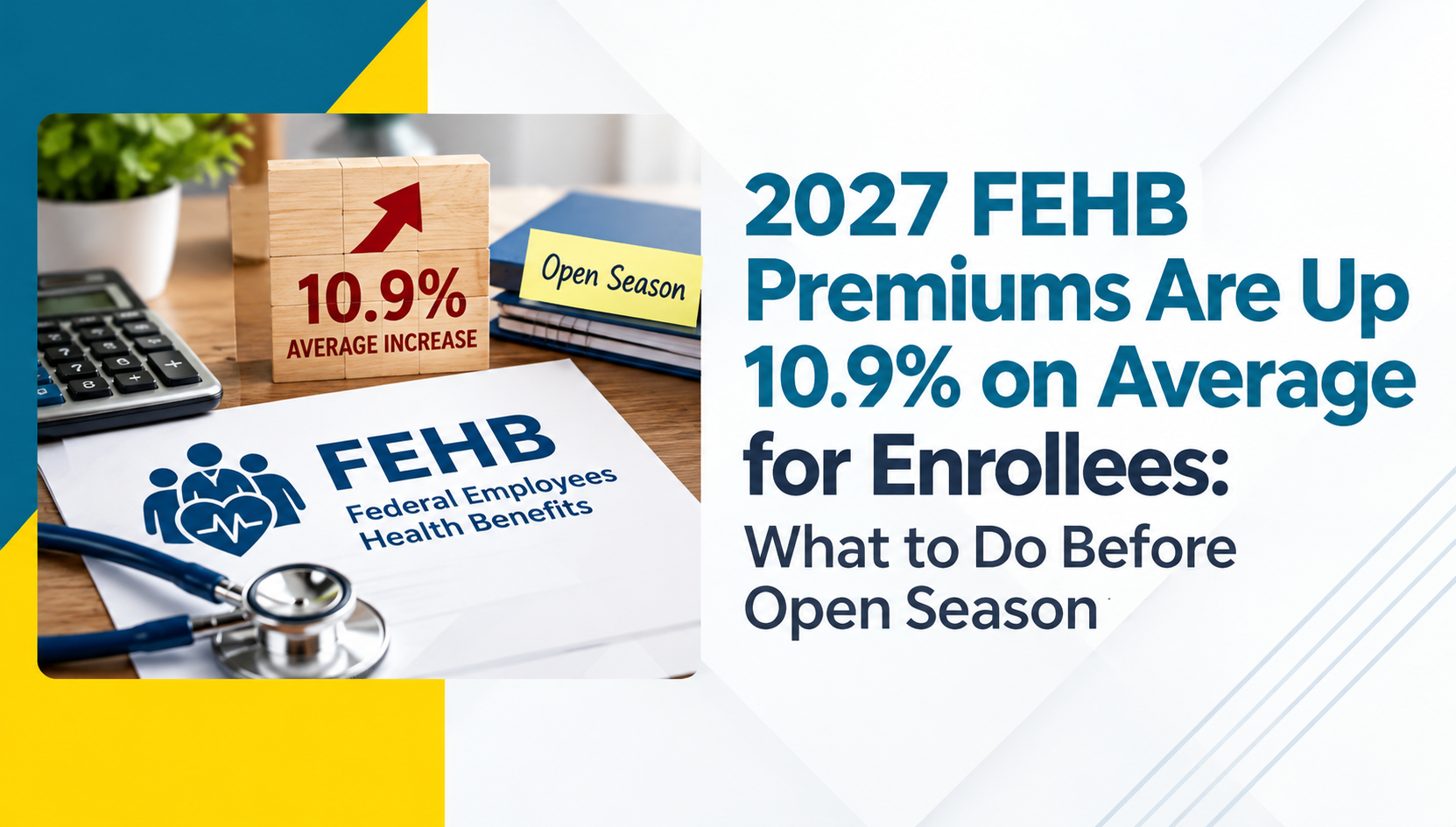
On September 30, 2026, OPM announced that FEHB enrollees will pay an average 10.9% more toward their share of 2027 premiums. The overall average premium, which includes the government's share, rises 9.3%.
According to Becker's Payer Issues, the enrollee increase is down from 12.3% for 2026. Even so, it's the third consecutive double-digit increase in the average enrollee share.
Because the average enrollee share rises faster than the overall premium, the government's share grows more slowly. On average, more of each increase lands on you.
The 10.9% figure is a program-wide average, not your personal increase. Your actual change depends on your plan, your coverage tier, and your share of the premium.
How the government contribution works
According to OPM, the government pays the lesser of 72% of the program-wide weighted average premium or 75% of the total premium for the plan you select. You pay the remainder.
For 2027, OPM set these program-wide figures:
These figures come from OPM's 2027 premium data as published by MyFederalRetirement. The two right-hand columns show the most the government will pay, not your premium; the monthly figures convert the biweekly amounts using 26 pay periods a year.
Individual plan premiums vary, so confirm your exact rate in OPM's 2027 FEHB premium tables. If your plan costs more than the weighted average, the contribution cap means you absorb the full difference.
Why FEHB premiums keep rising
Prescription spending is a major driver. According to OPM's Office of the Inspector General, FEHB pharmacy spending on GLP-1 weight-loss medications rose more than 500% from 2019 to 2024 for the two carriers studied. Federal employees reviewing their overall benefits and retirement budgets may also want to understand the projected TSP contribution limits for 2027.
Those carriers represent 69% of FEHB members, so the finding doesn't describe every FEHB carrier.
Plan changes and Open Season dates
Nine FEHB plan options will end after 2026, according to OPM's list as reported by MyFederalRetirement. These are individual options, not entire carriers or all coverage in affected areas.
If your current plan is changing, find it in OPM's FEHB Significant Events Tables. The default depends on which table lists your plan.
If your plan is leaving FEHB or terminating enrollment codes in your area, you must elect another plan during Open Season. Otherwise, OPM will enroll you in Compass Rose Health Plan Standard.
If only your option is ending within a continuing plan, OPM's table names the option you'll move to automatically. For example, MHBP Value and Consumer enrollees move to MHBP Standard unless they choose another plan.
A plan that shrinks its service area without ending your enrollment code is a different case. If you live in the dropped area and don't switch, you'll have only emergency services locally in 2027.
Whichever case applies, the safest move is to choose your 2027 plan yourself. OPM posts plan-by-plan 2027 premium rates on OPM.gov.
The 2026 Open Season, which sets 2027 coverage, runs from November 9 through December 14, 2026. New premiums generally start January 1, 2027, for annuitants, with the first pay period beginning in January 2027 for most employees.
2027 COLA Explained: How the Cost-of-Living Adjustment Works
The 2027 COLA equals the percentage increase in the average CPI-W for July, August, and September 2026 over the same three-month average from 2025. The U.S. Bureau of Labor Statistics publishes the CPI-W, the Consumer Price Index for Urban Wage Earners and Clerical Workers.
CSRS retirees and Social Security beneficiaries generally receive the full percentage. Most FERS retirees receive a reduced amount.
The Social Security Administration announces the official figure. You can review past adjustments in SSA's COLA information.
The third-quarter 2025 baseline is 317.265, and the August 2026 CPI-W was 328.481, according to Newsweek. The July 2026 CPI-W was 327.104, according to FedTools. These inflation figures are also relevant when comparing retirement income adjustments with rising health insurance costs, as discussed in our guide to 2027 COLA vs. FEHB premiums.
That leaves September as the final input.
Where forecasters stand
Published forecasts cluster between 3.4% and 3.6%, according to MyFederalRetirement:
Based on the July and August readings, a September CPI-W near 329.5 would put the final COLA at about 3.5%. BLS's CPI release schedule lists the September CPI report for October 14, 2026.
The Social Security Administration should announce the official COLA the same day. Until then, treat every figure in this section as a projection.
How the projected FERS COLA is calculated
The FERS COLA is smaller than the CSRS COLA whenever inflation exceeds 2%. Here's how the formula steps down, as described in OPM's COLA rules.
If the CPI-W increase is 2% or less, FERS retirees receive the full increase. If it falls between 2% and 3%, they receive 2%. If it exceeds 3%, they receive the increase minus one percentage point.
At a 3.5% CPI-W increase, FERS retirees would therefore receive 2.5%, according to the National Active and Retired Federal Employees Association (NARFE).
Most regular FERS retirees under age 62 generally do not receive COLAs, subject to exceptions described in OPM's COLA rules. Exceptions exist for certain disability retirees, survivor annuitants, and special-category retirees. Before retirement, review this federal retirement benefits checklist to help you understand the benefits and requirements to consider.
If part of your annuity is computed under CSRS rules, that CSRS component may receive CSRS COLAs. Check which rules apply to you before you count on a 2027 increase.
CSRS vs. FERS vs. Social Security COLA
The 2026 CSRS and Social Security figures match the 2.8% COLA listed in SSA's COLA information, and the 2026 FERS figure follows OPM's formula. The projected 2027 figures follow the same formulas, and the final numbers depend on the September CPI-W.
What a projected COLA means in dollars
As an illustration, take a $45,000 annuity receiving a full COLA. A projected 3.5% CSRS COLA adds $1,575 a year, while the projected FERS rate of 2.5% adds $1,125, a $450 difference.
The 3.5% CSRS adjustment would add $131.25 per month before deductions, while the 2.5% FERS adjustment would add $93.75. The difference between the two monthly increases is $37.50, assuming the same $45,000 starting annuity.
If you haven't received annuity payments for a full year, your first COLA may be prorated. In that case, your increase would be smaller than these examples.
How the Pay Freeze, FEHB Costs, and COLA Combine
The three pressures can combine to put pressure on household purchasing power. How much depends on your pay, your plan, and your retirement circumstances.
Your career stage matters most.
Consider a planning scenario for an active employee earning $90,000 who pays $200 biweekly for FEHB. A 10.9% enrollee increase raises that premium to about $221.80 biweekly, roughly $567 more per year. As part of a broader retirement income strategy, federal employees should also understand required minimum distributions (RMDs) from the TSP, which can affect how they plan withdrawals from their retirement savings.
With no raise and inflation near 3.5%, maintaining the same purchasing power would require about $3,150 more in annual income. This is a simplified illustration, not a measured loss. This hypothetical is for illustration only and does not represent a specific client.
Retirees face a different version. Most regular FERS retirees under age 62 generally receive no COLA, subject to exceptions, yet still pay the higher FEHB premium.
An older FERS retiree would receive a projected 2.5% against 3.5% inflation. As a simplified illustration at 3.5% inflation, that annuity trails prices by about one point in 2027.
This table assumes 3.5% inflation and a full-year COLA. It excludes other deductions, taxes, and changes in your personal spending, so it doesn't measure any one person's net disposable income.
Your own result depends on your actual expenses, your plan's premium change, and your COLA eligibility. Use OPM's 2027 premium tables to find your plan-specific figure.
The TSP, or Thrift Savings Plan, the federal government's tax-advantaged retirement savings program, may help with part of the gap. It can't guarantee that result, and contributions or withdrawals carry their own trade-offs for your budget and long-term savings.
FEHB Costs and COLA Explained: Steps to Take Before Year-End
You can respond to the 2027 squeeze in five steps, from reviewing plan rates to stress-testing your retirement income. This checklist is for educational purposes only.
- Compare 2027 FEHB rates. Review your plan's new premium on OPM.gov and compare it with at least two alternatives before December 14.
- Confirm your plan isn't ending. Nine plan options leave the program, so verify yours is still offered.
- Recalculate your budget under the announced pay plan. Model 2027 income with no raise unless Congress or OPM changes the outcome.
- Check your FERS COLA eligibility. Confirm whether you're 62 or older or qualify for an exception, since that determines whether a COLA applies.
- Review your TSP contribution. Decide whether your current contributions still fit a tighter 2027 budget, using the contribution rules on TSP.gov.
These steps are general information, not individualized advice. Premium rates, COLA figures, and pay decisions can change before they become final.
Plan Around Three Moving Numbers
The 2027 squeeze rests on three figures. The first is a 0% civilian pay adjustment under the announced pay plan, and the second is a 10.9% program-wide average increase in FEHB enrollee premiums. Federal employees can use this retirement planning checklist to review their retirement preparations and evaluate how changing benefit costs may affect their plans.
The third is a projected COLA near 3.5% for CSRS retirees and 2.5% for most FERS retirees. Some details can still shift.
The COLA becomes official on October 14, and Open Season closes December 14. Congress could still change federal pay, and OPM will finalize law enforcement pay details through its implementation process. If you need help understanding how these changes may affect your retirement plans, you can schedule a federal retirement consultation.
Federal Pension Advisors offers federal benefits reviews to help you evaluate how potential pay changes, FEHB premiums, and COLA adjustments may affect your retirement plan. Schedule a federal benefits review to discuss your individual situation.
For more detail on each piece, read our guides to 2027 FEHB Changes, the 2027 Federal Pay Raise Freeze, the 2027 FERS and CSRS COLA Estimate, and the FERS COLA Forecast.
For additional guidance on Thrift Savings Plan contributions and retirement planning, explore our TSP webinars.
This article is educational and does not constitute individualized financial, legal, or tax advice. Verify all figures at OPM.gov, SSA.gov, BLS.gov, and TSP.gov before making decisions.
Frequently Asked Questions
Will federal employees get a pay raise in 2027?
Under the announced 2027 pay plan, most civilian federal employees are slated for no raise. President Trump's alternative pay plan, announced August 26, 2026, sets base and locality pay at 2026 levels for covered employees.
Covered law enforcement positions may receive up to 3.8%, subject to eligibility and salary caps. Congress can still pass legislation that changes federal pay.
How much are FEHB premiums going up in 2027?
Enrollees in FEHB, the Federal Employees Health Benefits Program, will pay 10.9% more on average toward their share of 2027 premiums. OPM, the U.S. Office of Personnel Management, announced the figure on September 30, 2026.
The overall average premium rises 9.3%. Because these are program-wide averages, your own plan may rise more or less, so check its rate during Open Season.
What is the projected 2027 COLA for federal retirees?
The official 2027 cost-of-living adjustment (COLA) is due October 14, 2026, and forecasts cluster near 3.5%. If that projection holds, CSRS retirees and Social Security recipients would generally receive the full amount.
Most FERS retirees age 62 or older would receive about 2.5%. CSRS is the Civil Service Retirement System; FERS is the Federal Employees Retirement System.
Why do FERS retirees get a smaller COLA than CSRS retirees?
Under FERS, the Federal Employees Retirement System, the COLA shrinks when inflation exceeds 2%. CSRS annuitants generally receive the full COLA, although the first adjustment may be prorated depending on when annuity payments began.
During periods of higher inflation, the FERS formula can produce lower cumulative increases than the CSRS formula. That difference matters more the longer you're retired.
When is FEHB Open Season for 2027?
The Federal Employees Health Benefits Program (FEHB) Open Season for 2027 coverage runs from November 9 through December 14, 2026, according to OPM. During this period, eligible employees and retirees can enroll in, change, or cancel FEHB coverage.
If your plan option continues in 2027 and you make no changes, your coverage carries over automatically. If your plan or option is ending, check OPM's Significant Events Tables for your default, and make your own election during Open Season.
Can Congress override the 2027 federal pay freeze?
Yes. Congress can pass legislation setting a civilian pay raise, such as the proposed FAIR Act, which calls for a 4.1% raise.
Congress overruled each of the pay freezes Trump proposed in his first three budgets during his first term. For 2027, the 0% adjustment stands unless Congress enacts a different increase.
Disclaimer:
This article is for educational and informational purposes only and does not constitute individualized financial, investment, legal, or tax advice. Federal pay adjustments, FEHB premiums, and 2027 cost-of-living adjustments (COLAs) may change as official decisions and figures are finalized. Projections are estimates, not guaranteed outcomes. Verify the latest information with the U.S. Office of Personnel Management (OPM), Social Security Administration (SSA), Bureau of Labor Statistics (BLS), and Thrift Savings Plan (TSP) before making financial or retirement decisions. Consult a qualified professional for guidance tailored to your circumstances.


Get Updated
Subscribe to our weekly updates for the latest on retirement planning, federal benefits, exclusive webinars, and more!

Thomas A. Doherty
Thomas A. Doherty is a retirement planning consultant with 35 years of experience helping individuals, federal employees, academic employees, and business owners better understand their retirement options. His work focuses on helping clients make the most of their available benefits, insurance policies, and investment plans so they can build more stable retirement income and reduce unnecessary financial risk.

Download Federal Retirement: Step-by-step Checklist
This comprehensive guide will help you understand your federal benefits, optimize your savings, and plan for a comfortable future.
Recent Post's