

Published
Sep 30, 2026

Last Updated
Sep 30, 2026
How to Maximize Your TSP Agency Matching Before the End of 2026
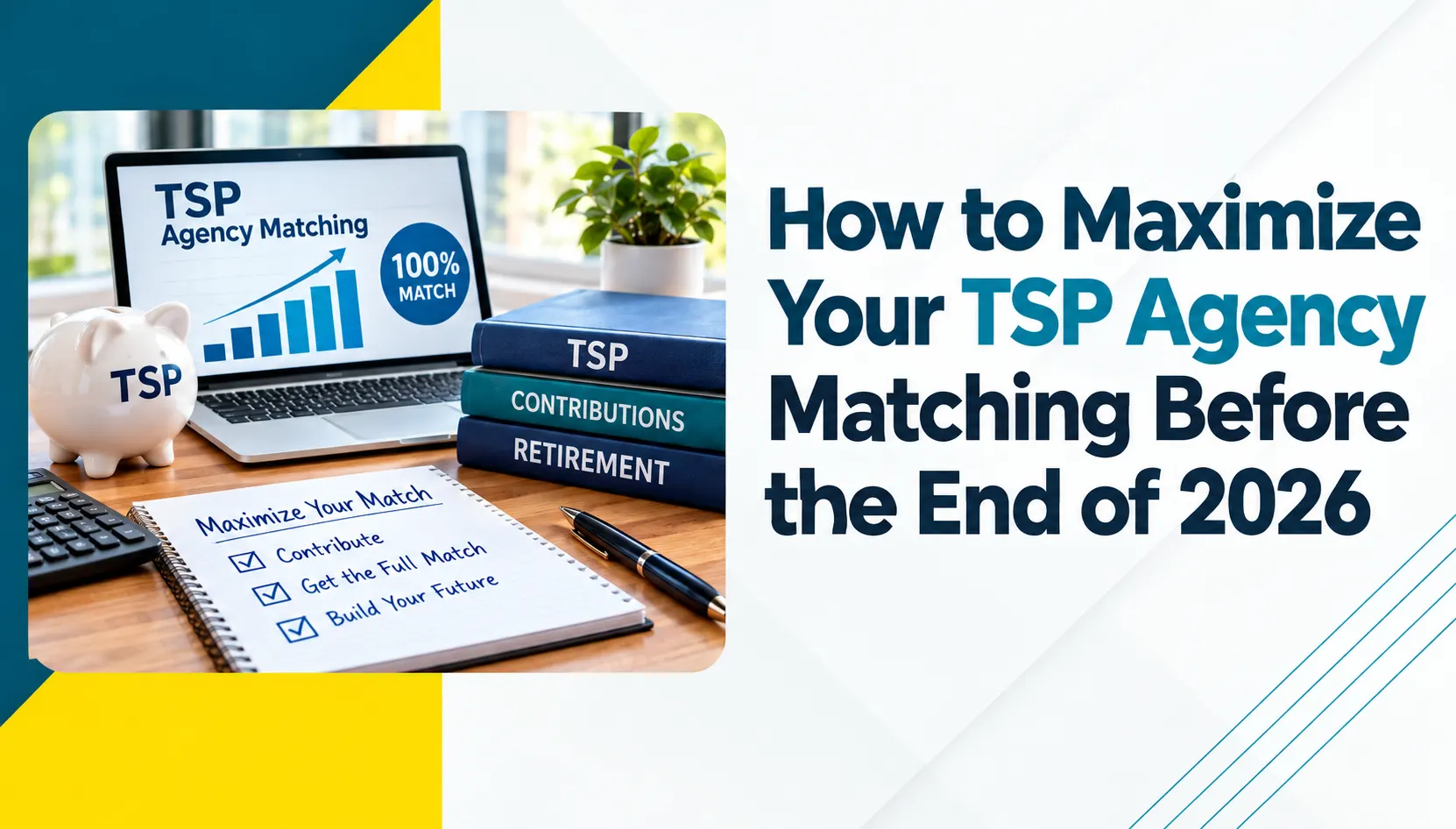
To maximize your TSP agency matching before the end of 2026, contribute at least 5% of your basic pay to your TSP account in every remaining pay period. Once you're reviewing your TSP strategy, you may also want to understand the TSP Mutual Fund Window and how it fits into your overall investment approach. Don't hit your annual contribution limit early.
TSP agency matching is the money your federal agency deposits into your Thrift Savings Plan (TSP) account when you contribute from your own pay. The TSP is the federal government's tax-advantaged retirement savings program.
For ordinary payroll contributions, you generally can't recover a missed pay-period match by contributing more later.
Federal Pension Advisors, a retirement planning firm specializing in federal employee benefits, wrote this guide for employees under FERS, the Federal Employees Retirement System. It covers how the match works, what it takes to earn it all, and the year-end mistakes that can cost you significant matching contributions.
What Is TSP Agency Matching?
TSP agency matching depends on your own contributions. If you're under FERS, you receive up to 4% of basic pay in matching contributions. If you're considering using your TSP for a home purchase, it's also important to understand the rules and potential impact of a TSP loan to buy a house.
You also receive a separate 1% automatic contribution, whether or not you contribute anything. Together, the agency contributions total 5% of basic pay.
https://www.federalpensionadvisors.com/retirement-planning-checklists
Employees under CSRS, the Civil Service Retirement System, are ineligible for automatic or matching contributions.
How the FERS TSP Match Works
The table shows what each contribution rate earns you.
According to TSP.gov, if you stop contributing, your matching contributions stop. The 1% automatic contribution generally continues. The 4% match doesn't. Understanding how TSP contributions affect your future retirement income is an important part of federal retirement income planning.
Contribute at least 5% to get the full match. Contributing more earns no additional match, though it builds your own savings.
Why Every Pay Period Counts
TSP calculates the match every pay period, not once a year.
According to the National Finance Center (NFC), a payroll provider for many federal agencies, the maximum TSP match requires contributing 5% of basic pay in every pay period throughout the year. Learn more about the 2026 TSP Roth catch-up rule for federal employees
If you contribute less than 5% in a pay period, you get a smaller match for that period. At 3%, for example, you earn a 3% match instead of 4%. Contributing more later doesn't make up the difference for ordinary payroll contributions.
Common ways you can lose matching contributions include:
- A late start. If you begin contributing in June, you miss the match for earlier pay periods.
- A mid-year pause. If you stop contributions to cover an expense, you lose matching for that time.
- An early limit. If you contribute aggressively, you can reach the IRS limit before December and lose matching for the remaining pay periods.
2026 TSP Contribution Limits by Age
According to IRS Notice 2025-67, the 2026 elective deferral limit is $24,500 for all ages. Employees age 50 and older can add catch-up contributions, and those ages 60 to 63 get an enhanced super catch-up. As you review your retirement planning, understanding current federal retirement processing timelines can also help you prepare for the transition from employment to retirement income.
The IRS, the Internal Revenue Service, sets these limits each year.
According to NFC, the $24,500 limit applies to your combined traditional and Roth contributions. The agency's 1% automatic contribution and up to 4% matching are separate and don't count against it.
The per-pay-period figures are the annual limit divided by 26. They're planning illustrations only.
The match depends on contributing at least 5% of your basic pay in each pay period, so check that any even-spread amount meets that floor.
Your actual pay schedule, contributions you've already made this year, and any mid-year changes affect the right number for you. Confirm your limits on TSP.gov before you change your election.
How Front-Loading Costs You Matching
If you reach your annual contribution limit before your last pay date, your contributions stop, and your agency matching stops with them. The 1% automatic contribution continues.
For participants under 50, reaching $24,500 ends employee contributions and matching for later pay periods. Participants age 50 and older may continue through spillover toward the catch-up limit.
Consider a hypothetical: a 45-year-old FERS employee earning $100,000 elects $1,300 per biweekly pay period. That employee contributes $23,400 over the first 18 pay periods, leaving $1,100 of contribution room. Understanding how your FERS pension may fit alongside your TSP contributions can also help you estimate your broader retirement income.
The employee reaches the $24,500 limit during pay period 19, and contributions stop there. Seven pay periods remain, and the 4% match is about $154 per pay period on basic pay of about $3,846.
The lost match comes to roughly $1,077, plus the investment growth on it. This scenario is illustrative arithmetic, not a client result.
Check your year-to-date total against your limit each quarter to catch an early finish before it costs you.
Catch-Up Contributions, Spillover, and the Match
If you're 50 or older, you have a different limit to watch because of a mechanism called spillover. Once your contributions reach the $24,500 regular limit, additional contributions automatically count toward your catch-up limit.
You don't make a separate catch-up election. TSP has used this method since 2021. For more guidance on TSP contributions and retirement strategies, you can also explore our TSP webinars.
According to NFC, the agency matches contributions that spill over toward the catch-up limit, but only up to the 5% of salary you already qualify for.
Your contributions don't necessarily stop at 24,500.Theycancontinuethroughspilloveruntilyoureachyourcombinedlimit(32,500, or $35,750 for ages 60 to 63).
A 55-year-old who reaches $24,500 in October may keep contributing through spillover. Eligible matching contributions can continue, subject to the 5% matching limit and payroll timing.
Older NFC guidance still says FERS participants receive no match on catch-up contributions. That text describes the separate catch-up election TSP used before spillover. For a broader overview of how federal employee retirement contributions work, including FERS contributions and TSP savings, see this guide to [federal employee retirement contributions].
Current TSP.gov guidance says catch-up contributions can qualify for the match up to 5% of your salary. Confirm how this applies to your account with your agency payroll office.
Comparing Three Contribution Strategies
Your best strategy depends on your cash flow, age, and retirement goals.
Seven Steps to Capture the Full Match
Follow these steps in order:
- Confirm your coverage. Check that FERS covers you, since CSRS employees receive no agency contributions.
- Find your current contribution percentage. Look at your latest earnings statement or your agency's payroll system, and confirm it's at least 5% of basic pay.
- Count your remaining pay periods. Check your payroll calendar for how many pay dates remain in 2026.
- Calculate your year-to-date contributions. Compare what you've contributed so far against your age-based limit.
- Project your total. Multiply your per-period contribution by the remaining pay periods. If it exceeds your limit before the last pay date, lower your election.
- Submit your change. Most employees update elections in their agency's payroll or HR system. Confirm the process with your agency and allow for processing time.
- Recheck after the next paycheck. Confirm the new election appears on your earnings statement.
Federal Pension Advisors recommends making any change at least two pay periods before year-end. This is a planning recommendation, not an official deadline. Processing times vary by agency.
Roth or Traditional: Does It Change the Match?
Choosing traditional or Roth TSP doesn't change how much match you receive. According to NFC, you can split your contributions between the two in any proportion. You can also use a TSP calculator to estimate how your contributions may affect your retirement savings.
To get the maximum match, you must contribute at least 5% of basic pay to the traditional TSP, Roth TSP, or both each pay date. Agency contributions go into the traditional balance either way.
The difference is tax treatment. Traditional contributions lower your taxable income now. You pay tax on Roth contributions now, and you can withdraw them tax-free in retirement, subject to the rules. If you're unsure which approach fits your federal retirement goals, you can schedule a free retirement consultation to discuss your options.
The Roth catch-up rule for higher earners
Since 2026, SECURE 2.0 requires some participants to make catch-up contributions on a Roth basis. According to the IRS, that applies if your prior-year wages with the plan sponsor exceeded $150,000 for 2026.
The test uses your 2025 Social Security (FICA) wages from your federal employer, not your total household income. Those wages appear in Box 3 of your 2025 W-2. Federal employees can also review their broader retirement and Social Security planning options with Federal Benefits Advisor
If your 2025 wages were $150,000 or less, the requirement doesn't apply to you. You can still split regular contributions up to $24,500 between traditional and Roth as you choose.
Year-End Checklist for FERS Employees
Use this checklist in the final quarter of 2026:
- Verify that your contribution is at least 5% of basic pay for every remaining pay period.
- Calculate whether your current election reaches your annual limit before your last pay date.
- Confirm how spillover applies to your combined limit if you're 50 or older.
- Check whether the super catch-up applies to you if you're 60 to 63.
- Compare your 2025 W-2 Box 3 wages with the $150,000 Roth catch-up threshold if you plan to make catch-up contributions.
- Review your TSP fund allocation against your retirement timeline.
- Confirm your new election appears on your next earnings statement.
- Plan your 2027 election now, since limits typically change each year.
Frequently Asked Questions
How does TSP agency matching work?
FERS employees receive an automatic 1% agency contribution whether or not they contribute. The agency also matches your first 3% dollar-for-dollar and your next 2% at 50 cents on the dollar. Contributing 5% every pay period earns the full 5% agency total.
What is the maximum TSP contribution for 2026?
The 2026 TSP elective deferral limit is $24,500 for all ages, according to IRS Notice 2025-67. Participants age 50 and older can add $8,000 in catch-up contributions, for $32,500 total. Participants ages 60 through 63 can add $11,250, for $35,750 total.
Will I lose my TSP match by hitting the limit early?
Yes, if you're under 50. Your contributions stop at the $24,500 limit, and your agency matching stops with them. The 1% automatic contribution continues.
If you're 50 or older, you can keep contributing through spillover. Eligible spillover contributions can still earn the match, up to the 5% of basic pay you already qualify for.
Do catch-up contributions get the TSP match?
Yes, up to a point. According to TSP.gov, the agency matches contributions that spill over toward the catch-up limit, up to the 5% of basic pay you're already entitled to.
Confirm how this applies with your payroll office.
Are CSRS employees eligible for TSP agency matching?
No. CSRS employees, including CSRS Offset employees, are ineligible for automatic or matching contributions. They can still contribute up to the annual IRS limits.
FERS employees and eligible Blended Retirement System members receive agency contributions.
When does the TSP agency match vest?
Matching contributions vest immediately, meaning they're yours from the first deposit. The 1% automatic contribution vests after 3 years of federal civilian service for most FERS employees, or 2 years for some non-career participants. Leaving before vesting forfeits the unvested automatic amount.
Disclaimer
This article is for informational purposes only and is not financial, tax, or legal advice. TSP contribution limits, matching rules, tax requirements, and federal retirement benefits may change. Verify current information with TSP.gov, OPM, the IRS, and your agency payroll office before making contribution decisions.


Get Updated
Subscribe to our weekly updates for the latest on retirement planning, federal benefits, exclusive webinars, and more!

Stuart Hunsicker
Stuart Hunsicker is a retirement planning professional with over two decades of experience in the financial industry. His work focuses on helping federal employees, educators, and families better understand their retirement options and build strategies designed around long-term financial stability.

Download Federal Retirement: Step-by-step Checklist
This comprehensive guide will help you understand your federal benefits, optimize your savings, and plan for a comfortable future.
Recent Post's