
.png)


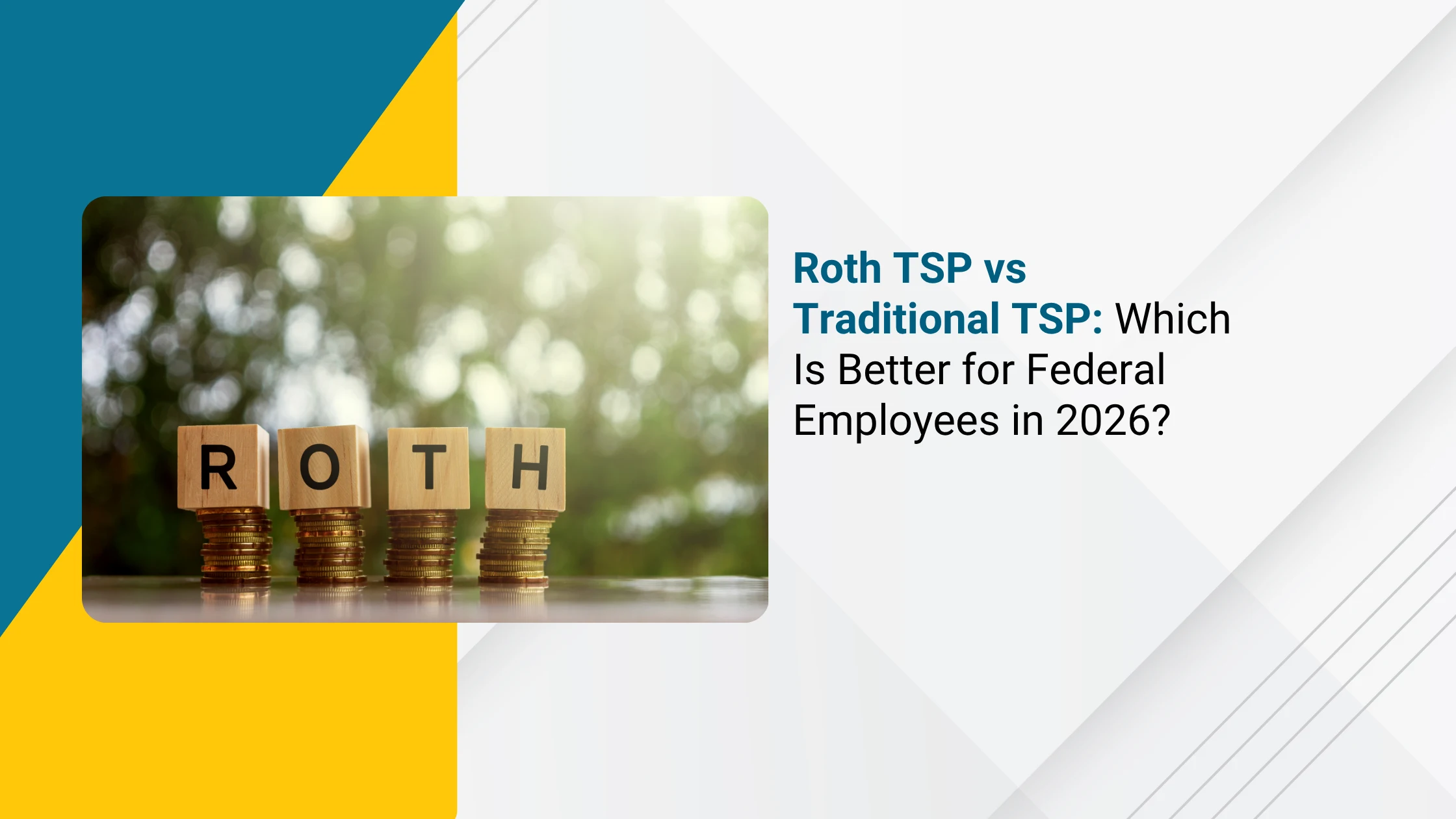
Roth TSP vs Traditional TSP: Which Is Better for Federal Employees in 2026?
The choice between Roth TSP vs traditional TSP comes down to one question: do you want to pay taxes now or in retirement? Roth TSP contributions are made with after-tax dollars and grow tax-free. Traditional TSP contributions reduce your taxable income today but are taxed as ordinary income when you withdraw the money.
For most federal employees in 2026, the better account depends on your current marginal tax bracket, your expected retirement tax bracket, and how many years of compounding you have left.
The TSP, or Thrift Savings Plan, is the federal government's tax-advantaged retirement savings program. It offers both Roth and traditional contribution options inside a single account. The right mix can materially affect lifetime taxes, especially for high earners or employees with large TSP balances.
This guide explains the difference, the 2026 contribution limits set by the IRS, how the new Roth TSP conversion rules work, and how to decide which option fits your career stage.
Roth TSP vs Traditional TSP: The Core Difference
The core difference between Roth TSP and traditional TSP is the timing of taxation. The federal government deducts traditional TSP contributions from your pay before calculating federal income tax, which lowers your taxable income for that year.
You make Roth TSP contributions from pay that has already been taxed. They don't reduce current income, but qualified withdrawals in retirement, including all investment earnings, are completely tax-free.
Both options share the same investment funds, the same agency matching rules under FERS (the Federal Employees Retirement System), and the same annual elective deferral limit. The biggest difference is tax timing.
Roth and traditional TSP also differ in withdrawal tax treatment, the Roth five-year rule, RMD planning, mandatory Roth catch-up rules for high earners, and in-plan conversion considerations. All of these points are covered below.
According to the Thrift Savings Plan, agency automatic and matching contributions always go into the traditional balance. That rule applies whether the employee chooses Roth or traditional for their own contributions. A Roth-only contributor will still build a traditional balance over time from agency matching. To see how your full retirement income picture comes together, use our federal retirement calculator.
2026 TSP Contribution Limits
The IRS, or Internal Revenue Service, sets the annual contribution limits for the TSP under Section 402(g) of the Internal Revenue Code. The 2026 elective deferral limit is $24,500, and the standard age 50+ catch-up contribution is $8,000, according to IRS Notice 2025-67.
A new tier introduced under the SECURE 2.0 Act applies in 2026. Employees aged 60 through 63 qualify for an enhanced TSP catch-up contributions 2026 limit of $11,250 instead of the standard $8,000, according to the IRS. Employees aged 64 and older revert to the standard $8,000 catch-up.
2026 TSP Contribution Limits at a Glance
Source: IRS Notice 2025-67 and TSP, 2026 plan year.
The $24,500 elective deferral limit is the combined cap across Roth TSP and traditional TSP contributions. You can split contributions between the two in any proportion. The total cannot exceed the limit. Run your numbers through our TSP calculator to see how each contribution split affects long-term growth.
Mandatory Roth Catch-Up Rule for High Earners
Starting in 2026, federal employees aged 50 and over whose prior-year FICA wages exceeded $150,000 must make any catch-up contributions as Roth, according to TSP.gov. These employees can still make regular traditional contributions up to the $24,500 elective deferral limit. Any contributions above that limit, the catch-up portion, must go to the Roth balance.
This rule applies on a year-by-year basis using prior-year Social Security (FICA) wages. So an employee's eligibility for pre-tax catch-up contributions can change annually.
Employees below the $150,000 wage threshold keep the choice between Roth and traditional catch-up contributions. For affected high earners, catch-up contributions in 2026 must be made as Roth contributions. That makes this a 2026 planning decision point that didn't exist in prior years.
How Roth TSP Contributions Work
Roth TSP contributions come out of your paycheck after federal and state income tax has been withheld. Once deposited, the contributions and all future earnings grow tax-free.
Qualified withdrawals in retirement aren't taxed at all, provided two conditions are met: the account has been open for at least five years, and the participant is at least 59 1⁄2 years old, disabled, or deceased.
The Roth TSP is particularly valuable if you expect to be in a higher tax bracket in retirement than you are today. This typically applies to early-career employees, employees with significant non-TSP retirement income expected (such as a working spouse, rental income, or a sizable inherited IRA), and employees who plan to retire in a high-tax state.
Because agency matching always flows to the traditional balance, a FERS employee contributing only to Roth TSP will still see traditional dollars accumulate. FERS employees receive an automatic 1% agency contribution plus matching of up to 4% on the first 5% of employee contributions, according to OPM, the U.S. Office of Personnel Management. That's a 5% total agency contribution that lands in the traditional side of the account. Estimate your FERS pension alongside your TSP balance using our FERS retirement calculator.
How Traditional TSP Contributions Work
Traditional TSP contributions reduce your current-year federal taxable income dollar-for-dollar. If you're in the 22% marginal bracket and contribute $24,500 to traditional TSP in 2026, you reduce your federal income tax bill by roughly $5,390 that year, before state taxes or other tax effects, according to the IRS 2026 tax bracket schedule.
The trade-off is that all withdrawals in retirement, both contributions and earnings, are taxed as ordinary income. Required minimum distributions, known as RMDs, apply to traditional TSP balances but not to Roth TSP balances for the original participant. That follows the SECURE 2.0 Act change for employer-plan Roth accounts.
Under SECURE 2.0, the traditional TSP RMD age is 73 for participants born between 1951 and 1959, and 75 for those born in 1960 or later, according to the IRS.
Traditional TSP contributions are most efficient if you expect to be in a lower tax bracket in retirement than during your working years. This profile commonly fits late-career federal employees in higher pay grades, employees nearing their MRA, or Minimum Retirement Age (the earliest age a FERS employee can retire with an immediate annuity), and employees who plan to relocate to a state with no income tax in retirement.
Roth TSP vs Traditional TSP: Side-by-Side Comparison
The table below summarizes how each contribution type behaves across the variables that matter most when choosing between them.
Source: TSP and IRS, 2026 plan year. Under the SECURE 2.0 Act, Roth balances in employer plans are no longer subject to lifetime RMDs for the original participant. Beneficiary distribution rules still apply.
Roth TSP Conversion: What Federal Employees Need to Know
As of 2026, the TSP allows Roth in-plan conversions, according to the TSP official site. Eligible participants can convert money from a traditional TSP balance directly to a Roth TSP balance inside the plan, without first rolling the funds to an IRA.
The converted amount is treated as taxable income in the year of conversion. You can still use the IRA-rollover route if you prefer, but the in-plan option is now the simpler path for most participants.
A Roth conversion, whether in-plan or via IRA rollover, is a significant taxable event and requires careful planning. The full converted amount is added to that year's taxable income. That can push you into a higher bracket, increase Medicare IRMAA, or Income-Related Monthly Adjustment Amount, surcharges on Medicare Part B and D premiums, and reduce eligibility for income-based credits.
Federal Pension Advisors generally recommends smaller staged conversions across multiple low-income years rather than a single large conversion that triggers an outsized tax bill. The typical window is the gap between federal retirement and the start of Social Security benefits at age 70. The new in-plan conversion option makes this staging easier to execute without external account transfers.
Which Option Is Better for You in 2026?
The right choice depends on three variables: your current marginal tax bracket, your projected retirement tax bracket, and your time horizon to retirement. Use these general guidelines.
Roth TSP is typically the better choice when:
- You're early in your federal career and expect significant salary growth.
- You're in the 12% or 22% federal marginal bracket today.
- You expect substantial taxable retirement income from other sources, such as a FERS annuity, the FERS supplement, Social Security, a working spouse's pension, or rental property.
- You want to leave heirs the ability to take tax-free withdrawals, though inherited account distribution rules still apply to non-spouse beneficiaries.
Traditional TSP is typically the better choice when:
- You're in the 24%, 32%, or higher federal marginal bracket today.
- You plan to retire in a state with no income tax (such as Florida, Texas, Tennessee, or Nevada). This may help, but you should still model the decision against federal tax brackets, RMDs, Social Security taxation, and Medicare IRMAA.
- You expect your retirement spending to be modest relative to current income.
- You need the current-year tax deduction to qualify for income-based programs or credits.
For many mid-career federal employees, a split contribution strategy, some Roth and some traditional, produces tax diversification that gives you flexibility to manage taxable income year by year in retirement. That flexibility is particularly useful for managing IRMAA brackets and controlling the taxation of Social Security benefits.
Need help deciding between Roth TSP and traditional TSP? Federal Pension Advisors can help you compare taxes, retirement income, and long-term withdrawal strategy.
The Bottom Line for Federal Employees
The Roth TSP vs traditional TSP decision isn't a one-time choice. Revisit it as your salary, family situation, and retirement timeline evolve.
Younger federal employees and those in lower brackets today usually benefit from Roth TSP. Higher-paid late-career employees often benefit from traditional TSP and a phased Roth conversion strategy after retirement. Most federal employees fall somewhere in between and gain from a deliberate mix.
Federal Pension Advisors helps federal employees model the long-term tax impact of each TSP contribution mix alongside their FERS annuity, Social Security claiming strategy, and FEHB (the Federal Employees Health Benefits Program) and FEGLI (the Federal Employees Group Life Insurance program) decisions. The right TSP allocation today compounds for decades, and the decision deserves more than a default setting.
Frequently Asked Questions
1. What is the difference between Roth TSP and traditional TSP?
Roth TSP contributions are made with after-tax dollars, and qualified withdrawals in retirement are tax-free. Traditional TSP contributions are pre-tax and reduce your current taxable income, but all withdrawals in retirement are taxed as ordinary income. Both options share the same $24,500 combined contribution limit in 2026, according to the IRS.
2. Can I contribute to both Roth TSP and traditional TSP at the same time?
Yes. You can split contributions between Roth TSP and traditional TSP in any proportion within a single TSP account. The combined total cannot exceed the 2026 IRS elective deferral limit of $24,500, or $32,500 with the standard catch-up contribution if you're 50 or older.
3. How much can I contribute to my TSP in 2026?
The 2026 elective deferral limit is $24,500 for all participants, according to IRS Notice 2025-67. The standard age 50+ catch-up is $8,000. If you're aged 60 through 63, you qualify for an enhanced catch-up of $11,250 under the SECURE 2.0 Act. That raises your total potential contribution to $35,750.
4. Does agency matching go into Roth TSP or traditional TSP?
Agency automatic and matching contributions always go into the traditional TSP balance. That applies whether you contribute to Roth, traditional, or both. According to TSP.gov, this rule applies to all FERS participants and cannot be redirected. Roth-only contributors still accumulate a traditional balance from agency contributions.
5. Can I convert my traditional TSP to a Roth TSP?
Yes. As of 2026, the TSP allows Roth in-plan conversions, according to TSP.gov. Eligible participants can convert traditional TSP money to Roth inside the plan. You can also use an IRA rollover strategy depending on your situation. The converted amount is taxed as ordinary income in the year of conversion.
6. Are catch-up contributions required to be Roth in 2026?
If you're aged 50 and over and your prior-year FICA wages exceeded $150,000, catch-up contributions must be made as Roth, according to TSP.gov. Employees below that wage threshold can still choose between Roth and traditional catch-up contributions. Eligibility is reassessed annually based on the prior year's Social Security wages.
7. Do Roth TSP withdrawals affect Social Security taxation?
No. Qualified Roth TSP withdrawals generally aren't counted as provisional income in the Social Security taxation formula, according to the Social Security Administration (SSA). Qualified Roth withdrawals don't increase the taxable portion of Social Security benefits. That makes the Roth TSP particularly valuable for retirees managing combined income thresholds.

Get Updated
Subscribe to our weekly updates for the latest on retirement planning, federal benefits, exclusive webinars, and more!

Brad Myers
Brad Myers is a Federal Benefits Specialist with 17 years of experience helping federal employees better understand and maximize their retirement benefits. As a ChFEBC professional, Brad specializes in FERS and CSRS retirement planning, pension maximization strategies, Thrift Savings Plan (TSP) guidance, and federal employee benefits education designed to support long-term financial security.

Download Federal Retirement: Step-by-step Checklist
This comprehensive guide will help you understand your federal benefits, optimize your savings, and plan for a comfortable future.
Recent Post's