
.png)


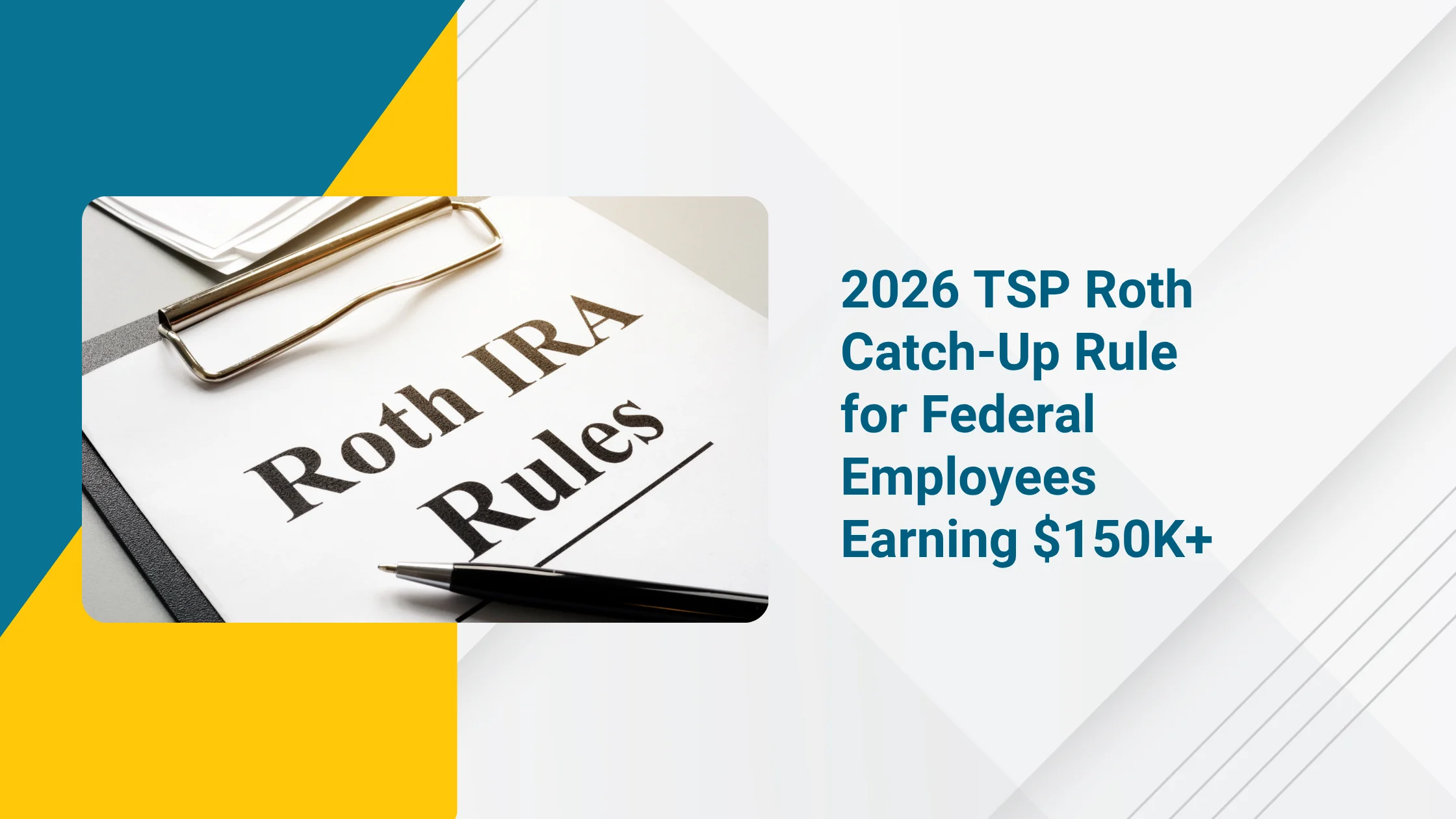
2026 TSP Roth Catch-Up Rule for Federal Employees Earning $150K+
The Roth catch-up rule 2026 requires federal employees age 50 and older who earned more than $150,000 in FICA (Federal Insurance Contributions Act) wages from their employing agency in the prior calendar year to make all catch-up contributions to the TSP, or Thrift Savings Plan, the federal government's tax-advantaged retirement savings program, on a Roth (after-tax) basis rather than traditional pre-tax. Section 603 of the SECURE 2.0 Act of 2022 created this mandate, which applies to TSP participants beginning with 2026 contributions under guidance published by the Federal Retirement Thrift Investment Board (FRTIB), the independent agency that oversees the TSP. For high-earning federal employees nearing retirement, the rule changes both the tax treatment of catch-up dollars and the planning math behind every contribution decision.
This article explains who the new Roth catch-up rules apply to, how the $150,000 threshold is calculated, what changes inside the TSP for affected participants, and how to adjust your 2026 contribution strategy. It also covers the interaction with FERS, the Federal Employees Retirement System, and how the rule fits into a broader retirement income plan.
What Is the Roth Catch-Up Rule 2026?
The Roth catch-up rule 2026 is a federal tax provision requiring higher-income employees age 50 or older to designate all "catch-up" retirement contributions as Roth contributions. The dollars are taxed in the year you contribute them rather than at withdrawal.
The rule applies to 401(k) plans, 403(b) plans, governmental 457(b) plans, and the TSP. Employees below the wage threshold keep the choice between traditional pre-tax and Roth treatment for their catch-up dollars.
IRS Notice 2023-62 gave employers a two-year administrative transition period after Section 603 was enacted. The IRS, the U.S. Internal Revenue Service, issued final regulations in September 2025, and they were published in the Federal Register on September 16, 2025. For TSP participants, the Roth catch-up requirement begins with 2026 contributions under TSP's published 2026 contribution bulletin, following the end of the IRS administrative transition period.
Who Is Affected: The $150,000 Threshold
The threshold uses FICA wages from the prior calendar year, paid by the same employer that sponsors the retirement plan. For a federal employee, that means wages from a single federal agency reported on Form W-2, Box 3.
For 2026, the rule applies to federal employees aged 50 or older whose prior-year FICA wages exceeded $150,000, based on 2025 wages reported by their employing agency.
Several details matter for federal employees:
- The threshold isn't your total household income, your adjusted gross income, or your basic pay. It's the FICA wage figure from your prior-year W-2, Box 3.
- The threshold applies per employer. An employee who switched agencies mid-year may not cross the threshold at the new agency in the first year of employment.
- The threshold is statutory but indexed for inflation. Per the IRS final regulations published in the Federal Register on September 16, 2025, the figure is adjusted annually. The $150,000 figure for 2026 reflects an upward adjustment from the original $145,000 base in the statute.
- Self-employment income doesn't count toward the federal threshold, since self-employed individuals don't participate in the TSP.
Many higher-paid federal employees may exceed the 2026 threshold, including some GS-14 and GS-15 employees in higher locality areas, Senior Executive Service members, physicians, attorneys, and special-pay personnel. Federal Pension Advisors, a retirement planning firm specializing in federal employee benefits, recommends that any employee within $10,000 of the threshold model both Roth and traditional outcomes before locking in a 2026 election.
2026 TSP Contribution Limits at a Glance
The IRS announces TSP contribution limits each fall. The figures below reflect the 2026 limits published by the IRS and the FRTIB.
The "enhanced catch-up" for ages 60 through 63 is a separate SECURE 2.0 provision that took effect in 2025. The FRTIB implemented the enhanced catch-up beginning January 2025, and the Roth-only requirement layers on top of it for affected participants in 2026.
How the New Roth Catch-Up Rules Change TSP Mechanics
Before 2026, a federal employee aged 50 or older could direct catch-up contributions to either the Traditional TSP balance, the Roth TSP balance, or split between them. Beginning with 2026 contributions, affected employees lose that choice for the catch-up portion only. Three operational points follow.
First, the payroll office is responsible for the Roth designation. Per TSP's 2026 contribution bulletin, once an affected participant reaches the traditional pre-tax maximum, the payroll office must submit additional catch-up contributions as Roth contributions. Each federal payroll provider, including the Defense Finance and Accounting Service (DFAS), the National Finance Center (NFC), and the Interior Business Center, identifies affected employees based on prior-year W-2 data.
Second, agency matching is unaffected. Under FERS, the Federal Employees Retirement System, the federal government provides an automatic 1% contribution plus matching of up to 4% on the first 5% of employee deferrals. Per the IRS final regulations issued in September 2025, agency contributions remain pre-tax (traditional) regardless of employee Roth designation. Only the employee's own catch-up dollars must be Roth for affected participants.
Third, the regular elective deferral remains a choice. The Roth-only mandate applies solely to the catch-up portion above the standard elective deferral limit. You can still allocate the first $24,500 of 2026 contributions between Traditional TSP and Roth TSP at your discretion.
Roth vs. Traditional: A Tax Trade-Off Comparison
The shift from traditional to Roth catch-up changes the timing of tax payment, not the amount of the contribution. Whether the change benefits you depends on your current versus future marginal tax rates.
According to the Congressional Research Service report on SECURE 2.0 published in 2023, the policy intent of the Roth catch-up mandate is to accelerate federal tax revenue while preserving the long-term retirement benefit for the saver. For you as an individual employee, the question is whether locking in today's marginal rate is preferable to deferring at an unknown future rate.
Planning Adjustments for 2026 and Beyond
For affected employees, four adjustments deserve attention before the 2026 plan year begins.
Re-run your contribution allocation. If you were previously contributing the full catch-up amount on a traditional basis, your 2026 take-home pay may decrease. Catch-up dollars are no longer deducted before federal income tax withholding. A federal employee in the 32% bracket making the full $8,000 standard catch-up will see roughly $2,560 less in current-year tax savings. That money is now in the Roth balance instead.
Reconsider your Traditional-Roth balance overall. Some employees who held a strong preference for Traditional TSP may now be forced into a more diversified tax position whether they wanted it or not. Many federal retirees see taxable income stack from a FERS annuity, Social Security, and Traditional TSP withdrawals, which can affect tax planning in retirement. A Roth balance built through TSP catch-up contributions can blunt that stack later.
Coordinate with the FERS supplement. The FERS supplement, paid to certain FERS retirees between MRA, or Minimum Retirement Age, and age 62, is subject to an earnings test but is not treated as wages for the catch-up rule's threshold calculation. Roth TSP withdrawals, when qualified, also don't count as earned income against the supplement.
Verify your agency's identification process. Each federal payroll provider is responsible for flagging affected employees and routing additional catch-up contributions to the Roth balance. If you crossed the threshold but your December pay statement doesn't reflect the Roth designation, contact your agency benefits office before the first 2026 contribution posts.
How Federal Pension Advisors Approaches the New Rule
Federal Pension Advisors models the Roth catch-up impact as part of a complete retirement income projection rather than in isolation. A typical analysis examines three variables together: your projected marginal tax rate at retirement (factoring in FERS annuity, Social Security, and required minimum distributions), the size of your existing Traditional TSP balance, and your desired retirement income floor.
In a hypothetical planning scenario, a GS-15 employee with a large Traditional TSP balance and a high projected retirement tax bracket may benefit from the added Roth savings produced by the new catch-up rule. Results vary based on tax rates, withdrawal timing, retirement age, account balances, and other personal factors. The same analysis wouldn't apply to every employee, and any specific outcome depends on your circumstances.
The Bottom Line for High-Earning Federal Employees
The 2026 Roth catch-up rule removes a tax-planning lever that high-earning federal employees aged 50 and older have relied on for years. For some, the forced Roth treatment may improve long-term after-tax outcomes by building a tax-free balance that reduces future RMD pressure. For others, particularly employees within a few years of retirement who expect a meaningfully lower bracket in retirement, the rule reduces flexibility and may increase current-year tax cost.
The right response isn't a generic preference for one tax treatment over the other. It is a complete retirement income projection that accounts for FERS, Social Security, existing TSP balances, and projected withdrawal sequencing. Federal Pension Advisors works with federal employees to build that projection before each plan year so the new Roth catch-up rules become a planning input rather than a compliance surprise.
To review how the 2026 Roth catch-up rule affects your specific retirement plan, schedule a complimentary consultation with Federal Pension Advisors today.
Frequently Asked Questions
1. Does the 2026 TSP Roth Catch-Up Rule apply to federal employees earning over $150K?
Yes. For 2026, federal employees aged 50 or older whose 2025 FICA wages exceeded $150,000 may need to make TSP catch-up contributions as Roth contributions once they reach the regular pre-tax deferral limit. The threshold uses prior-year wages from a single employing agency, as reported on Form W-2, Box 3.
2. When does the new Roth catch-up rule take effect?
The new Roth catch-up rules take effect for TSP participants with 2026 contributions, following the IRS administrative transition period under Notice 2023-62. Section 603 of the SECURE 2.0 Act of 2022 created the rule, and final regulations were issued in September 2025 and published in the Federal Register on September 16, 2025.
3. Who has to follow the SECURE 2.0 Roth catch-up rule?
The SECURE 2.0 Roth catch-up rule applies to employees aged 50 or older whose prior-year FICA wages from their current employer exceeded the indexed threshold, set at $150,000 for 2026. For federal employees, this means W-2 Box 3 wages from a single federal agency, not total household income or adjusted gross income.
4. Can I still contribute to Traditional TSP in 2026 if I earn over $150,000?
Yes. The 2026 Roth catch-up rules apply only to the catch-up portion above the standard elective deferral limit. High-earning federal employees can still allocate their first $24,500 of 2026 contributions to Traditional TSP, Roth TSP, or any combination. Only the additional catch-up contribution must be Roth for affected participants.
5. How is the $150,000 threshold calculated for federal employees?
The threshold uses prior-year FICA wages from a single employer as reported on Form W-2, Box 3. For a federal employee, this means wages from one federal agency only. The figure is indexed annually under the IRS final regulations, and agency-paid retirement contributions aren't included in the wage figure used for this test.
6. Does the Roth catch-up rule affect agency matching contributions?
No. The Roth catch-up rule applies only to employee catch-up contributions. Under FERS, agency matching contributions of up to 4% and the automatic 1% contribution remain pre-tax (traditional) regardless of your Roth designation. Only your own catch-up dollars are affected. For more on the tax mechanics in retirement, see Roth TSP withdrawal rules and how they fit alongside Roth TSP and Roth IRA planning.
Disclaimer
This article is for general informational and educational purposes only. It is not tax, legal, accounting, or investment advice. Federal benefits rules, IRS regulations, and TSP guidance are subject to change, and individual outcomes depend on facts and circumstances unique to each person. Consult a credentialed federal benefits planner, licensed tax professional, or attorney regarding your specific situation before making any contribution, withdrawal, or retirement-timing decision.

Get Updated
Subscribe to our weekly updates for the latest on retirement planning, federal benefits, exclusive webinars, and more!

Michael A. Fox
Michael A. Fox is a Financial Advisor and Retirement Income Planning Specialist with more than 25 years of experience helping individuals and families make informed retirement decisions. He specializes in retirement income planning, tax-efficient retirement strategies, retirement account distributions, and long-term income planning. Michael helps clients evaluate complex retirement planning decisions, including TSP contribution strategies, Roth versus traditional savings approaches, and retirement tax planning designed to support long-term financial confidence and security.

Download Federal Retirement: Step-by-step Checklist
This comprehensive guide will help you understand your federal benefits, optimize your savings, and plan for a comfortable future.
Recent Post's