


Published
Oct 12, 2026

Last Updated
Oct 12, 2026
2027 COLA vs. 2027 FEHB Premiums: Will Your Retirement Income Keep Up with Costs?
The 2027 COLA vs. 2027 FEHB premiums comparison shows the average health premium increase outpacing the estimated pension increase. Your own result depends on your plan, coverage tier, and annuity size.
According to OPM, the U.S. Office of Personnel Management, the average enrollee share of FEHB premiums will rise 10.9% in 2027. Forecasters, including The Senior Citizens League, estimate the 2027 FERS cost-of-living adjustment (COLA) at about 2.5% for eligible FERS retirees and 3.5% for CSRS retirees. The official announcement comes on October 14, 2026.
2027 COLA vs. 2027 FEHB premiums compares the January 2027 cost-of-living adjustment (COLA) on your federal annuity with the 2027 rise in your Federal Employees Health Benefits premium share. If the premium increase is larger in dollars, your monthly annuity after premiums falls. If the COLA is larger, it rises.
Key terms used throughout:
- FEHB, the Federal Employees Health Benefits Program, is the health insurance program for federal employees and annuitants.
- FERS, the Federal Employees Retirement System, is the system covering most employees hired after 1983.
- CSRS, the Civil Service Retirement System, is the older system covering mostly pre-1984 hires.
- PSHB, the Postal Service Health Benefits Program, is the separate health program for Postal Service employees and annuitants.
Federal Pension Advisors, a retirement planning firm specializing in federal employee benefits, prepared this article. It is educational information, not individual financial advice.
What Is the 2027 COLA for Federal Retirees?
Forecasters estimate the 2027 COLA for federal retirees at 3.5% for CSRS annuitants and 2.5% for most eligible FERS annuitants. The increase would arrive in your January 2027 annuity payment. These are forecasts, not official figures.
The COLA tracks the CPI-W, the Consumer Price Index for Urban Wage Earners and Clerical Workers. According to OPM's CSRS and FERS Handbook, the COLA equals the percentage increase in the July through September CPI-W average over the prior third-quarter average. Understanding this adjustment is an important part of federal retirement planning, helping federal employees prepare for changes in retirement income and living costs.
According to FedSmith's analysis of Bureau of Labor Statistics data, the July and August 2026 CPI-W readings average 327.793. That's about 3.3% above the third-quarter 2025 average of 317.265.
FedSmith estimates that a September CPI-W near 329.5 would lift the final increase to 3.5%. The Social Security Administration announces the official rate on October 14, 2026, after the Bureau of Labor Statistics releases September data.
How the FERS COLA formula works
The FERS COLA, often called the "diet COLA," follows three rules set in federal law:
- If the CPI-W increase is 2% or less, FERS retirees receive the full increase.
- If the CPI-W increase is between 2% and 3%, FERS retirees receive a flat 2%.
- If the CPI-W increase is above 3%, FERS retirees receive the increase minus 1 percentage point.
At a 3.5% CPI-W increase, the third rule applies. Your FERS COLA would be 2.5%.
Who receives the 2027 FERS COLA?
Most regular FERS retirees receive no COLA on their annuity until age 62. According to OPM, exceptions include survivor annuitants, retirees under the special provisions for law enforcement officers, firefighters, and air traffic controllers, and many disability annuitants.
Disability annuitants paid at 60% of their High-3 average salary in their first year generally receive no COLA during that year. The FERS supplement, a temporary payment some FERS retirees receive until age 62, receives no COLA at all.
Rules that apply to both CSRS and FERS
CSRS annuities generally receive the full CPI-based COLA, subject to two limits. First, OPM prorates your first COLA after retirement, paying one-twelfth of the rate for each month you received your annuity before December 1. Second, a COLA can't raise a CSRS annuity above a statutory cap tied to General Schedule pay.
OPM's CSRS and FERS Handbook chapter on cost-of-living adjustments sets out the full eligibility, proration, and cap rules. Federal employees can also review this guide to CSRS vs. FERS to better understand the differences between the two retirement systems.
How Much Are 2027 FEHB Premiums Increasing?
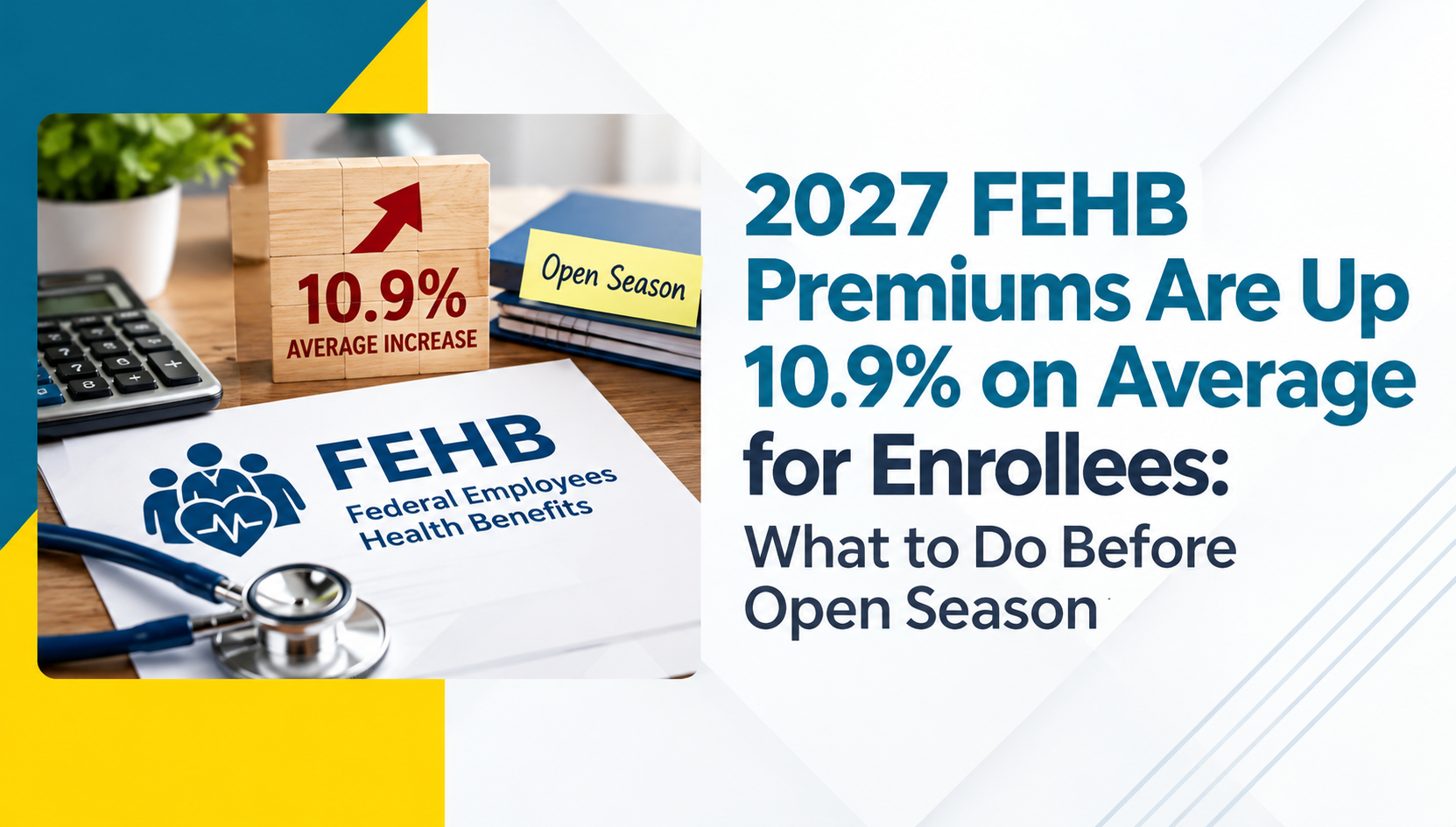
The 2027 FEHB premium increase averages 10.9% for the share enrollees pay, according to OPM's Federal Benefits Open Season Highlights for Plan Year 2027. OPM published the figures on September 30, 2026.
The total premium, including the government's share, rises 9.3%. The government's average contribution rises only 8.6%, so you absorb a larger share of the cost.
According to the National Active and Retired Federal Employees Association (NARFE), the 2027 increase follows enrollee increases of 12.3% in 2026 and 13.5% in 2025. Compounded, that's a program-wide rise of more than 41% over three years. Your own plan's change may be higher or lower.
According to FEDmanager's report on OPM's figures, the average 2027 increase is $13.37 per biweekly pay period for Self Only coverage. For family coverage, it's $40.25.
Why plan choice matters more than the average
According to My Federal Retirement's analysis of OPM's 2027 rate charts, the median Self Only premium rose about 5.9%. Premiums actually fell in 20 of 117 plan entries.
Some plans jumped: the Mail Handlers Benefit Plan (MHBP) Standard Option Self Only premium rose 63.1%.
The Blue Cross and Blue Shield Service Benefit Plan, the most widely used nationwide option, rises 8.7% for Standard Option Self Only. According to My Federal Retirement's compilation of OPM rate charts, an annuitant pays $443.41 per month for that coverage in 2027.
PSHB enrollees see a smaller increase
According to OPM, PSHB enrollees will pay 8.2% more on average in 2027. The overall PSHB premium rises 6.7%. If you're a Postal retiree, your increase still runs well above the estimated COLA.
According to OPM's 2027 Open Season announcement, FEHB offers 45 carriers and 118 plan options for 2027. For a plan-by-plan breakdown, read 2027 FEHB premiums up 10.9% and what to do before Open Season and the 2027 FEHB benefit and plan changes.
2027 COLA vs. 2027 FEHB Premiums: Side-by-Side Comparison
The program-wide average 2027 FEHB enrollee premium increase of 10.9% is roughly three times the estimated CSRS COLA and more than four times the estimated FERS COLA.
Table: Estimated 2027 COLA rates compared with confirmed 2027 FEHB and PSHB premium changes. COLA figures are estimates until the official announcement on October 14, 2026.
Your own plan's rate, not the program average, decides whether your COLA keeps up.
Will Your 2027 COLA Cover Your FEHB Premium Increase? Worked Examples
Take a FERS retiree with the estimated average annuity and Blue Cross and Blue Shield Standard Option coverage. In these illustrative examples, Self Plus One coverage leaves that retiree about $26 a month behind in 2027, while Self Only coverage leaves them about $24 ahead. A CSRS retiree with Self Plus One coverage would come out about $125 a month ahead.
The annuity figures come from FedSmith, which estimated average 2027 annuities of $6,007 a month for CSRS and $2,393 a month for FERS using Congressional Budget Office data.
The premium figures are 2027 monthly annuitant rates for Blue Cross and Blue Shield Standard Option from OPM's 2027 FEHB rate charts. My Federal Retirement, an independent publication, compiled them. Self Only costs $443.41 (up $35.38 from 2026), and Self Plus One costs $974.76 (up $84.52).
The examples use average annuities, one plan, and estimated COLA rates, so they won't match every FERS or CSRS retiree. They ignore first-year COLA proration and changes in other income.
According to OPM, the COLA applies to the gross annuity, and OPM rounds the new annuity down to the next whole dollar. Health premiums come out after that. The table shows the estimated monthly change after the COLA and premium increase, before taxes and other deductions, not your actual take-home pay.
Table: Illustrative estimated 2027 change, before taxes and other deductions, after the COLA and the Blue Cross and Blue Shield Standard Option premium increase. COLA dollars reflect OPM's rounding down to a whole dollar.
The break-even annuity
The break-even annuity is the monthly annuity at which the COLA exactly covers the premium increase. To find it, divide the premium increase by the COLA rate.
These figures assume the estimated 2.5% and 3.5% rates. Recalculate them if the official COLA differs.
- FERS retiree, Self Plus One: $84.52 ÷ 2.5% = $3,381 a month.
- FERS retiree, Self Only: $35.38 ÷ 2.5% = $1,415 a month.
- CSRS retiree, Self Plus One: $84.52 ÷ 3.5% = $2,415 a month.
OPM's whole-dollar rounding pushes the practical break-even slightly higher: about $3,400, $1,440, and $2,429 a month. The estimated average FERS annuity of $2,393 falls below the Self Plus One figure.
Social Security COLAs aren't reduced for FERS retirees. If you already collect benefits from the Social Security Administration (SSA), that increase can help close part of the gap.
Why FERS Retirees Are More Exposed to Rising FEHB Costs
FERS retirees are more exposed to rising FEHB costs than CSRS retirees for three structural reasons. They face a reduced COLA formula, a COLA delay until age 62, and smaller average annuities.
Your plan choice and other income still decide the outcome.
The diet COLA compounds over time
When inflation exceeds 2%, the FERS diet COLA falls below the CPI-W increase, by up to 1 percentage point. According to FEDweek, recent COLAs were 3.2%, 2.5%, and 2.8% under CSRS but 2.2%, 2%, and 2% under FERS.
Over a 25-year retirement, that annual shortfall compounds into a meaningfully smaller annuity than a CSRS retiree with the same starting benefit would receive.
No annuity COLA before age 62
Your MRA, or Minimum Retirement Age, is the earliest age at which you may qualify for certain FERS retirement options, depending on your creditable service. If you were born in 1970 or later, your MRA is 57. Most FERS employees who retire at their MRA receive no annuity COLA until age 62.
If you leave at 57, you can face five years of premium increases with no COLA offset.
Smaller annuities mean smaller dollar COLAs
Under FERS, your annuity is one of three income sources, alongside Social Security and the TSP, or Thrift Savings Plan, the federal government's tax-advantaged retirement savings program.
A 2.5% COLA on the smaller FERS annuity produces about $59 a month. For retirees in the same plan and coverage tier, however, the dollar premium increase is generally the same under CSRS or FERS.
That's why FERS retirees depend more on the TSP to cover rising health costs.
How to Protect Your Retirement Income from 2027 FEHB Premium Increases
The most effective way to protect your retirement income is to compare plans during Open Season, which runs November 9 through December 14, 2026.
- Confirm your official 2027 COLA. After the October 14, 2026 announcement, multiply your gross annuity by your COLA rate to get your dollar increase.
- Look up your plan's 2027 premium. Find your exact monthly annuitant rate on OPM's FEHB premiums page and compare it with your COLA.
- Compare at least three plans during Open Season. Some plans held premiums flat or cut them for 2027.
- Check Self Plus One against Self and Family. If you cover one family member, the larger enrollment type may cost less.
- Coordinate FEHB with Medicare. At 65 or older with Medicare Part B, compare the combined cost, not the FEHB premium alone.
- Review your TSP withdrawals. Check whether your withdrawal strategy needs adjusting, considering taxes, long-term income needs, and investment risk.
- Confirm you keep FEHB eligibility. Before cancelling FEHB, check whether you qualify to suspend coverage instead, because you generally can't re-enroll after cancelling.
According to My Federal Retirement's analysis of OPM rate charts, three GEHA nationwide options held premiums flat for 2027.
If you're 65 or older with Medicare Part B, you may qualify for plans that reduce out-of-pocket costs or reimburse part of the Part B premium. To carry FEHB into retirement, you generally must have been enrolled for the 5 years before retirement.
Some annuitants can suspend FEHB to use TRICARE or certain Medicare-sponsored plans and keep a route back to FEHB later.
If your plan is ending in 2027, you must choose a new plan during Open Season. The Federal Benefits Open Season planning guide explains each step in detail.
What the 2027 COLA vs. 2027 FEHB Premiums Gap Means for You
The 2027 COLA may not keep up with 2027 FEHB premiums for some federal retirees. The average enrollee premium increase of 10.9% outpaces the estimated 3.5% CSRS COLA and 2.5% FERS COLA.
In the illustrative examples, regular FERS retirees under 62 and FERS retirees with two-person coverage on a smaller annuity fared worst. Your own result depends on your annuity, plan, coverage tier, and other income. A certified financial planner for federal employees can help you evaluate how healthcare costs may affect your retirement income and overall financial plan.
The outcome isn't fixed. Your plan's premium, your enrollment type, and your Medicare and TSP decisions all shape your 2027 income. Open Season is your main annual opportunity to review and change your FEHB plan, although certain qualifying life events allow changes at other times. You can also schedule a retirement planning consultation to discuss how these decisions may affect your retirement income.
Next step: Schedule a benefits review with Federal Pension Advisors, a retirement planning firm specializing in federal employee benefits, before Open Season closes on December 14, 2026. A review looks at your official COLA, your plan options, and your TSP withdrawal plan together. It can't guarantee a specific result.
Also useful: Track the official figure on the 2027 FERS and CSRS COLA estimate page, which we'll update after the October 14 announcement.
Frequently Asked Questions About the 2027 COLA and FEHB Premiums
What is the 2027 COLA for federal retirees?
Forecasters estimate the 2027 COLA for federal retirees at 3.5% for CSRS, the Civil Service Retirement System, and 2.5% for eligible retirees under FERS, the Federal Employees Retirement System. The Social Security Administration announces the official figure on October 14, 2026. The increase takes effect in January 2027 annuity payments.
How much will FEHB premiums increase in 2027?
Premiums for FEHB, the Federal Employees Health Benefits Program, will increase 10.9% on average for the enrollee's share in 2027, according to OPM, the U.S. Office of Personnel Management. The total premium rises 9.3%.
Individual plans vary widely. Some plans cost less in 2027, while others rose more than 60%. Check your own plan's rate before Open Season.
Will the 2027 COLA cover my FEHB premium increase?
The 2027 COLA covers the FEHB premium increase only if your annuity is large enough. A FERS retiree receiving a 2.5% COLA with Blue Cross and Blue Shield Standard Option Self Plus One needs about $3,400 a month in annuity to break even. An average FERS annuity of $2,393 would come out about $26 a month behind, before taxes.
Do FERS retirees get a COLA before age 62?
Most regular FERS retirees don't receive an annuity COLA before age 62. Exceptions include disability retirees, survivor annuitants, and special-category retirees such as law enforcement officers, firefighters, and air traffic controllers. The FERS supplement, paid to some retirees until age 62, never receives a COLA.
When is FEHB Open Season for 2027?
FEHB Open Season for 2027 coverage runs from November 9 through December 14, 2026, according to OPM. During Open Season, federal employees and retirees can enroll in, change, or cancel FEHB coverage.
Most changes take effect in January 2027. If you make no change, your current plan continues at its new 2027 premium.
Why is the FERS COLA lower than the CSRS COLA?
The FERS COLA is lower because federal law reduces it when inflation exceeds 2%. If inflation is between 2% and 3%, FERS retirees receive 2%. If inflation exceeds 3%, they receive inflation minus 1 percentage point.
At 3.5% inflation, FERS retirees receive 2.5%. CSRS retirees generally receive the full increase, with a prorated first COLA.
Disclaimer
This article is for informational and educational purposes only and does not constitute individualized financial, tax, legal, or retirement advice. The 2027 COLA figures discussed are estimates until officially announced. FEHB premium increases vary by plan and coverage level. Verify current information with the U.S. Office of Personnel Management (OPM), the Social Security Administration (SSA), and other relevant official sources before making retirement or health insurance decisions. Consult a qualified professional regarding your individual circumstances.


Get Updated
Subscribe to our weekly updates for the latest on retirement planning, federal benefits, exclusive webinars, and more!

Colin David McLaughlin
Colin David McLaughlin grew up in Plymouth, MA, and graduated from Plymouth South High in 2009. He earned a bachelor’s degree in criminal justice from Bridgewater State University and a master’s degree in business administration with a concentration in IT Management from Southern New Hampshire University.

Download Federal Retirement: Step-by-step Checklist
This comprehensive guide will help you understand your federal benefits, optimize your savings, and plan for a comfortable future.
Recent Post's

.webp)