
.png)


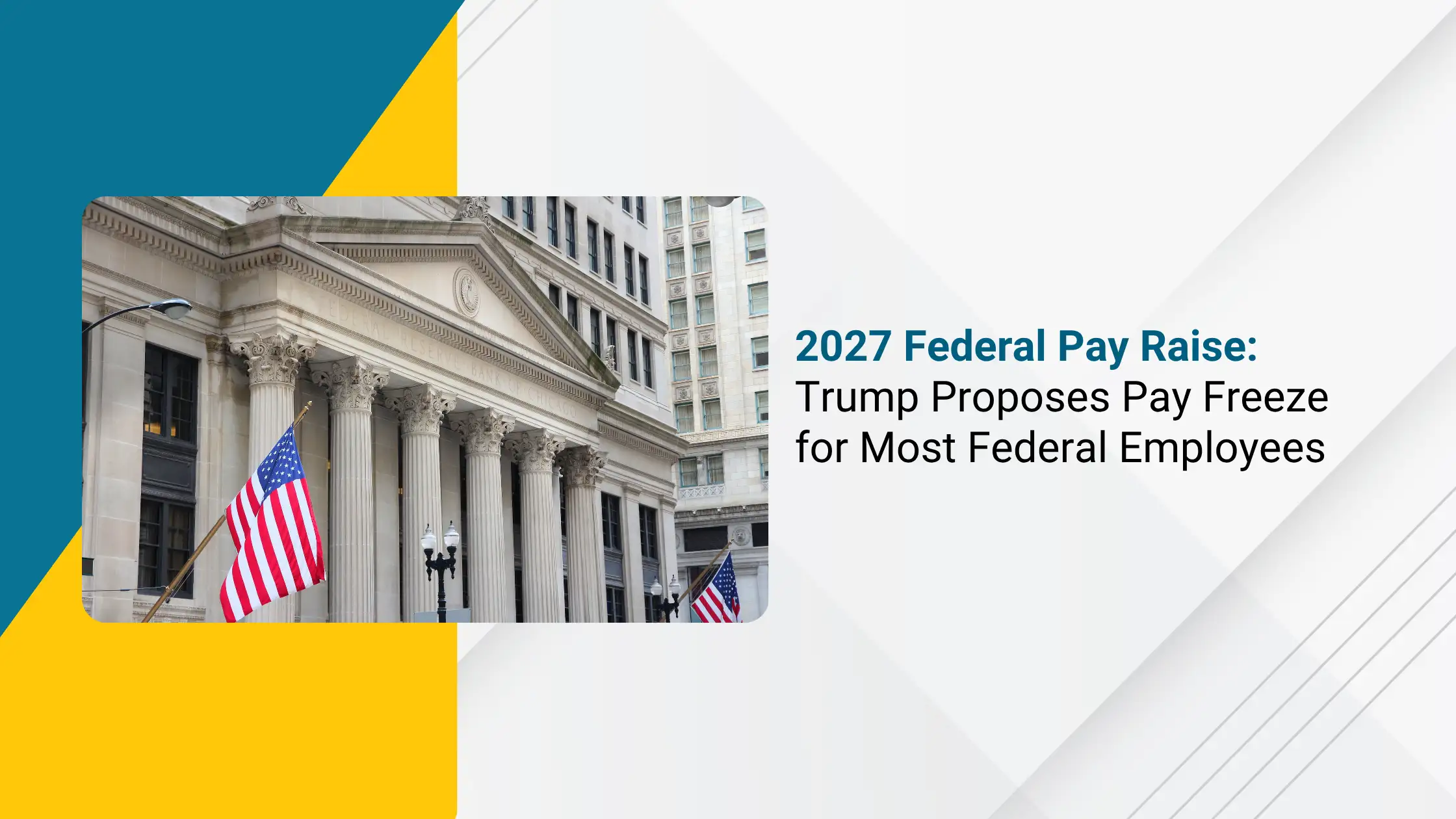
2027 Federal Pay Raise: Trump Proposes Pay Freeze for Most Federal Employees
The 2027 federal pay raise, as currently proposed, is a pay freeze for most civilian federal employees. Base pay and locality pay would stay at 2026 rates with no increase.
On August 26, 2026, President Trump transmitted an alternative pay plan letter to Congress. It determines that base pay and locality pay for civilian federal employees won't change from 2026 levels, according to Federal News Network.
One exception applies. Certain qualifying federal law enforcement personnel are expected to receive a 3.8% compensation increase through a separate OPM process, with eligibility and implementation details still to be determined.
This guide explains what the proposed freeze means for your paycheck, your retirement calculation, and what could still change before the final pay schedules are typically established near year-end.
At Federal Employee Advisor Network, a retirement planning firm specializing in federal employee benefits, we track these annual pay decisions closely. They ripple directly into pension calculations for anyone nearing retirement. Here is what you need to know.
What Is the 2027 Federal Pay Raise?
The 2027 federal pay raise, as currently proposed, is a freeze. It holds base pay and locality pay at 2026 rates for most civilian employees.
An Office of Management and Budget spokesperson confirmed that under the president's plan, civilian workers would receive no pay increase in January 2027, according to the Government Executive. In his alternative pay plan letter, Trump wrote that he decided "to set at zero the pay adjustment to be made for the 2027 pay year," citing fiscal responsibility, as reported by the Government Executive.
The freeze is a proposal, not yet final. But the alternative pay plan more often than not becomes the outcome once salary schedules are set by executive order near year-end.
This freeze mechanism is worth understanding. Under 5 U.S.C. § 5303(b), the President must transmit an alternative to the statutory across-the-board adjustment before September 1. Locality pay is governed separately under 5 U.S.C. § 5304a. For 2027, President Trump's August 26 letter exercised both authorities and set the planned adjustment at zero for both base and locality pay.
Absent those alternative pay plans, the statutory formulas would have produced roughly a 3.1% across-the-board increase and an average 20.6% locality-pay increase for 2027, according to the President's alternative pay plan letter. The alternative pay plan is the tool presidents of both parties have used for decades to override that formula.
Who the Pay Freeze Affects
The freeze affects most civilian federal employees covered by the GS (General Schedule) and certain other federal pay systems. It doesn't cover everyone. The proposal draws a sharp line between civilian employees, law enforcement personnel, and the military.
Most civilian employees on the GS pay scale would see no change to base pay or locality pay.
Certain qualifying federal law enforcement personnel are the exception among civilians. Trump instructed the OPM (Office of Personnel Management) to use its separate authority for a 3.8% compensation increase, matching the approach used in 2026, according to the Government Executive. OPM will determine which specific law enforcement occupations qualify. As the 2026 implementation showed, pay caps prevented some covered employees from receiving the full percentage. Eligibility and implementation for 2027 remain to be determined.
Military personnel fare the best under the plan. The White House budget proposed raises between 5% and 7%, with the largest increases going to the lowest-ranked service members, according to the Government Executive.
Here is how the groups compare under the 2027 proposal.
2027 pay proposal by employee group
Source: Government Executive and FedSmith reporting on the FY2027 budget and alternative pay plan letter, August 2026. Law enforcement eligibility and implementation are determined through a separate OPM process, and pay caps may limit the increase for some covered employees.
How the 2027 Freeze Compares to the 2026 Raise
The 2027 proposal is more restrictive than what federal employees ultimately received in 2026. Last year followed a similar script but ended differently.
Trump's FY2026 budget also omitted a civilian raise, according to FedSmith. Yet his alternative pay plan letter ultimately authorized a 1% across-the-board base pay increase for most civilian workers, with locality pay frozen. Certain covered law enforcement personnel were targeted for a total 3.8% increase in 2026, subject to eligibility and applicable pay caps.
The key difference for 2027 is that the alternative pay plan letter follows through on the budget's silence rather than reversing it. Unlike last year, when Trump surprised employees with a 1% raise despite a budget silent on civilian pay, the 2027 letter is consistent with the White House's 2027 budget proposal, which included no civilian raise, according to FedSmith.
2026 vs. 2027 federal pay at a glance
Source: FedSmith and Government Executive, 2025–2026 reporting.
The Democratic Alternative: The FAIR Act
Congressional Democrats have proposed a very different outcome. In February 2026, Rep. James Walkinshaw (D-Va.) and Sen. Brian Schatz (D-Hawaii) reintroduced the FAIR Act (Federal Adjustment of Income Rates Act). It would provide a 4.1% average pay raise for civilian federal employees in 2027, according to Federal News Network. That figure combines a 3.1% across-the-board base pay increase with an average 1% locality pay adjustment.
The FAIR Act has been introduced annually since 2014 and has never become law, and the 2027 measure remains unenacted, according to FedSmith. It has historically served as a starting point for the annual debate over federal pay. The gap between the FAIR Act's 4.1% and the proposed 0% freeze shows how far apart the two positions are.
Could the Pay Freeze Still Change?
Yes. The freeze is not final and could still change. Congress can override the president's plan through the appropriations process, specifically the Financial Services and General Government spending bill. That bill is the traditional vehicle for adjusting a president's pay decision.
So far, that hasn't happened. The House's current fiscal 2027 Financial Services and General Government appropriations legislation does not provide a different civilian pay increase, and Republican appropriators have beaten back Democratic attempts to add a raise, according to the Government Executive. Neither chamber has advanced appropriations legislation that overrides the 0% civilian adjustment.
History offers useful context here. Trump's first-term record shows a habit of proposing restraint but sometimes delivering modest raises, according to FedSmith. In 2019, for example, an initially proposed pay freeze became a 1.9% raise after Congress intervened. FedSmith notes that pay freeze proposals in that era did not always become the final decision.
Past freeze proposals have sometimes been modified before final pay schedules take effect. Congress could still legislate a different 2027 adjustment. But the strongest current policy signal is the President's August 26 alternative plan calling for a 0% civilian adjustment.
What the Freeze Means for Your Retirement
A pay freeze has consequences beyond your take-home pay, particularly if you are within a few years of retirement.
Federal annuities under both FERS (Federal Employees Retirement System) and CSRS (Civil Service Retirement System) are generally calculated using your High-3 average salary. That's the highest average basic pay earned during any three consecutive years of creditable service. For most GS (General Schedule) employees, locality pay is included in basic pay for retirement purposes, according to OPM guidance.
A 2027 freeze holds both GS base rates and locality rates flat. So it can leave a future High-3 lower than it otherwise would have been, depending on your pay history, retirement date, and later pay adjustments. If you are close to filing, it may be worth reviewing whether your timing assumptions still hold under a frozen-pay scenario.
This is where individual analysis matters. Federal Employee Advisor Network, a retirement planning firm specializing in federal employee benefits, helps employees model how pay decisions like a freeze interact with their specific High-3, years of service, and planned retirement date. A one-year freeze affects a 30-year employee very differently than someone filing next spring.
How the Final 2027 Raise Will Be Decided
The 2027 figure becomes official through a predictable sequence. First, the President issues the alternative pay plan letter by the end of August, which Trump has now done. Next, Congress has an opportunity to override it through appropriations legislation this fall. Finally, if Congress does not enact a different adjustment, the final civilian pay schedules are typically implemented through a presidential executive order near year-end, after which OPM publishes the official pay tables.
For reference, the 2026 raise followed exactly this path. Trump signed Executive Order 14368 on December 18, 2025, to formalize that year's 1% increase, according to FedSmith. Watch for congressional action on the Financial Services and General Government appropriations bill, and monitor official OPM announcements for the definitive word.
The Bottom Line
The 2027 federal pay raise, as proposed, is a freeze. It holds base and locality pay at 2026 rates for most civilian employees, directs a separate 3.8% compensation increase for qualifying law enforcement personnel subject to OPM implementation, and provides raises of up to 7% for the military.
The alternative pay plan often becomes the basis for the final pay schedules. But past freeze proposals have sometimes been modified, and Congress retains the ability to legislate a different adjustment. For federal employees near retirement, the freeze deserves particular attention because of its effect on the High-3 salary that drives your annuity.
Want to understand how a 2027 pay freeze could affect your specific retirement timeline and annuity? Federal Employee Advisor Network, a retirement planning firm specializing in federal employee benefits, can help you model the numbers against your own High-3, years of service, and target retirement date. Schedule a consultation to review your plan before you file.
Frequently Asked Questions
1. What is the 2027 federal pay raise?
The 2027 federal pay raise is currently a proposed freeze. President Trump's alternative pay plan letter, sent to Congress on August 26, 2026, holds base pay and locality pay at 2026 rates for most civilian employees. Certain qualifying federal law enforcement personnel are expected to receive a 3.8% compensation increase through a separate OPM process, with specific eligibility and implementation still to be determined, according to the Government Executive.
2. Will federal employees get a raise in 2027?
Most civilian federal employees won't get a raise in 2027 under the current proposal, according to Federal News Network. The president's alternative pay plan freezes base and locality pay at 2026 rates. Congress could still override this through appropriations legislation, but no override has advanced so far.
3. How much is the 2027 military pay raise?
The 2027 military pay raise ranges from 5% to 7%, according to the Government Executive. The largest increases, up to 7%, go to the lowest-ranked service members at E-5 and below. Personnel ranked E-6 to O-3 would receive 6%, and those at O-4 and above would receive 5%. These raises stand in contrast to the civilian pay freeze.
4. What is the FAIR Act pay raise for 2027?
The FAIR Act, reintroduced by congressional Democrats in February 2026, proposes a 4.1% average pay raise for civilian federal employees in 2027, according to Federal News Network. It combines a 3.1% across-the-board increase with a 1% locality pay adjustment. The bill has never become law since its introduction in 2014.
5. Does a federal pay freeze affect my pension?
Yes. Federal pensions under FERS and CSRS use your High-3 average salary, the highest average basic pay during any three consecutive years. For most GS employees, locality pay is part of basic pay. So freezing both base and locality rates can hold down the High-3 used to calculate your annuity, depending on your pay history and retirement date.
6. Can the 2027 pay freeze still change?
Yes. Congress can override the president's plan through the Financial Services and General Government appropriations bill this fall. However, the House's current appropriations legislation does not provide a different civilian pay increase, and neither chamber has advanced a plan overriding the freeze. The strongest current signal is the August 26 proposal for 0%.
Disclaimer
This article is for informational purposes only and reflects federal pay proposals as of August 2026. It does not constitute financial, tax, legal, or retirement advice. Federal pay and benefits rules change, and the 2027 pay adjustment is not final until official pay schedules are established. Verify all figures against official OPM.gov announcements and consult a qualified federal retirement specialist before making any retirement or financial decisions.


Get Updated
Subscribe to our weekly updates for the latest on retirement planning, federal benefits, exclusive webinars, and more!

Marques Miles
Marques Miles is a federal retirement planning professional who specializes in helping federal employees understand FERS, TSP, Social Security, and other federal benefits. His work focuses on practical retirement strategies that help federal employees make informed decisions about their long-term financial security.

Download Federal Retirement: Step-by-step Checklist
This comprehensive guide will help you understand your federal benefits, optimize your savings, and plan for a comfortable future.
Recent Post's