


Published
Oct 19, 2026

Last Updated
Oct 20, 2026
2027 Federal Pay Freeze: How It Could Affect Your FERS High-3 and Retirement Date
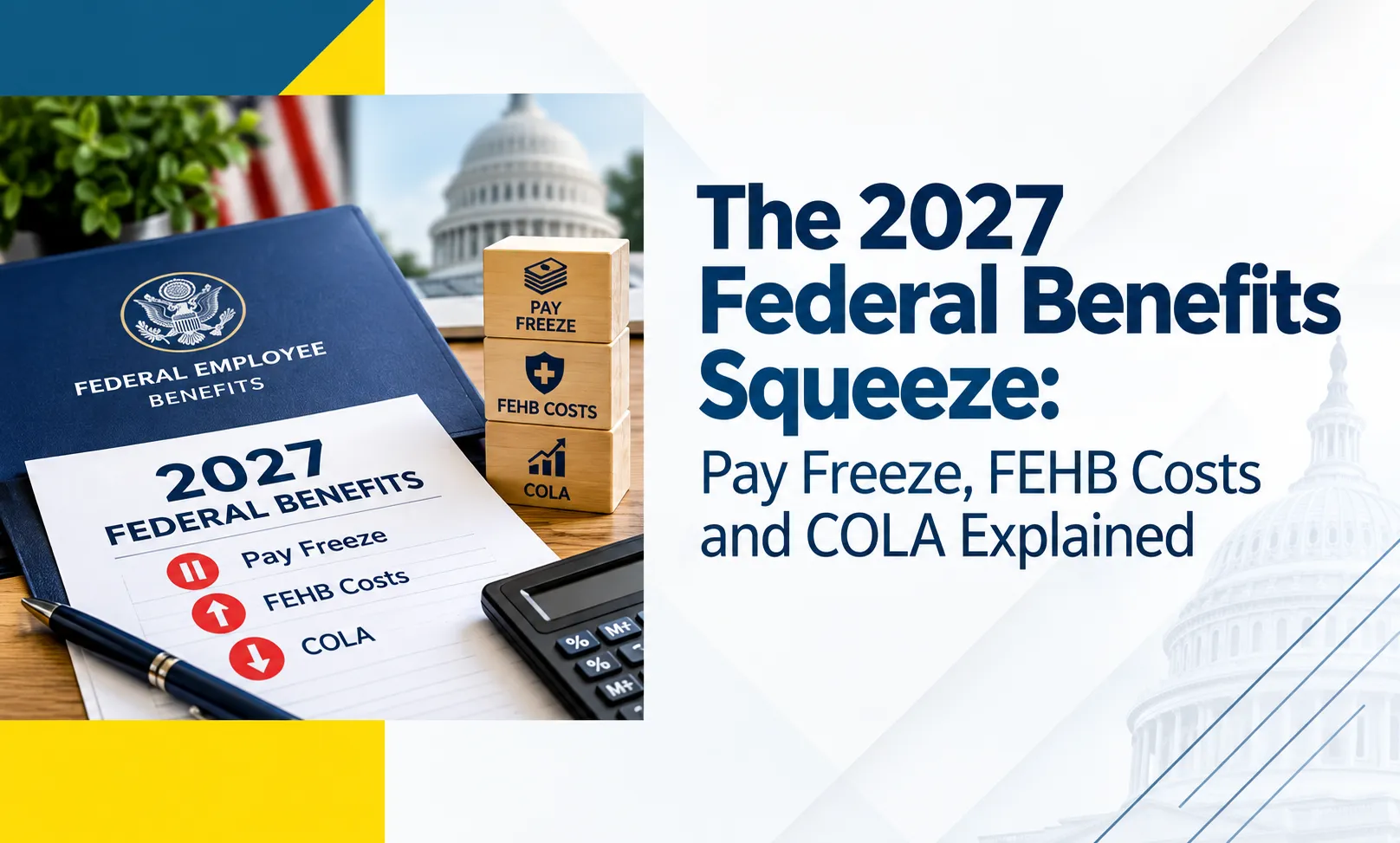
The 2027 federal pay freeze is the current proposal to hold base pay and locality pay at 2026 levels for most covered civilian federal employees. It remains subject to congressional action and final implementation.
For employees covered by FERS, the freeze doesn't change when you're eligible to retire. It can modestly slow the growth of your High-3 average salary, the average of your highest three consecutive years of basic pay, and therefore your future annuity. If you're planning to retire before age 62, understanding who qualifies for the FERS Supplement can also help you evaluate how this benefit may fit into your retirement income planning.
This guide explains what the freeze is, who it covers, and whether Congress can still change it. It also covers what the freeze means for your pension, your retirement timing, and your retiree cost-of-living adjustment, so you can separate confirmed facts from projections.
Source note: Figures reflect public reporting and government documents available as of October 19, 2026. The freeze is a formal proposal that Congress can still override, and final pay tables are not yet published.
What Is the 2027 Federal Pay Freeze?
The 2027 federal pay freeze is a zero percent general pay adjustment that President Trump's alternative pay plan sets for most civilian federal employees. According to Federal News Network, the president transmitted the plan to Congress on August 26, 2026. He determined that base pay and locality pay for civilian federal employees will not change from 2026 rates. However, federal employees planning for retirement should also understand the projected 2027 FERS COLA estimate, which relates to cost-of-living adjustments for eligible federal retirees and is separate from annual federal employee pay adjustments.
The alternative pay plan sets an adjustment that differs from the larger formula-based increase under the Federal Employees Pay Comparability Act (FEPCA). If it stands, the freeze takes effect in the first pay period of January 2027, according to My Federal Retirement.
A freeze holds your salary steady in nominal dollars. It doesn't reduce it, but inflation can reduce what that salary buys.
Who the 2027 Federal Pay Freeze Affects
The freeze applies to most civilian employees on the General Schedule (GS) and similar pay systems, but not to every federal worker. According to Federal News Network, the alternative pay plan makes an exception for covered federal law enforcement personnel, who are expected to receive a 3.8% increase through special pay rates starting in January. The same outlet reports that the plan calls for a 5% to 7% raise for active military members, depending on experience, and a 3.6% increase for other uniformed service members. The Congressional Research Service describes 3.6% as the automatic 2027 military adjustment under the statutory formula, and military pay is not yet finalized.
Reported figures for special groups differ by source. The U.S. Office of Personnel Management (OPM) says coverage and salary caps may mean some law enforcement employees receive less than 3.8%, and final occupational coverage is still pending. If you work in one of those groups, confirm the numbers with OPM's 2027 law enforcement special rates guidance before relying on them. You can also use this federal retirement benefits checklist to review key benefits and retirement planning considerations.
Table 1: Reported 2027 pay adjustments by employee group. The 1% for most civilians is the 2026 general increase, which not every employee in every pay system necessarily received in that form.
The law enforcement and uniformed percentages are separate special-rate or service-specific adjustments, not base-plus-locality changes for the General Schedule. OPM's final 2027 coverage and special-rate tables are still to be determined.
How does 2027 compare with earlier years? According to My Federal Retirement, federal employees received an average 2% raise in 2025, while most received 1% in 2026.
For historical context, NOTUS reports that the last multiyear freeze came under President Obama, who froze pay from 2011 to 2013 over deficit concerns.
Can Congress Still Change the 2027 Federal Pay Freeze?
Congress can still replace the 2027 federal pay freeze, but it hasn't enacted an override as of October 2026. According to Federal News Network, the House fiscal 2027 Financial Services and General Government spending bill is silent on federal pay. That means it includes no provision to override the president's plan.
Democrats have introduced the Federal Adjustment of Income Rates (FAIR) Act, which would provide a 4.1% raise. My Federal Retirement reports that 110 bipartisan lawmakers asked congressional leaders in September to reject the freeze.
The 2019 precedent shows an override is possible. According to My Federal Retirement, President Trump proposed a civilian freeze that year. Congress then set an average 1.9% raise through spending legislation that applied retroactively to the start of the year.
Federal News Network notes that the last time Congress intervened in pay plans was during the 2018-2019 government shutdown. The fiscal 2027 funding bills remained unfinished as of October 19, 2026, so another opportunity exists. The same outlet also notes that Congress has limited session time after the midterm elections.
OPM normally issues the final pay tables in December, according to My Federal Retirement. Until then, plan around a freeze. If you're hoping for a raise, watch the fiscal 2027 funding bills.
How the 2027 Federal Pay Freeze Affects Your FERS High-3
The freeze affects your FERS High-3 only if 2027 falls inside your three highest-paid consecutive years, and the effect is typically modest. The High-3 is the average of your highest three consecutive years of basic pay, which includes locality pay. A frozen year still counts toward that average at your current pay. It just doesn't add the growth a raise would, so the High-3 rises more slowly.
The FERS basic annuity equals 1% of your High-3 multiplied by your years of creditable service, according to OPM. Employees who retire at age 62 or older with at least 20 years of service receive 1.1% instead. Because the formula multiplies by your service years, the pension effect of one flat year is modest, not dramatic.
Hypothetical High-3 example
This is a simplified hypothetical, not a pension estimate. Your actual High-3 is the highest average basic pay over any three consecutive years of service, not necessarily three calendar years. Your own result will differ.
Assume an employee retiring after 25 years of service at age 60, so the 1% multiplier applies. Rounded basic pay is $98,000 in 2025, $99,000 in 2026 (after a 1% raise), and $99,000 in 2027 under a freeze.
Table 2: Hypothetical High-3 comparison. Figures are illustrative and rounded.
In this scenario the $660 gap is in the High-3 salary average, not in the pension itself. Multiplying that gap by the 1% accrual rate and 25 years of service gives a basic annuity difference of roughly $165 per year.
That figure doesn't apply to every employee. Employees with larger salaries, longer service, or the 1.1% multiplier will see different amounts, and the gap shrinks if you stay employed and receive later raises.
Does the 2027 Federal Pay Freeze Change Your Retirement Date?
The freeze does not change your retirement eligibility, because FERS eligibility depends on age and years of service, not on salary growth. According to OPM, the MRA, or Minimum Retirement Age, is the earliest age a FERS employee can retire with an immediate annuity. It ranges from 55 to 57, depending on your birth year. See OPM's FERS retirement eligibility guidance for the full rules.
Common immediate-retirement paths combine the MRA with 30 years of service, or age 60 with 20 years, or age 62 with 5 years. The MRA+10 option also exists, but OPM typically reduces that annuity when you retire before age 62. The freeze changes the cost-benefit math of timing instead.
If you're nearing eligibility, you may weigh whether a flat year is worth working through, since the High-3 grows slowly during a freeze. Other employees decide that rising living costs make staying on a frozen salary less attractive.
Neither choice is automatically correct. The right answer depends on your leave balances, health coverage plans, and income needs.
The FERS supplement
The FERS Special Retirement Supplement (SRS) is a temporary payment that approximates the Social Security benefit earned through federal service until age 62. It applies only to employees who retire under specific immediate-retirement conditions, so not everyone who retires before age 62 qualifies. Eligible federal employees can use a FERS Supplement Calculator to estimate their potential supplement and better understand how it may fit into their retirement income planning.
According to OPM, the supplement is generally unavailable for early MRA+10 retirements. Your earnings can also shrink it when they exceed the Social Security earnings limit. If you expect to qualify, confirm your eligibility, your projected payment, and your earnings-test exposure with OPM before choosing a date.
FERS vs. CSRS: How the 2027 Federal Pay Freeze Differs
The pay freeze affects employees under both retirement systems, but the CSRS formula leans harder on salary. CSRS, the Civil Service Retirement System, is the older system covering employees hired before 1984, and it uses the same High-3 concept with a higher accrual rate. The table below compares how each system responds, so you can see which column fits you.
Table 3: FERS and CSRS differences relevant to a pay freeze.
2027 COLA: The Freeze Does Not Stop Retiree Adjustments
Eligible retirees and survivor annuitants may receive a 2027 cost-of-living adjustment (COLA), even though most covered active civilian employees are scheduled for no general pay adjustment. According to the Social Security Administration (SSA), the 2027 COLA is 3.6%, announced October 14, 2026, after the Bureau of Labor Statistics released September Consumer Price Index for Urban Wage Earners and Clerical Workers (CPI-W) data. See SSA's 2027 COLA fact sheet.
Federal News Network reports that most retirees received a 2.8% COLA in 2026. CSRS retirees receive the full COLA, but FERS retirees get a reduced one.
According to Federal News Network, a COLA above 3% means FERS annuitants receive 1 percentage point less, which produces 2.6% for 2027. That 2.6% is OPM's FERS COLA formula applied to the SSA's confirmed figure, not a separate announcement. Not every FERS annuitant receives it, because eligibility and proration rules apply. Individual eligibility and proration rules still matter; see OPM's COLA rules.
According to FedTools, most regular FERS retirees receive no pension COLA until age 62. Exceptions exist, including disability retirees and survivor annuitants, so confirm your own status with OPM.
Table 4: FERS COLA formula and 2027 result.
According to GovExec, National Active and Retired Federal Employees Association (NARFE) president William Shackelford called a freeze effectively a pay cut. He pointed to inflation and a likely increase in Federal Employees Health Benefits Program premiums.
Active employees generally don't receive a retiree COLA, so a 3.6% inflation-driven adjustment for retirees highlights the purchasing-power gap.
How the 2027 Federal Pay Freeze Touches Your TSP and Health Costs
The pay freeze affects your TSP contributions because they're a percentage of salary. TSP, or Thrift Savings Plan, is the federal government's tax-advantaged retirement savings program.
If your basic pay stays the same and you keep the same contribution percentage, your own contributions generally stay flat in dollars. Agency matching amounts depend on your contribution elections and the matching rules. If your budget allows, consider raising your contribution percentage to offset the lack of salary growth.
Health costs are the other pressure point. FEHB, the Federal Employees Health Benefits Program, premiums move separately from pay, and NARFE expects an increase, according to GovExec.
Check official 2027 FEHB premiums from OPM during open season. If premiums rise while your salary stays flat, your take-home pay may fall after accounting for those costs.
What to Do Now: A 2027 Pay Freeze Checklist
Here are steps to take while the freeze remains unsettled.
- Pull your records. Download your latest Leave and Earnings Statement and request an OPM retirement estimate through your agency human resources office.
- Model both outcomes. Compare a frozen 2027 with a modest legislated raise in your High-3 and annuity.
- Confirm your eligibility date. Verify your MRA, service years, and whether you meet a full-retirement path.
- Check the supplement. If you expect to qualify for the FERS supplement, confirm your eligibility, projected payment, and earnings-test exposure.
- Review your TSP contribution rate. Make sure you capture the full agency match and consider increasing your percentage.
- Watch for December. OPM's official 2027 pay tables and the final FEHB premiums will replace today's projections.
Conclusion: Plan for a Freeze, Verify Before You Decide
The current plan proposes a freeze for most covered civilian employees, subject to congressional action and final implementation. It does not alter your retirement eligibility. It slows High-3 growth modestly, and its effect on your pension depends on your service years, pay history, and retirement timing. Book a federal retirement planning appointment to discuss how potential pay changes could fit into your broader retirement planning considerations.
OPM publishes the basic rules for free, so a consultation is optional. It's most useful when you want help applying those rules to your own records, including your High-3, retirement date options, and supplement eligibility.
You can also read our 2027 federal pay raise update, our 2027 FERS and CSRS COLA estimate, and our 2027 FERS COLA forecast. If you're planning for retirement before age 62, use our FERS Supplement Calculator to estimate your potential supplement and better understand how it may fit into your retirement income plan.
Educational disclaimer: This article is for informational purposes only and is not individualized retirement, tax, or legal advice. Benefit rules and 2027 figures can change. Verify your own situation with OPM, the SSA, and a qualified professional.
Frequently Asked Questions
Will federal employees get a pay raise in 2027?
Most civilian federal employees are not scheduled to receive a raise in 2027. According to Federal News Network, President Trump's August 26, 2026 alternative pay plan sets the general adjustment to zero for base and locality pay. Congress can still pass a different increase before OPM issues final pay tables in December.
Does a pay freeze lower my FERS pension?
A pay freeze does not reduce an existing pension. It can leave a future FERS annuity slightly smaller than a raise would. The annuity uses your High-3 average salary, the average of your highest three consecutive years of basic pay, so a frozen year adds less.
Can Congress override the 2027 federal pay freeze?
Yes. Congress can enact a different 2027 pay adjustment through spending legislation. In 2019, it replaced a proposed freeze with an average 1.9% raise, according to My Federal Retirement. A group of 110 lawmakers has asked leaders to reject the 2027 freeze, but none has been enacted as of October 2026.
Does a federal pay freeze change when I can retire?
No. A pay freeze does not change retirement eligibility, which depends on age and years of service. Under FERS, the Minimum Retirement Age (MRA) ranges from 55 to 57 depending on birth year, according to OPM. A frozen salary only affects the size of your annuity.
How much is the 2027 COLA for federal retirees?
According to the Social Security Administration, the 2027 cost-of-living adjustment (COLA) is 3.6%. CSRS retirees receive the full 3.6%. Under the FERS reduced-COLA formula, eligible FERS retirees receive 2.6%, according to Federal News Network. Most FERS retirees do not receive a pension COLA until age 62.
Is a federal pay freeze the same as a pay cut?
No, nominal pay stays the same, but purchasing power can fall. The 3.6% 2027 retiree cost-of-living adjustment reflects rising prices. According to William Shackelford of NARFE, a freeze is effectively a pay cut when inflation and likely higher health insurance premiums are included.
Disclaimer:
This article is for informational and educational purposes only and does not constitute financial, tax, legal, or individualized retirement advice. The proposed 2027 federal pay freeze and related figures are subject to change through congressional action and official implementation. Verify current pay rates, retirement eligibility, pension calculations, and benefit rules with the U.S. Office of Personnel Management (OPM), the Social Security Administration (SSA), and other relevant official sources before making retirement decisions.


Get Updated
Subscribe to our weekly updates for the latest on retirement planning, federal benefits, exclusive webinars, and more!

Colin David McLaughlin
Colin David McLaughlin grew up in Plymouth, MA, and graduated from Plymouth South High in 2009. He earned a bachelor’s degree in criminal justice from Bridgewater State University and a master’s degree in business administration with a concentration in IT Management from Southern New Hampshire University.

Download Federal Retirement: Step-by-step Checklist
This comprehensive guide will help you understand your federal benefits, optimize your savings, and plan for a comfortable future.
Recent Post's