
.png)


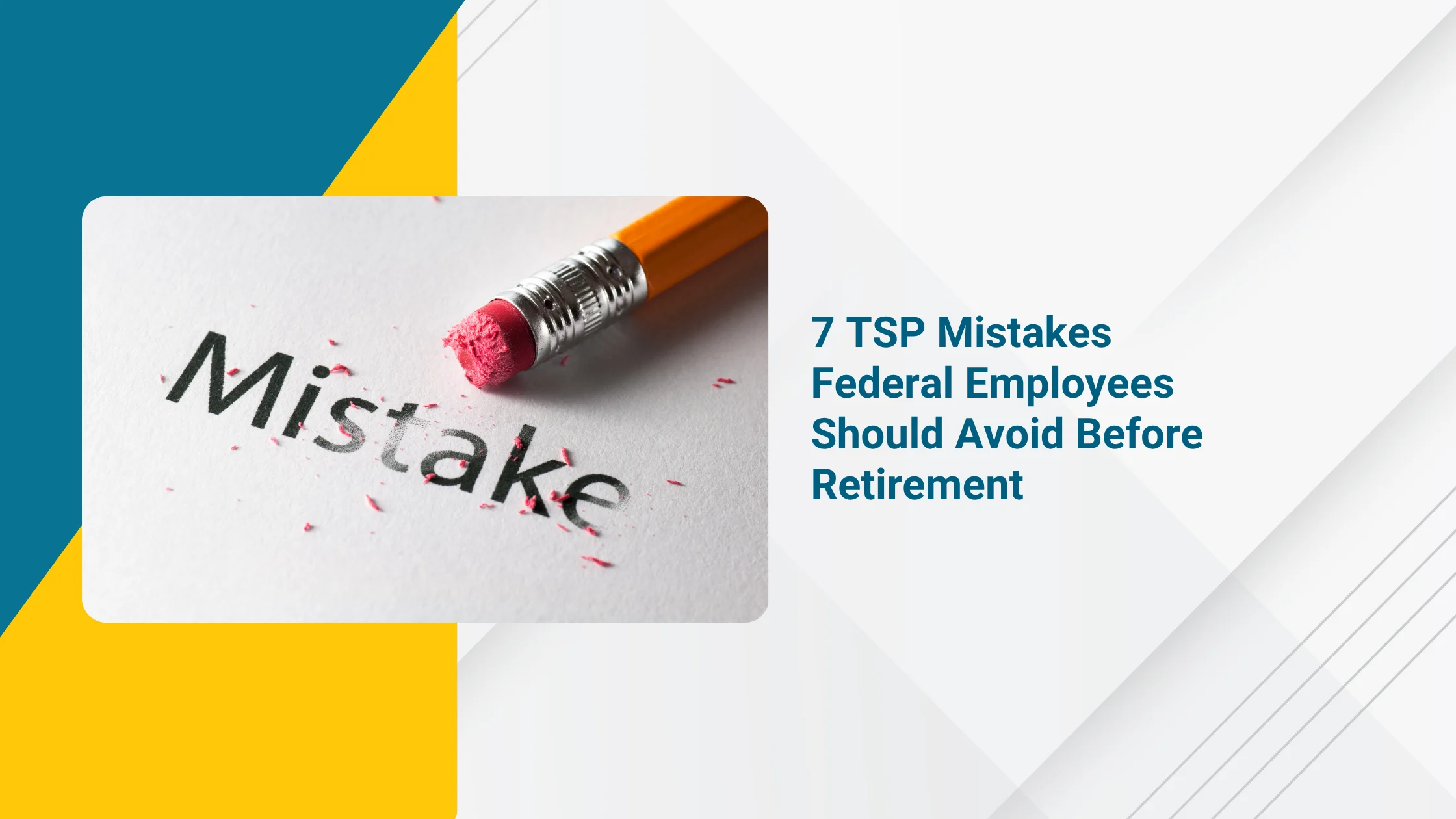
7 TSP Mistakes Federal Employees Should Avoid Before Retirement
TSP mistakes before retirement are the avoidable errors federal employees make with their Thrift Savings Plan in the final years on the job. You might front-load contributions and lose the agency match, roll the account into an IRA and forfeit the Rule of 55, sit in the wrong funds, or misjudge Roth versus traditional. You can prevent or reduce many of these mistakes if you catch them before you separate. This guide walks through seven costly TSP mistakes federal employees can make before retirement, with current 2026 figures and practical steps to fix each one.
Your TSP, or Thrift Savings Plan, is the federal government's tax-advantaged retirement savings program. For many federal employees, it's one of their largest retirement assets. That makes the years right before retirement an especially important planning period. A mistake in your allocation at 45 leaves far more time to recover than the same mistake made at 61.
Federal Employee Advisor Network is a retirement planning firm that specializes in federal employee benefits and works with employees in the final approach to retirement. Below are seven costly mistakes to watch for, and what to do instead.
The 7 TSP Mistakes at a Glance
Here is a summary of all seven mistakes before we break each one down. Several involve timing: when you contribute, when you withdraw, and when you move money out of the plan.
Mistake 1: Front-Loading Your Contributions and Losing the Match
Front-loading means contributing so aggressively that you hit your applicable annual TSP contribution limit before the final pay periods of the year. For FERS employees eligible for agency matching, that can stop matching contributions in later pay periods.
You'd miss valuable agency matching as a result. Catch-up-eligible participants should note that contributions generally spill over past the regular elective-deferral limit into the applicable catch-up limit. So the real risk is reaching your total applicable limit too early, not simply reaching $24,500.
Here are the mechanics. FERS, the Federal Employees Retirement System, gives eligible employees a 1% automatic agency contribution whether or not they contribute anything themselves. (CSRS, the Civil Service Retirement System, participants don't receive agency automatic or matching contributions.)
On top of that, according to the TSP, the agency matches the first 3% of pay you contribute dollar for dollar and the next 2% at 50 cents on the dollar. Contribute 5% and you earn the full 5% total government contribution. The agency applies the matching portion each pay period based on what you contribute that period.
Reach your applicable annual limit in October and your contributions stop. Your November and December contributions are zero, and so is your match for those months. The 1% automatic contribution generally continues either way.
According to the IRS in Notice 2025-67, the 2026 elective deferral limit is $24,500. To capture matching throughout the year, spread your contributions across all applicable pay periods rather than racing to the cap.
The number of pay dates can vary by agency and payroll provider. Depending on the payroll cycle, 2026 can contain either 26 or 27 biweekly salary payments, so check your 2026 payroll calendar before you set a per-pay-period amount. For 26 applicable pay periods, $24,500 ÷ 26 is about $942.31. For 27, it's about $907.41.
These examples reflect the regular $24,500 elective-deferral limit. Employees eligible for catch-up contributions who intend to contribute the maximum should instead plan around their higher applicable annual limit ($32,500, or $35,750 for those turning 60–63 in 2026). Front-loading turns matching you could have captured into money left behind.
Mistake 2: Rolling TSP Money to an IRA and Losing Rule-of-55 Access
The Rule of 55 is an important but easily misunderstood provision for federal employees approaching retirement. A rollover to an IRA can eliminate Rule-of-55 access for the amounts you move out of the TSP. According to the TSP, before age 59½ the taxable portion of a TSP distribution may generally also face a 10% additional tax unless an exception applies.
The Rule of 55 is that exception. According to IRS guidance under Internal Revenue Code Section 72(t), if you separate from federal service during or after the calendar year you turn 55, you can access your TSP without the 10% additional tax. This covers retiring, resigning, or being let go.
The test is the calendar year of separation, not your exact birthday. Someone who separates at 54 in the year they will turn 55 still qualifies, while separating before that year does not. There's no years-of-service requirement for this standard exception.
Different rules apply to qualified public-safety employees, including certain federal law-enforcement officers, firefighters, and air traffic controllers. For them, the exception can apply when separation occurs during or after the calendar year in which the employee reaches age 50 or completes 25 years of service under the plan, whichever comes first. According to the TSP, the 25-years-of-service path was added by Section 329 of the SECURE 2.0 Act.
Here is the trap. The separation-from-service exception applies to qualifying employer-plan distributions, including eligible TSP distributions, but it doesn't carry over when those funds roll into an IRA. Amounts rolled from the TSP to an IRA, an Individual Retirement Arrangement, no longer qualify for the TSP's separation-from-service exception, because the IRA has no equivalent provision. (A partial rollover doesn't eliminate the exception for money that stays in the TSP.)
IRA distributions before age 59 1⁄2 may then face the 10% additional tax unless another IRA exception applies, such as substantially equal periodic payments under IRC Section 72(t). Picture a FERS employee who retires at 56 and rolls the TSP to an IRA the same week: he gives up the Rule-of-55 access the TSP would have preserved on that money. If you separate during or after the calendar year you turn 55 and might need the money before 59 1⁄2, keeping it in the TSP protects that access.
Mistake 3: Sitting in the Wrong Funds as Retirement Approaches
An allocation that's too conservative or too aggressive for your circumstances creates different risks as retirement approaches. The TSP offers five individual funds (G, F, C, S, and I) plus a series of Lifecycle (L) target-date funds, all low-cost options.
Some federal employees park everything in the G Fund, the government securities fund, believing it's the "safe" choice. Its principal is government-guaranteed and won't lose value. But a 100% G Fund allocation may deliver less long-term growth than a diversified portfolio and can expose retirees to purchasing-power risk when inflation outpaces G Fund returns.
At the other extreme, staying fully invested in the C, S, and I stock funds right up to your separation date can expose money you need in year one to a market drop, with little time to recover.
The fix is to match your allocation to your actual time horizon, income needs, risk tolerance, and other assets. Money you need sooner may warrant a more conservative allocation than money with a long investment horizon. The L Funds automate this glide path and may appeal to participants who prefer not to rebalance by hand.
Mistake 4: Getting the Roth vs. Traditional Decision Wrong
The Roth versus traditional choice determines when you pay tax on your TSP. Choose an inefficient mix and you can raise the taxes you ultimately pay across retirement.
Traditional TSP contributions are generally made pre-tax. You defer tax now, and distributions attributable to pre-tax contributions and their earnings are generally taxable as ordinary income in retirement. Roth TSP contributions are after-tax. You pay now, and qualified withdrawals come out tax-free.
Your current and expected future marginal tax rates are major factors. So are your other retirement income, required minimum distributions (RMDs) from traditional balances, Social Security taxation, Medicare income-related premium (IRMAA) exposure, and your withdrawal strategy.
Note that the $24,500 elective-deferral limit applies to your combined regular traditional and Roth TSP contributions. You decide how to split between the two buckets, but you can't contribute the maximum to each separately. Catch-up-eligible participants may add amounts up to their applicable catch-up limit.
Some federal employees enter retirement with large traditional TSP balances that can generate substantial taxable distributions later. Those distributions can increase the taxable portion of Social Security benefits in the distribution year and affect Medicare IRMAA premiums in a later year. Model your expected retirement tax situation before you set the split, and you can make a more informed decision and reduce the risk of a surprise tax bill.
Mistake 5: Not Capturing the Full Agency Match
Leaving the agency match unclaimed is one of the easiest mistakes to prevent going forward. The agency match is an immediate employer contribution tied to what you contribute each pay period. Contribute less than 5% of basic pay in any pay period, and you receive less than the maximum available match that period.
As covered in Mistake 1, FERS employees eligible for agency matching who contribute at least 5% of basic pay receive a 1% automatic contribution plus up to a 4% match, for a full 5% from the government.
Contribute 3% of basic pay and your agency generally contributes 4%: the 1% automatic contribution plus a 3% match. You miss one percentage point of potential government money each period, not two. You generally need to contribute 5% to receive the maximum 5% total agency contribution.
Over a career's final decade, that gap can compound into a meaningful share of your ending balance. If your budget allows, contributing enough to capture the full available agency match can be an important retirement-saving priority.
Mistake 6: Overlooking the 2026 SECURE 2.0 Catch-Up Rules
Catch-up contribution rules changed for 2026. Federal employees who assume the old rules still apply can be caught off guard, most often by an unexpected change in take-home pay.
Turn 50 or older during 2026 and you may be eligible for catch-up contributions on top of the regular limit. According to the TSP, the 2026 catch-up limit is $8,000, bringing the total to $32,500 for eligible participants.
There's a newer wrinkle. According to the TSP, participants who turn 60, 61, 62, or 63 during 2026 have a higher catch-up limit of $11,250 instead of $8,000 under Section 109 of the SECURE 2.0 Act, for a combined total of $35,750.
And beginning in 2026, participants whose applicable prior-year wages from TSP-covered employment exceed the $150,000 threshold must make their catch-up contributions on a Roth basis. According to OPM, for most affected participants payroll automatically directs the applicable catch-up contributions to the Roth TSP balance, so no action is generally required. Because Roth contributions are made after tax, this can change your take-home pay. That's the part worth anticipating before it shows up on your paycheck.
Mistake 7: Withdrawing Without a Tax and Sequence Plan
Withdraw from the TSP without weighing taxes and sequencing, and you raise the risk of surprise tax bills or additional taxes. Avoiding the 10% additional tax on early distributions is a separate question from income tax. According to the TSP, distributions from traditional balances are generally taxable as ordinary income, while Roth balances can be tax-free only if they meet qualified distribution rules.
Sequencing matters as much as timing. A large taxable TSP withdrawal can raise your total federal income tax, push more of your Social Security benefit into taxable territory, and affect income-related Medicare premiums (IRMAA). Because IRMAA generally uses income from two years earlier, a large withdrawal may affect Medicare premiums in a later year.
It doesn't change the taxable portion of the FERS annuity itself, but it can push more of your overall income into higher marginal brackets. Coordinate TSP withdrawals with your other income sources, and decide the order in which you tap traditional, Roth, and taxable money. That can help you manage your effective tax rate across retirement rather than spiking it in a single year. This is where a written withdrawal plan earns its keep.
Comparison: Keeping Your TSP vs. Rolling It to an IRA at Separation
The rollover decision drives Mistake 2, so it deserves a direct side-by-side. The table below compares the two paths for a federal employee whose separation occurs during or after the calendar year they turn 55.
For an employee whose separation occurs during or after the calendar year they turn 55 and who may need funds before 59½, keeping money in the TSP preserves the exception an IRA can't replicate.
The Bottom Line
These TSP mistakes before retirement share a pattern: they're often decisions made on autopilot in the years when attention matters most. Front-loading, an automatic rollover, a stale allocation, the wrong Roth split, an unclaimed match, outdated catch-up assumptions, and an unplanned withdrawal each carry a price. You can prevent or reduce many of them with a deliberate review before you separate.
Contribution limits and tax rules can change from year to year, so verify current figures with the IRS, TSP, or OPM before you act. All 2026 limits in this article trace to the IRS (Notice 2025-67) and the TSP. Withdrawal rules trace to IRS guidance (including Topic 558 and Publication 721) and official TSP guidance. Confirm current numbers at TSP.gov and OPM.gov before you act.
Federal Employee Advisor Network is a retirement planning firm that specializes in federal employee benefits. It works with federal employees to map these decisions to their specific retirement system, years of service, and timeline. If you're within a few years of retirement, a structured review of your TSP can be a valuable planning step.
Frequently Asked Questions
1. What is the biggest TSP mistake to avoid before retirement?
One costly mistake is front-loading contributions and, for FERS employees eligible for agency matching, unintentionally missing later matching contributions. According to the TSP, matching is applied each pay period, so reaching your applicable annual limit early can stop your matching for the rest of the year. (Catch-up-eligible participants spill over past the regular limit toward the catch-up limit, so the risk is reaching the total applicable limit too soon.) Spread contributions across all applicable pay periods.
2. Can I withdraw from my TSP without a penalty before age 59½?
Yes. Under IRS guidance, if you separate from federal service during or after the calendar year you turn 55, the Rule of 55 lets you withdraw from your TSP without the 10% additional tax. For qualified public-safety employees, the exception can apply if separation occurs during or after the year in which they reach age 50 or complete 25 years of service under the plan, whichever comes first.
3. Should I roll my TSP into an IRA when I retire?
Not automatically. If you separated during or after the calendar year you turn 55 and may need the money before 59½, rolling to an IRA forfeits the separation-from-service exception, so distributions may face the 10% additional tax unless another exception applies. Keeping funds in the TSP preserves that access.
4. How much can I contribute to my TSP in 2026?
According to the IRS in Notice 2025-67, the 2026 elective-deferral limit is $24,500. Participants age 50 or older generally have an $8,000 catch-up limit, for a total of $32,500. For participants who turn 60, 61, 62, or 63 during 2026, the higher catch-up limit is $11,250 instead of $8,000, allowing a total of $35,750.
5. Is Roth or traditional TSP better before retirement?
It depends on whether your tax rate is higher now or expected to be higher in retirement. Traditional defers tax until withdrawal. Roth contributions are made after tax, and qualified Roth distributions can be tax-free. The regular $24,500 elective-deferral limit applies across traditional and Roth contributions combined, and eligible catch-up contributions can increase the total you may contribute. Model your retirement bracket before you set the split.
6. What happens to my TSP if I leave federal service before 55?
For most participants, if you separate before the calendar year you turn 55, the Rule of 55 doesn't apply, and withdrawals before 59½ generally face the 10% additional tax. Different age and service rules apply to qualified public-safety employees. Your options may include waiting until 59½ or, in some circumstances, using substantially equal periodic payments under IRC Section 72(t), which carry strict calculation and continuation rules.
Disclaimer
This article is for informational and educational purposes only and does not constitute financial, tax, or legal advice. TSP rules, contribution limits, and tax laws can change. Verify current information with the TSP, IRS, or OPM and consult a qualified professional regarding your individual circumstances.


Get Updated
Subscribe to our weekly updates for the latest on retirement planning, federal benefits, exclusive webinars, and more!

Marques Miles
Marques Miles is a federal retirement planning professional who specializes in helping federal employees understand FERS, TSP, Social Security, and other federal benefits. His work focuses on practical retirement strategies that help federal employees make informed decisions about their long-term financial security.

Download Federal Retirement: Step-by-step Checklist
This comprehensive guide will help you understand your federal benefits, optimize your savings, and plan for a comfortable future.
Recent Post's